


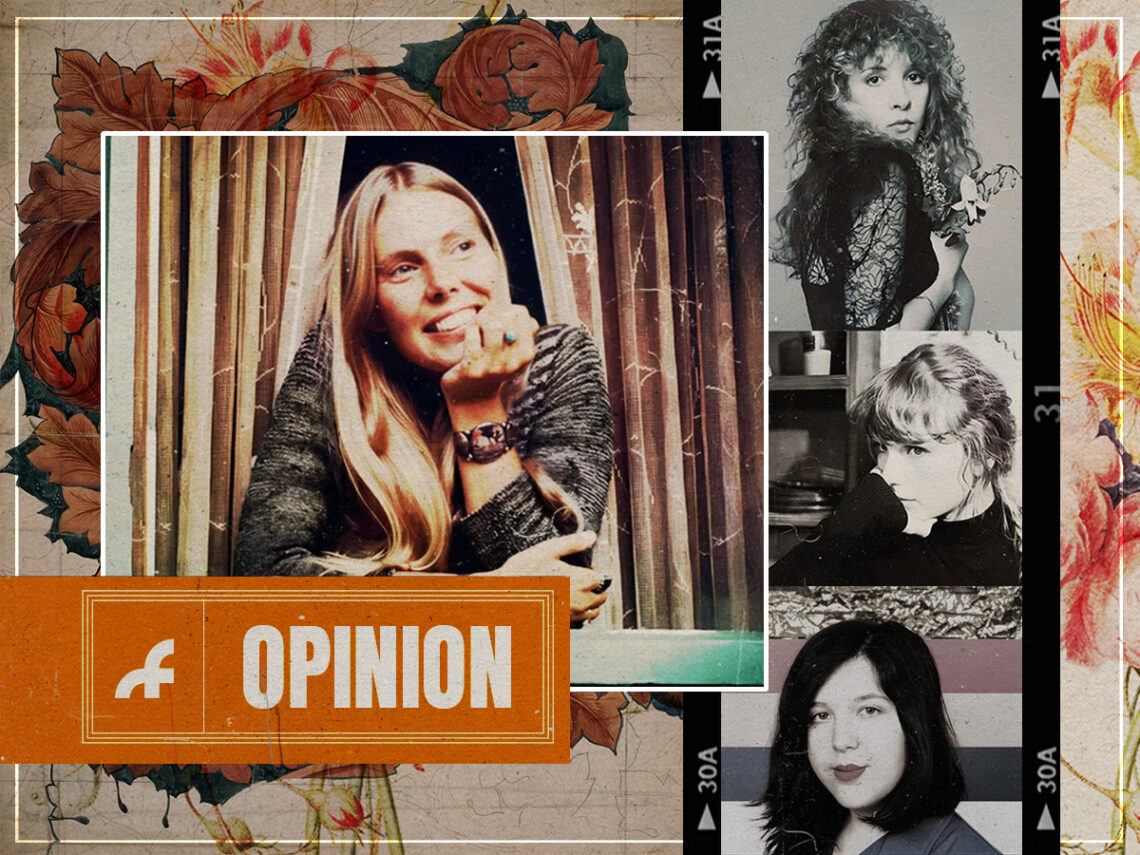
How Joni Mitchell inspired generations of female songwriters

You’d be hard-pressed to find an artist that doesn’t mention Joni Mitchell in their list of inspirations. A musician so singular and so impressive, Mitchell’s pioneering work burst open the world of folk to mix it with elements of pop, rock and poetry. Up there with the greats, Mitchell has gone down in history as one of the world’s finest songwriters, with countless other artists offering up their praise.
To put that into context, even Prince once said, “Joni Mitchell should be taught in school”. Chaka Kahn, meanwhile, claimed Mitchell saved her life, and Stevie Nicks counts her as one of her “greatest influences”. The list goes on. You can find quotes from almost every living musical icon, alongside a whole new generation of talent, all with respect and gratitude to lay at Joni Mitchell’s feet. Singing on ‘Melting Of The Sun’, St Vincent puts it simply; “Saint Joni, ain’t no phony”.
‘Saint’ feels so apt when talking about Joni Mitchell. As an artist and a cultural figure, Mitchell has reached the mythical heights that we only assign to select members of the highest order. Bob Dylan has it, Leonard Cohen has it, Patti Smith has it – and all three look up to Joni Mitchell, arguably placing her at the top of their godly order. It’s funny to think that in the early 1960s, Mitchell was merely a married housewife, stuck with a husband who looked down on her levels of education. “I’m illiterate,” she once complained to a friend, “My husband’s given me a complex that I haven’t read anything”.
Going on to become one of the most intelligent songwriters in history, weaving poetry, literary and religious references, rich metaphors and more into her storytelling lyrics, no one would ever claim that Joni Mitchell wasn’t well-read. But unlike Dylan or Cohen, figures that especially stand out as artists men love to reference, Mitchell feels like a vital figure in the lineage of women in music, inspiring generations to pick up a guitar and a pen.
While Mitchell certainly sits at the top with all the other musical icons, she is utterly in a class of her own. She appears to hold this position of intense respect at an almost mythological level but also delivers humility and relatability – something you might never say about her male peers. While never dumbing down her work or failing to write intelligent and interesting lyrics, Mitchell has also never shied away from writing her life. The primary reason why her album, Blue, is almost always brought up in the list of influences held dear by generations of female songwriters is because of Mitchell’s incredible ability to write about her experiences and not only make that fine but also make it an art form.
For too long, women have been critiqued for writing what they know. Look at Taylor Swift, for example; despite being one of the most prominent artists and most prolific songwriters of our time, there are daily comments about her only ever writing about herself and her relationships. Talking to Vogue, Swift says: “Find me a time when they say that about a male artist: ‘Be careful, girl, he’ll use his experience with you to get —God forbid — inspiration to make art’.” It’s this sexist approach, viewing women’s art as lesser despite writing about the same topics as men, that Joni Mitchell has always been a key figure in defying.
On an album like Blue, Joni Mitchell peels back the veil on her life. Singing about love, heartbreak, healing, travel and even the painful experience of putting her child up for adoption, you can find a plethora of real-life anecdotes within her lyrics. A direct predecessor, inspiring the careers of Swift as well as the likes of Lucy Dacus, Phoebe Bridgers, Lana Del Rey, Lorde – the list goes on.
It’s impossible to hear the wisdom in lyrics like “I’ve looked at love from both sides now, from give and take and still somehow, It’s love’s illusions I recall, I really don’t know love at all” and not draw a line of connection to works like Lorde’s ‘Supercut’, as she sings: “When you’ve outgrown a lover, the whole world knows but you.” Without Joni Mitchell’s ‘Little Green’, or ‘Free Man In Paris’ with their vivid storytelling, there would be no ‘Graceland Too’, Phoebe Bridges’ ode to Julien Baker, or any of Lucy Dacus’ narrative works on her album Home Video. If Joni Mitchell had never written “Help me I think I’m falling in love again”, Taylor Swift wouldn’t have said, “Oh no, I’m falling in love” and have it hold so much meaning.
Even moving into brand new talent, up-and-comers like Katie Gregson-Macleod, with her emotive piano ballads, are undeniably coming from the school of Joni Mitchell. In her breakout single ‘Complex’, it feels plain to see that without Mitchell’s work, the desperate and devastating chorus of “I need him like watеr, he lives on a landslide, I cry in his bathroom, hе turns off the big light, i’m being a cool girl, i’m keeping it so tight”, may never have found the courage to come out.
Something that’s never spoken about enough, however, lost in the boring misogynistic moans that women writing about their lives and their feelings is a sign of lack of imagination or intelligence, is the fact that vulnerability takes courage. Listening back to Joni Mitchell’s work, her courage comes through loud and clear. It’s one thing having the strength to leave your husband, pick up a guitar, move to a city and try to make a name for yourself in the male-oriented space of the 1960s rock and folk scene. It’s a whole other level to write that courage as plainly and confidently as she did on her debut; “she’s so busy being free”.
Joni Mitchell made an art form out of confessional writing. She stands out, tall as a God, when we look back not only at the lineage of female songwriters but at music history in general. While earning the love and respect of her male peers, it’s Joni Mitchell’s immeasurable impact on female artists past, present and future that stands out as her legacy. No one would ever dare suggest that Mitchell’s writing on her own love, loss and life isn’t intelligent enough. No one would claim what Joni Mitchell has given to the world isn’t art. And by the mere act of writing her life, singing it back so beautifully and carving out a space for her existence and her talent to coincide, Joni Mitchell sends a message to women everywhere that their art, no matter how personal the subject matter, is valid, important and worthy or respect.
