


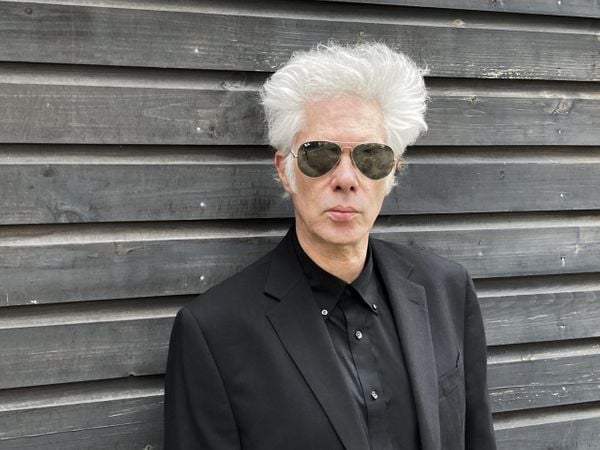
How Jim Jarmusch uses music to define his movies

Since the early 1980s, Jim Jarmusch has established himself as one of the most influential figures in independent cinema. However, the director’s movies are heavily indebted to his love for music, often employing beloved musicians such as Iggy Pop, Tom Waits and Joe Strummer to act in his features.
Dutch lute composer Jozef van Wissem, who worked with Jarmusch on the Only Lovers Left Alive soundtrack, once stated: “I know the way [Jarmusch] makes his films is kind of like a musician. He has music in his head when he’s writing a script, so it’s more informed by a tonal thing than it is by anything else.” Not only has the director incorporated musicians into his narrative films, but he has also made two music-based documentaries, Year of the Horse, which followed Neil Young’s 1996 tour, and Gimme Danger, about the Stooges.
He once shared, “Music, to me, is the most beautiful form, and I love film because film is very related to music. It moves by you in its own rhythm. It’s not like reading a book or looking at a painting. It gives you its own time frame, like music, so they are very connected for me. But music, to me, is the biggest inspiration. When I get depressed or anything, I go, ‘think of all the music I haven’t even heard yet!’ So, it’s the one thing. Imagine the world without music. Man, just hand me a gun, will you?”
Jarmusch was in a no-wave band, The Del-Byzanteens, during the early 1980s and has continued to make music in different projects ever since, such as the avant-garde band SQÜRL, who provides the music for Only Lovers Left Alive. It is safe to say that the filmmaker harnesses a deep appreciation for music, and his choice of songs in his films reflects this.
In his first film, Permanent Vacation, Jarmusch uses music to provide a glimpse of hope despite his character’s aimlessness and desperation. The semi-autobiographical movie follows an alienated hipster, played by Chris Parker, as he wanders around New York, encountering a unique cast of characters whilst attempting to figure out his life. In one scene, Parker’s character can be seen in an almost empty room with a semi-naked girl. Whilst she sits by the window, he begins to frantically dance around the sparse setting to the equally chaotic jazz sounds of ‘Up There In The Orbit’ by Earl Bostic.
Another memorable use of music came in his following film, Stranger Than Paradise, starring jazz musician John Lurie, original Sonic Youth drummer Richard Edson, and violinist Eszter Balint. Lurie’s character, Willie, asks Balint’s Eva what she is listening to. She replies, “It’s Screamin’ Jay Hawkins, and he is a wild man.” The song is ‘I Put A Spell On You’, which seems to represent an idealised version of America in the Hungarian character’s mind, and the guttural screeches of Screamin’ Jay Hawkins fit perfectly into the film’s desolate landscape.
Mystery Train, which stars Strummer and Screamin’ Jay Hawkins himself, is divided into three interconnected stories, starting with the tale of a teenage Japanese couple, Mitsuko and Jun, who, inspired by a love for Elvis Presley, go on a pilgrimage to Memphis. Since the characters are all foreigners in America, who better to soundtrack the film than the King of Rock and Roll, the epitome of an idealised Americana? Jarmusch uses music as a symbol, not just an accompaniment to the narrative and thematic events.
Over the past four decades, Jarmusch’s films have become a collage of American music created by those who have been unafraid to stand up against the mainstream, just like he has done within his films. In Down By Law, which stars Waits, his song ‘Jockey Full of Bourbon’ plays over the opening sequence. According to Juan A. Suárez: “Waits’s songs tell of fractured romances set in an underworld of drifters, pimps, and prostitutes – to a large extent the milieu of the film.”
The importance of music to his characters cannot be understated. By highlighting underrepresented groups and outsider characters within his films, Jarmusch uses similarly underground and leftfield music, chosen with careful precision. The filmmaker does not merely place songs in his films; music is part of their very framework, and his movies wouldn’t be imbued with the atmosphere and thematics they possess if it weren’t for their soundtracks.
In an interview with Red Bull Music Academy, the director stated: “Music, I think is maybe the purest form of human expression. Maybe I could live if films had never existed, but I can’t imagine not having music. I love filmmaking because it has every other form in it, composition, and photography, and writing, and acting, and style, and form, and colour. But music is maybe the deepest.”
