


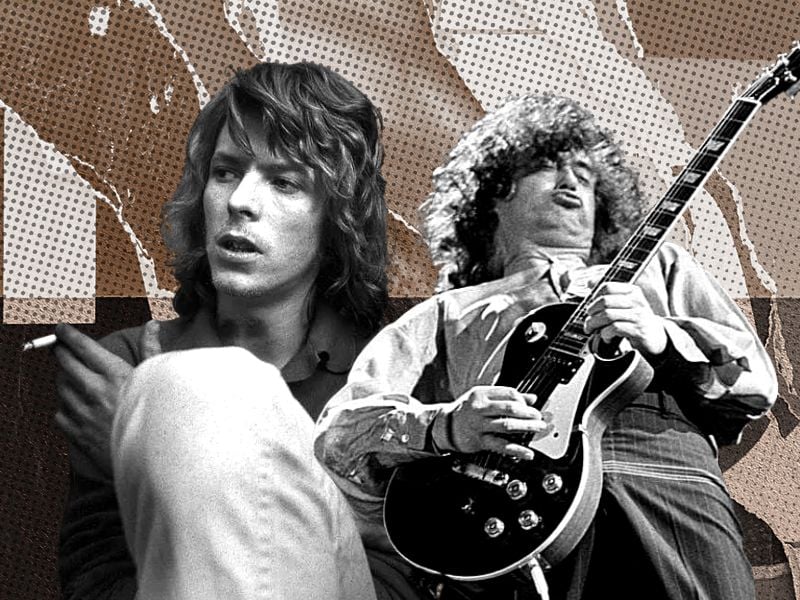
How “generous” Jimmy Page gave David Bowie the perfect riff for two of his songs

The songwriting chops of David Bowie aren’t up for debate. Across a career that spanned six decades, The Starman delivered some of rock and roll’s most potent outings. Whether from his iconic Ziggy Stardust persona and ‘Moonage Daydream’, his deeply moody Berlin-inspired’ Heroes’ or his hip-shaking pop turn with ‘Let’s Dance’, Bowie gave us some of the best tunes around. However, like all great artists, he wasn’t afraid to collaborate and once shared that he even got the help of a “generous” Jimmy Page for two of his songs.
Unfortunately, for all those dreaming of a starry-eyed Ziggy Stardust crossing paths with the wild man of Led Zeppelin during the hedonistic 1970s and sitting down to create a song together, we have to burst your bubble. The duo’s collaboration came before either man truly tasted success, pitching Bowie as a struggling blues hero and Page as a session master.
Daydreaming about a noodling Ziggy Zeppelin, is one thing, but we shouldn’t forget that we still have their original work together, however mawkish it may be. The collaboration came about after a youthful 18-year-old David Jones who fronted The Manish Boys at the time, not yet taking the name Bowie and still very much a Starboy, crossed paths with the notorious session musician. But the meeting provided two more moments of pop culture crossover.
Bowie was leading his pop-rock group with all the vigour and enthusiasm that would see him become a star. They had some great credentials. As well as Bowie fronting the band, the group had also stolen their name from a Muddy Waters track just like The Rolling Stones and looked to compete on the thriving London blues scene. So much so, that they had booked some studio time to get their name out on record. But the song needed some more oomph, so they recruited a local session musician for the day. The gun for hire would turn out to be a 21-year-old Jimmy Page.
While Page would feature on The Manish Boys’ recording ‘I Pity The Fool’, his more potent contribution would come in the form of a riff that Bowie would utilise on two future songs under his own name. The riff would be prevalent on his The Man Who Sold The World cut ‘The Supermen’, and again on Dead Man Walking from Bowie’s 1997 album Earthling, separated by over a quarter of a century; the dark and brooding riff feels entirely in-tune with Bowie’s internal artistry.
Bowie remembered working with Page that day and the guitarist’s excitement over a guitar development that would change the course of rock history: “He was wildly excited about [the fuzz box], and he was quite generous that day. He said, ‘Look, I’ve got this riff, but I’m not using it for anything, so why don’t you learn it and see if you can do anything with it.”
The dark and stormy riff feels like the perfect central point between the two artists. Exactly the kind of hypnotic set of chords one might expect to hear on the early records of Led Zeppelin and still would expect to hear back the wild lyricism of bowie’s innermost thoughts. “I’ve used [the riff] ever since,” Bowie said in the same interview, “It’s never let me down.”
