


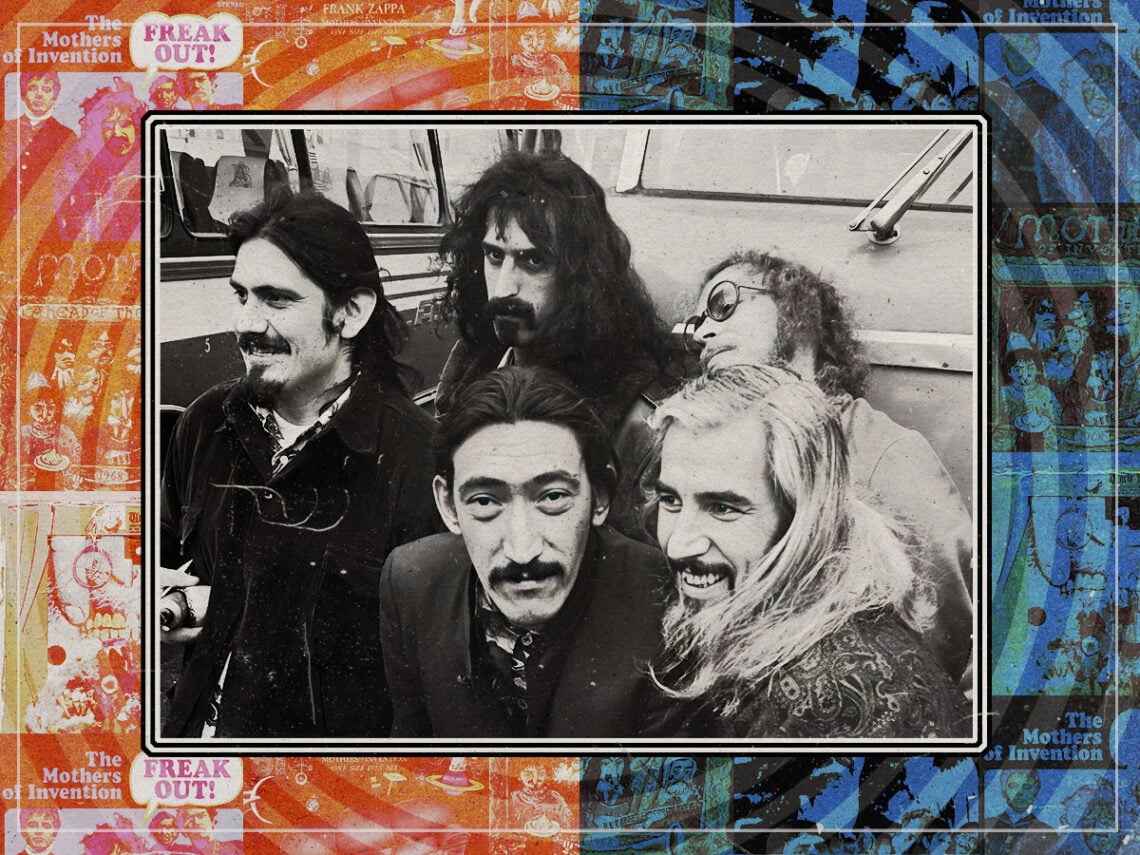
A Confederacy of Weirdos: How Frank Zappa assembled The Mothers of Invention

Frank Zappa never seemed to be a man in the music business. The moustachioed mystic was merely playing with its participants whilst masquerading as a rock star. He was shrewd, erudite and often inscrutably ironic. Take, for instance, the moment the journalist Howard Smith asked him whether a woman could ever be part of his band, “I don’t think there’s a girl around,” he replied, “That could fit in with what we do.” Unbeknownst to the interviewer, multi-instrumentalist Ruth Underwood was pretty much a fully-fledged member at that stage.
However, while the whys and the wherefores of this misdirection might be obscure, there was always a reason for his weirdness. In fact, even The Mothers of Invention were carefully calculated long in advance. “Although the Mothers have been in existence for about three years, the project was carefully planned about four and a half years ago,” he wrote in a Hit Parader op-ed in 1968. “I had been looking for the right people for a long time.”
The right people were not just musicians who could tap into his Igor Stravinsky of rock ways; they had to have the right image, mindset, and a slew of other facets unknown to anyone but Frank. Much of this stemmed from a pre-fame job that made him realise the music in the pop culture age was exactly 50% to do with image. As he explained: “I was in advertising before I got into…ha… show business. I’d done a little motivational research. One of the laws of economics is that if there is a demand, somebody ought to supply that demand, and they’ll get rich.”
With that in mind, he “composed a composite, gap-filling product that fills most of the gaps between so-called serious music and the so-called popular music”. In truth, Zappa was a fan of both to some degree. His music, contrary to the instrumentation, has more in common with classical music than atypical rock ‘n’ roll. He started off as a high-school drummer, with his early influences being percussion-heavy modern-classical, before picking up the guitar and dipping into doo-wop. Each element proved essential because while the so-called seriousness of Edgard Varese was a huge influence, so too was the so-called popular strand of Johnny Guitar Watson and his growing interest in the likes of The Monkees and the outsiders looking to imitate.
So, he grew his own “group to present this music to the public. The group that was to become the Mothers was working in the Broadside, a little bar in Pomona, California.” This band that piqued his interest were outsiders in the true sense; many had arrived in California from far different States and were pariahs struggling to make it in Orange County. They were drummer Jim Black, bassist Roy Estrada, guitarist Ray Hunt, Dave Coronado on sax, and Ray Collins standing up front. They called themselves The Soul Giants, and they largely rattled off classics like ‘Gloria’ and ‘Louie, Louie’.
But seemingly, Zappa, having spotted the band around, noticed something peculiar was happening with them. “Ray Hunt decided he didn’t like Ray Collins and started playing the wrong changes behind him when he was singing,” he recalled. “A fight ensued, Ray Hunt decided to quit.” This left a spot vacant that Zappa figured he could fill.
“I started working with them at the Broadside,” he continued. “I thought they sounded pretty good. I said, ‘Okay, you guys, I’ve got this plan. We’re going to get rich. You probably won’t believe this now, but if you just bear with me we’ll go out and do it.’ Davie Coronado said, ‘No. I don’t want to do it. We’d never be able to get any work if we played that kind of music. I’ve got a job in a bowling alley in La Puene, and I think I’m gonna split.’ So he did. I think he’s got a band now called Davie Coronado and his Sagebrush Ramblers or something like that.” He had made a sizeable mistake despite his assumption seeming fairly sound. That’s the gutters and strikes of life, I suppose.
Thankfully, Zappa was steadfast enough in his thinking that his standing in advertising meant he was onto a winner when it came to the mid-expanding art he wanted to supply the public, so they endured. “There were four original Mothers – Ray Collins, Jim Black, Roy Estrada and myself. We starved for about ten months because we were playing a type of music that was grossly unpopular in that area. They couldn’t identify with it,” he says about the troublesome early days in Los Angeles.

A marketing ploy was needed. So, they decided to do what nobody was doing in the age of pop culture: they decided to bait their own audience with abuse. “We made a big reputation that way,” Zappa comically continues. “Nobody came to hear us play, they came in to see how much abuse they could take. They were very masochistic.” Sadly, a few club owners were derided as collateral damage and that was bad for business, but they were now in Hollywood, which opened the world up to them a little more. As they grew, they added singer and guitarist Alice Stuart to their ranks, and she added further edge to the oddball outfit.
But Stuart, like many of the members, didn’t last long. Henry Vestine, who later joined Canned Heat, was another inductee who was freaked out by the misshapen music on offer and fled despite Zappa crowning him “the most outstanding blues guitarists on any coast.” But the prognosis of this counter-intuitive approach was that something decidedly singular was taking place, and by Zappa’s calculation, irreplaceable entities had great market value. Thus, the rabbit hole of The Mothers burrowed deeper and they decided to stand as the calculated antithesis of the likes of The Beatles. So, when Collins quit the three remaining pariahs barely flinched.
The comings and goings were frequent, but by the time the famed producer Tom Wilson heard them, Collins was back in the fold alongside Elliot Ingber, making them a five-piece. Somewhere along the line, they managed to convince Wilson to produce a record for them off the back of a single about the Watts Riots that he had enjoyed. The problem was, ‘The Watts Riots Song (Trouble Every Day)’ was a typical R&B protest song, but they were far from a typical R&B protest band. Nevertheless, Wilson stuck by them and backed Freak Out firmly, welcoming in a 17-piece orchestra to help with the album, but racked up costs.
“He laid his job on the line by producing the album,” Zappa proudly proclaimed. “MGM felt that they had spent too much money on the album and they were about to let it die, but it started selling all over the place. Like, they’d sell forty copies in some little town the size of a pumpkin in Wyoming. We sold five thousand albums all over the country with no extra hype or anything. Finally, the company started pushing the album, and sales went even higher. We went to Hawaii right after the album was completed, and we worked over there. Then we came back and worked with Andy Warhol at the Trip.”
Most fittingly, they were now part of the counterculture scene they had placed under the microscope. The outcast people in pumpkin towns all over the world had united in fandom. While this ostensibly baffled Zappa somewhat, it may well have been part of his plan. After all, pop culture is a supply and demand business, and what do the outsiders of this world want if not art outside the norm? Zappa was cognisant enough of what the norm was to be able to twist it with interest towards his own artistic goal that just so happened to be commercial by virtue of people’s interest in it rather than the other way around.
As the former advertiser explained: “Science is moving closer to weaponry, and Art is moving closer to commercialism. And never the twain shall meet.” In some ways, he weaponised artistry to meet a commercial end, perfectly highlighting his message to the masses to such an extent that there is now a pumpkin-like town in Lithuania that has declared itself a separatist bohemia with Zappa at the spiritual helm.
“I never set out to be weird. It was always other people who called me weird.” – Frank Zappa
