


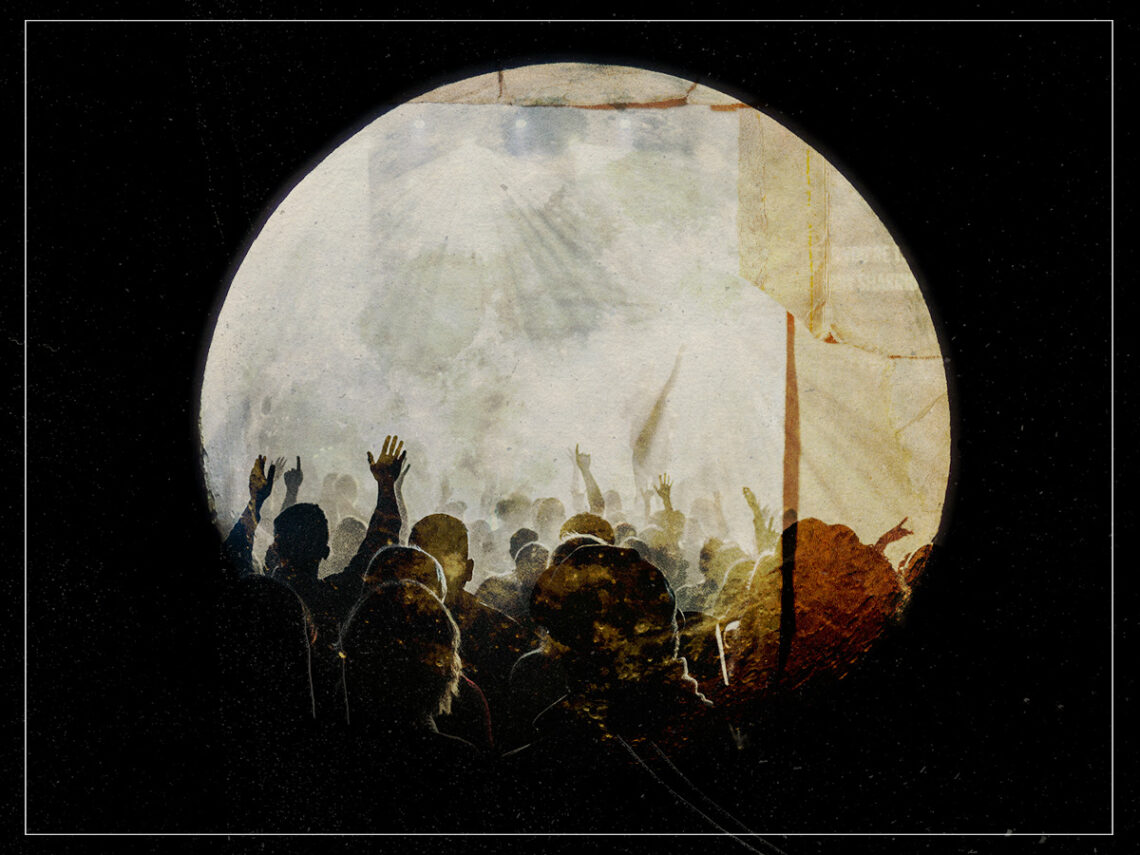
“Imagine how it could be”: How far away are we from the first concert in space?

If you were to ask anyone about where the future of live music is headed, it would likely only be a matter of time before someone floated the idea of one day attending a concert in space. Technological advancements over the last few decades have undoubtedly pointed toward such an abstract idea, but how close are we to really buying tickets for coordinates outside of our usual terrain? Well, considering the latest achievements with the Sphere in Las Vegas, it might not be as far off as you think…
The idea of music providing a soundtrack to space isn’t that alien. In fact, it hasn’t been for years, not just with the famed Voyager record but with other advancements, too. There’s poetry to the entire idea—going to a live show in space—especially considering the industry’s longstanding fascination with otherworldly realms at the hands of artists like David Bowie. But, realistically, enjoying music among the stars could actually one day be another part of space tourism enabled by a series of unavoidable names like Elon Musk and Richard Branson.
Almost a decade ago, Lady Gaga almost became the first artist to realise such a vision. In 2013, it was announced that Branson would allow the ‘Pokerface’ singer a spot on one of his Virgin Galactic flights in a plan to make her “the first artist to sing in outer space.” However, the flight was cancelled, and Gaga never managed to exercise her vocal cords in the Earth’s atmosphere, leaving that coveted record up for grabs.
Musicians have performed aboard space missions in the past, a growing list which more recently includes Sarah Gillis’ rendition of ‘Rey’s Theme’ from Star Wars: The Force Awakens on SpaceX’s Crew Dragon spacecraft. However, such instances have appeared few and far between, remaining to space-specific spaces and niche audiences beyond the mainstream terrain. No artist has performed a fully-fledged live concert in outer space that reaches a global audience, nor have any developments pointed towards the possibility of an audience joining a musician aboard a spacecraft for one or more live renditions.
Following U2’s remarkable spectacle at the Sphere, it’s clear that the possibilities of out-of-this-world musical experiences are endless. This trend for unique experiences would be fitting for an outer space concert, particularly as the framework seems to be ready to go already, not just with simulation capabilities on Earth but with the growing accessibility of such ideas. The add-ons might be cost, logistics, and ensuring safety, but with names like Musk at the top, these seem mere stepping stones.

In a more corporate-leaning manner, the music industry has been venturing into a more meticulous arena since the mid-20th century, with concerns about commercialism, capitalism, and the potential dangers of technology stripping away the human aspect of creativity. While the industry is known for being riddled with figures focused solely on numbers, how much does exclusivity actually steer the direction of the industry itself? With rising ticket prices and gigs increasingly reserved for smaller, more select guest lists, the prospect of space-hosted concerts raises one overriding question: Just how exclusive would intergalactic shows be?
“I’m floating in a most peculiar way, and the stars look very different today…” In a broader sense, the entire idea might be a complete pipe dream that not even the greatest minds of the 21st century could ever see happening in the near future. But more musicians and musical innovators are starting to open their minds to the possibility of music among the stars, even if it’s not a fully-fledged concert. Chainsmokers, for one, have been saying they plan to perform from a pressurised space capsule since 2022. Some organisations are also working hard to simulate space-like performances, while others are toying with the boundaries of performances at great heights.
Moreover, the appeal is evident, which has been intrinsic to the music industry since day one. Innovation, and more specifically, the idea of space-themed music and experiences, was once perhaps best summarised by Brian Eno, whose thoughts on the matter reflect the many reasons space is the quintessential muse because it’s completely out of reach. “Space is silent. It’s a vacuum,” he explained. “In fact, we can’t really experience space directly at all: even those few humans who’ve been out there have done so inside precarious cocoons.”
He continued: “We’ve become used to translating our feelings and understandings about space into metaphors, mental playgrounds where we’re allowed to imagine how it could be. That process of imagining is unanchored to experience, unconfined by any demand other than it be in some way true to our feelings. Making music about space, then, is sheer fantasy, or perhaps sheer metaphor.”
Therefore, while it’s not yet a real possibility, it’s not difficult to imagine the spectacle that taking music out of our usual terrain would generate, especially with the current capabilities of certain virtual reality advancements and the viscera and immersiveness of space as a backdrop to any experience. The imaginative element is already there: the idea of experiencing your favourite music set to a scene of weightless transcendence, existing somewhere in between spectacle and reality, wonder and excitement leading the way in an unforgettable, otherworldly experience.
