


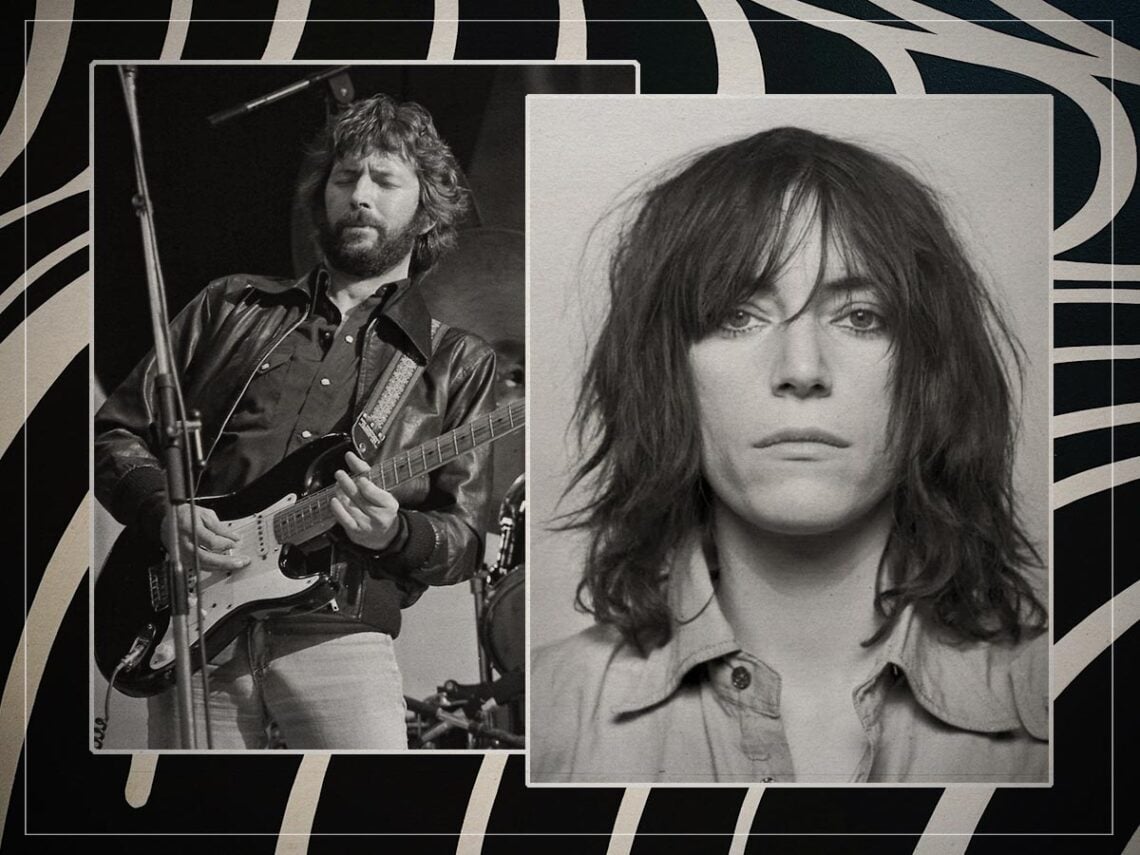
The day Eric Clapton cost Patti Smith her job

When Patti Smith was growing up, her mother handed her a copy of Another Side of Bob Dylan. It was a nondescript moment—Smith even recalls her mother’s casual nonchalance. But this simple gift soon came to represent the zenith of fate and discovery that Graham Greene was referring to when he wrote: “There is always one moment in childhood when the door opens and lets the future in.”
However, despite Smith’s instant love of music from that moment on, it wasn’t her first chosen vehicle of expression. She was still rather shy and retiring and looked towards more conventional professions when she headed out into the world.
To begin with, music for the would-be ‘Gloria’ singer was just a shortcut to wistful reverie rather than a dreamy aspiration. She had fallen in love with the poet Arthur Rimbaud, who died 55 years before she was even born, so a second obsession proved rather healthy, too.
As she said herself: “Rimbaud was like my boyfriend. If you’re fifteen or sixteen and you can’t get the boy you want, and you have to daydream about him all the time, what’s the difference if he’s a dead poet or a senior? At least with Bob Dylan, it was a relief to daydream about somebody who was alive.” Needless to say, she had a habit of idolising revered names from the past—sheltering in their shadow.
When Patti Smith moved to Manhattan in 1967, she began actively engaging in the arts but remained on the fringe of the music scene, operating mainly as a poet and painter. Poetry has never been a reliable engine of income, and Smith needed to sustain herself in the Big Apple, so she lent her words and passion to the Ronseal of music mags named Rock Magazine.

Rock Magazine was in direct competition with a new editorial on the block by the name of Rolling Stone. Thus, when they secured the scoop of an interview with Eric Clapton, it was a chance to get their noses in front. The Cream guitarist was hot property at the time as the head of a lauded supergroup. He was dubbed by many publications as the greatest guitarist around prior to Jimi Hendrix’s ensuing reign. In fact, spraypainted all over London was the phrase, “Clapton is God”.
In short, for a junior reporter, he was quite the scoop. Smith went along to the interview, sat down afore the esteemed Brit and boldly asked one simple question: “What are your six favourite colours.” With that, her journalism career was over. Clapton just looked on bemused. Smith blushed with embarrassment. Assistants rapidly intervened.
The piece never made it to print, so there is no knowing whether he did indeed list off his chosen sextet palette. However, what Smith did recall beyond the blur of the most awkward moments of her life was the realisation that she might not make it as a hardnosed reporter—that was just as well.
Some reports state that Smith simply fled the interview in embarrassment, others that Clapton suffered an onset of emotions from dumbfounded through to outraged and all shades of perplexed in between. What is known is that Smith decided she was too beguiled by the music scene to be a critic for too long, and after the interview, she decided the door was closed for good on her days of journalism. Rock Magazine may very well have decided that for her.
Since then, the story has faded somewhat into obscurity as neither Smith nor Clapton have commented all that much on each other, perhaps because they sit on separate sides of the musical coin in many ways. As her fellow CBGB cohort and friend Joey Ramone once said: “Play before you get good, because, by the time you get good, you’re too old to play.”
Smith has always clung to that youthfulness, honouring the naive impetus of what drives us towards creativity in the first place. With that in mind, maybe her disastrous question wasn’t that daft after all.
