


How does Quentin Tarantino portray women in his movies?

Quentin Tarantino is typically associated with a significantly large male fan base. This perception exists because of his hyper-macho, violent yet suave action heroes. A definite masculine energy characterises several of his films – aggression, charm, and direct violent action are his primary ingredients. Thus, as a sweeping generalisation, means women enjoying his work as a whole is considered unforeseen. However, the Kill Bill director offers layered and entertaining portrayals of women in his films, which either contrast or align with the film’s violent nature.
Tarantino has dealt with accusations of misogyny in his work, as Lex Briscuso writes in Paste: “Building female characters with an agency is a decision Tarantino seems to make willy-nilly as it suits him.” Furthermore, movie fans have noticed the director’s pattern of centring specific female body parts in his shots, alluding to some podiatric fetishes. Briscuso comments: “The focus on legs and feet are obvious, especially when you remember the director’s proclivities, and there are tons of shots with a clear-cut emphasis on the vagina itself in a way that feels slightly exploitative.”
In 2019, Time Magazine reported that only 27.7% of dialogue across all ten of Tarantino’s films is spoken by women, with the more virile characters such as Vincent Vega taking centre stage. This statistic showcases that Tarantino, as a man, prefers making men the stars of his movies most of the time, which is fine because these men are well-written characters.
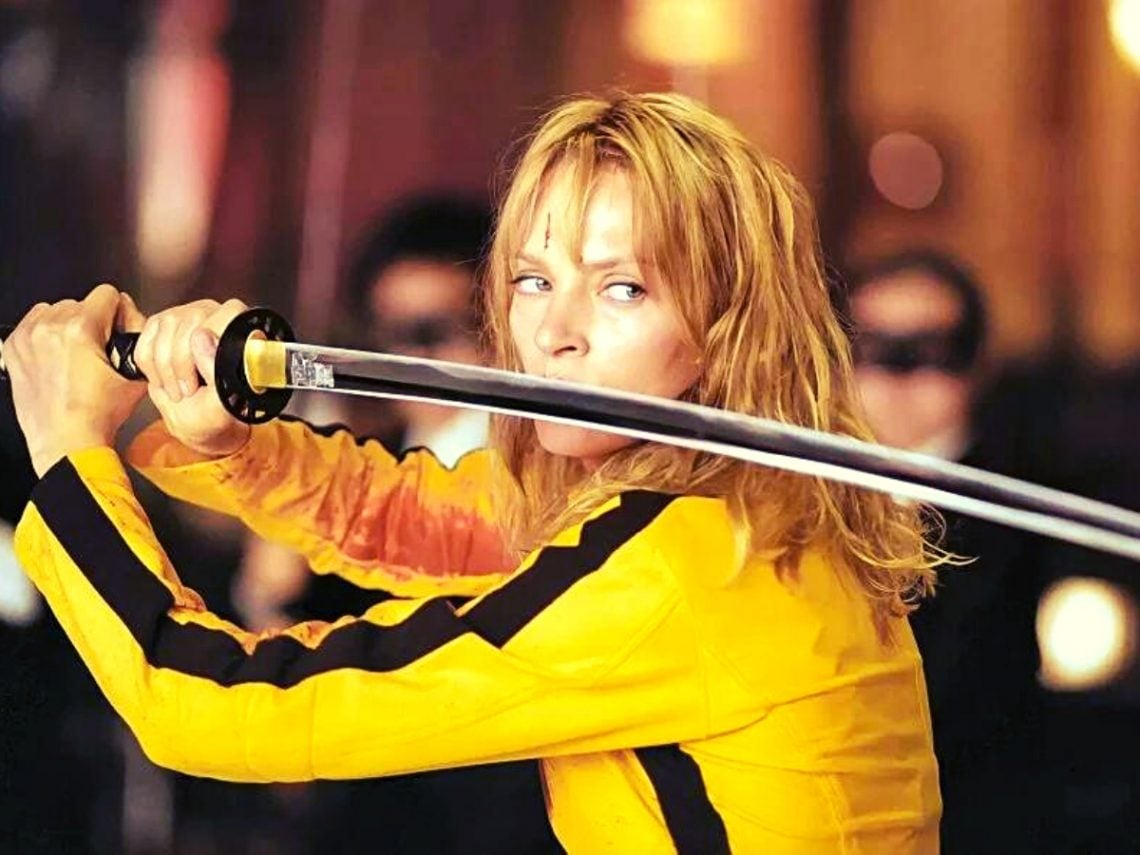
However, one of the initial characters audiences think of when they think “Tarantino” is a woman. Beatrix ‘The Bride’ Kiddo is the focus of the widely acclaimed and beloved Kill Bill Vol 1 & 2. The films exemplify Tarantino’s fascination with vengeance, as Kiddo states: “Revenge is a dish best served cold”. The Bride, as she is known, is portrayed by actor Uma Thurman and leads audiences through her quest to get revenge on her husband, Bill, for attempting to murder her and killing their unborn child. She is highly skilled in martial arts, having studied under the teachings of Pai Mei, and is a member of the Dead Assassins Squad.
The Bride was well-received by critics and film fans, ranked by many as one of the greatest contemporary characters. Intelligent, driven, dangerous and violent, The Bride embodies stereotypically masculine traits with relative ease. However, Tarantino soon reveals the twist that her daughter survived and is being raised by Bill, giving another layer to the character. Kiddo then exemplifies traditionally feminine traits – displaying sudden maternal energy, emotional warmth and a willingness to do anything for her child.
Considering this, it seems that Beatrix Kiddo is a positive portrayal of a woman because she demonstrates how women can exist between masculine and feminine binaries. This is intelligent and objective character writing. It’s impossible to dislike the character, and audiences immediately align with her pain and goals, rooting for her success. Kill Bill Vol 1 & 2 also offer other interesting female characters. There’s O-Ren Ishii, a former Deadly Viper who has become the leader of the Japanese Yakuza. O-Ren was once a close companion to Kiddo before betraying her by assisting Bill, causing her to become Kiddo’s head target in her quest for revenge. This leads to a bloody yet beautifully choreographed fight scene in the film’s climax.
The rivalry between two women may initially prompt thoughts of sexist ideals to pit women against each other. However, Tarantino presents something deeper. The rivalry these two have is an emotional and intense burn caused by a genuine scathing betrayal that validates the anger. O-Ren, played by Lucy Liu, is a fascinating character. Despite being one of the antagonists, she is intriguing and magnetic in her persistent resistance against her male counterparts. The men only question her leadership skills because O-Ren is half-Chinese and half-American, something the Yakuza initially rejected her for, not because of her gender. However, O-Ren brutally retaliates, cutting off the head of the man who dared question her and states: “The price you pay for bringing up either my American or Chinese heritage as a negative is… I collect your fucking head”.
Tarantino shows O-Ren to be, like Kiddo, a character with a past and boundaries. O-Ren has no issue with asserting her intolerance of bigotry, alongside the gruesome punishment that will take place if anyone violates those boundaries. It is refreshing to see a woman face obstacles unrelated to her sex.
Meanwhile, another popular Tarantino character who serves as one of the faces of his work is Pulp Fiction’s Mia Wallace, also played by Uma Thurman. Wallace is moulded after the French actor Anna Karina. She is featured on possibly one of the most iconic film posters of all time, transforming her into a cultural icon. Wallace is confident, elegant, intelligent and intuitive, as shown in the diner scene. However, she is also a drug addict, with one of her most infamous visuals consisting of an adrenaline needle in her chest with blood seeping out of her nose. Her husband, Marcel Wallace, perceives her as a possessed prize that only he can touch. The film hardly questions this, complicating Tarantino’s portrayal of women.
However, it’s Tarantino’s portrayal of the actor Sharon Tate in his alternative history film, Once Upon a Time in Hollywood, where divisive discussion unfolds. Tate was a beloved actor working in the 1960s. However, the Manson family cult tragically murdered her in 1969. Tate was eight months pregnant at the time. However, Tarantino’s version of Tate survives, thanks to Leonardo DiCaprio’s Dalton becoming their target instead. In the film, Tarantino humanises Tate, showing her gentle nature alongside her burning passion for acting. Many critics pointed towards Margot Robbie’s lack of lines, as the audience felt like she was a ploy to expand the male characters’ story. This reimagining of Tate also moves into a realm of symbolic hope and a fairy tale style, detracting from her humanisation.
Overall, the women in Tarantino’s movies exist beyond a one-dimensional scope or limited read. They reconcile with female audiences through emotional alignment with events, such as Kiddo’s loss as a mother or O-Ren’s mission to prove herself. There may be flaws in how Tarantino writes and directs his female characters, including women being ‘owned’ by the men in their life. However, two of these characters exist as larger-than-life symbols in film culture, residing in complex and timeless visual stories.

Never Miss A Take
The Far Out Quentin Tarantino Newsletter
All the latest Quentin Tarantino content from the independent voice of culture.
Straight to your inbox.