


How did a silent song make it to the charts?

Mike Tyson once famously entered the ring to the sound of a single note. No chord progressions, no vocals and crucially, no rhythm section, just one ominous tone. And it was more intimidating than anything his rivals could even muster. It was essentially a soundtrack to a shark, stalking its prey in the calm chaos of the deep blue water. In many ways, it was the quintessential instrumental track.
For someone who spent the best part of a decade getting punched in the head, I’m curious to know where the genius idea developed. What artistic director existed in his entourage and brazenly suggested the use of a continuous note as entrance music. Because it’s something I can well imagine Brian Eno, or Damon Albarn suggesting in the experimental studio sessions of their individual endeavours. Only to be rightly shut down by clearer minds, who remind them that fooling the general public with simple nonsense is a bridge too far.
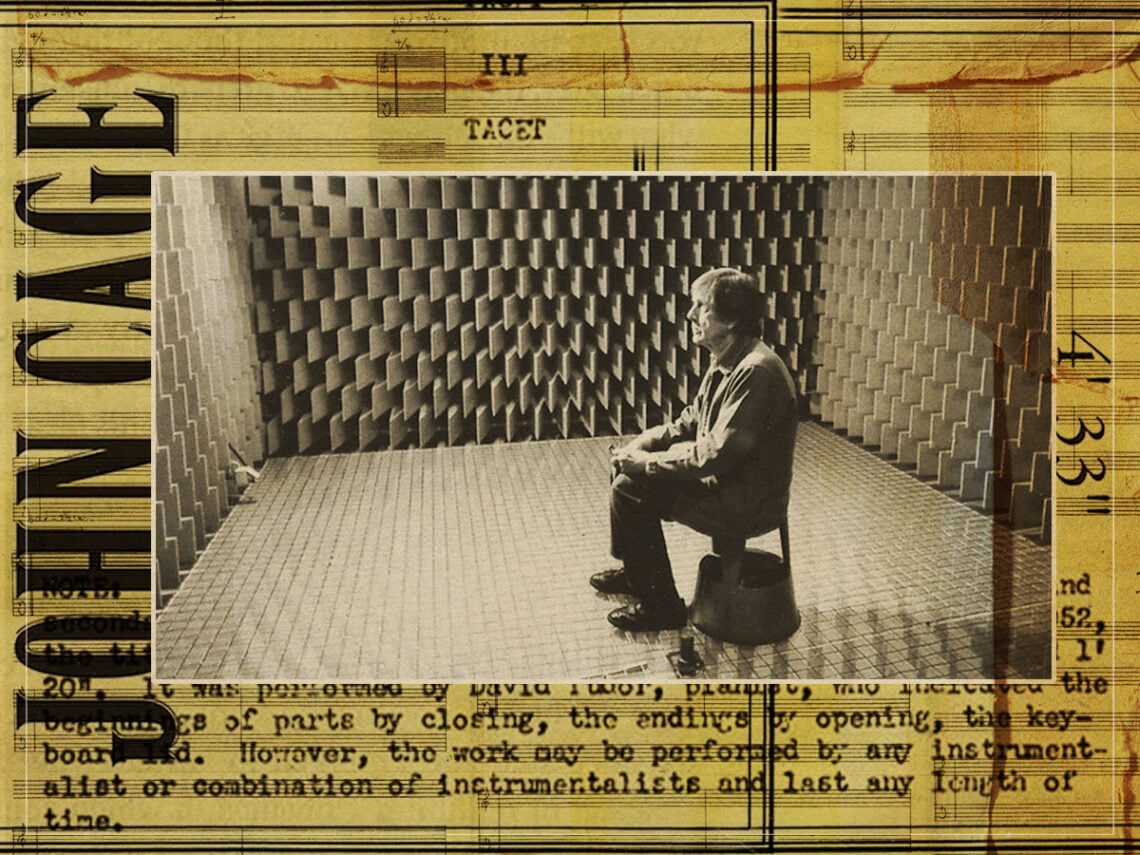
But what about silence? Surely in the realms of nonexistent tones, there is no wool to be pulled over people’s eyes? Well, John Cage disagreed and did so to chart success. The avant-garde composer always believed there was something to be explored in the space of silence. In fact, he once thrust himself into the depths of an anechoic chamber, an environment designed to be so soundproof that its inhabitants can listen to the sound of blood rushing through their head. The steady exposure to the extremities of silence led him to develop ‘4′33″’, his silent masterpiece that stumbled into the charts.
So, how did it work?
Well, it’s purely in the eye of the beholder. It’s an encouragement to be present with your surroundings, harnessing the environment in which you are listening. For example, at its premiere in 1952 at an outdoor music hall, pianist David Tudor closed and opened the lid of his keyboard as part of its performance. Or maybe take myself, who, upon pressing play at this very moment, is enveloped in the sounds of keyboard smacks, chirping of summer birds and the pneumatic drill resurfacing the road outside my house. While I respect Cage’s efforts for present-day living, there’s a reason his invention was conjured up in the purer, untrapped from modernity days of the mid-20th century.
But in 2010, when music fans continued to rage on at the annual tradition of some flimsy X-factor star taking the number one spot in the charts with their trashy cover song, they decided that Cage’s silent number would be the appropriate vehicle to stage their revolution. Eventually it peaked at number 21 in the charts, failing its mission but it nevertheless acted as a small silent process against music commercialism.
Has anybody covered ‘4′33″’?
While its indeed an arbitrary concept, several musicians have in fact covered the silent work of Cage. Proving the malleable nature of the project, Frank Zappa conducted his own cover in the 1993 John Cage tribute album A Chance Operation where his version put focus on the humdrum of a studio with a person present.
Elsewhere, the Amadinda Percussion Group from Hungary recorded it twice, with their second version in 2014 harnessing the calming sounds of nature. There have been several re-recordings over the years, and in many ways, you could say the existence of everyday life acts as a cover to Cage’s avant-garde work. Pointless, evocative or ridiculous, whatever you think of the idea, it has you questioning the realms of possibility.
