


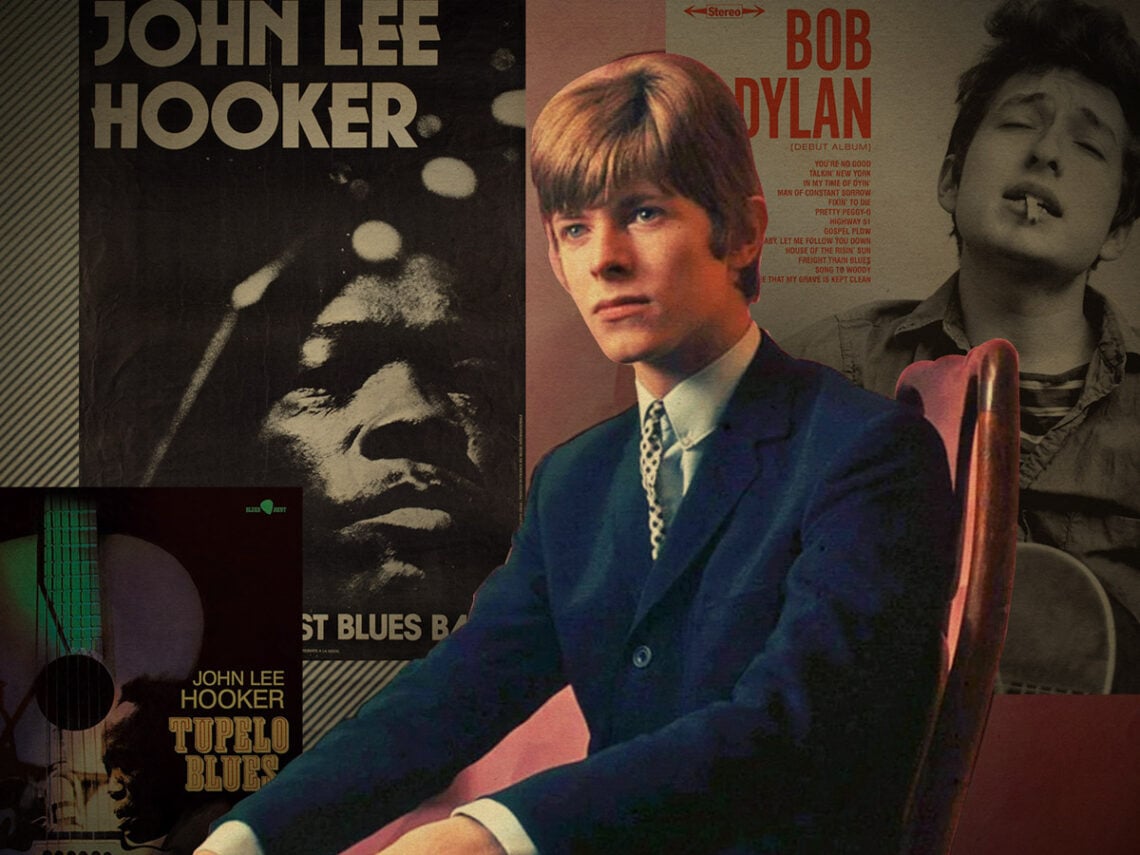
The story of how David Bowie first discovered Bob Dylan and John Lee Hooker: “In the bins”

In 1963, Bob Dylan released his second LP, The Freewheelin’ Bob Dylan, a collection of soon-to-be classics that chronicled the ongoing political upheaval in the United States alongside timeless love ballads, and that same year, David Bowie was 16 years old, working as a junior commercial artist at an advertising agency in London, with aspirations of becoming a pop star.
Bowie had formed his first band, the Konrads, the year prior, playing guitar-driven rock ‘n’ roll at local gigs. His sonic aspirations began to outweigh his bandmates’ own, and, simultaneously, his musical repertoire was expanding. Working at the advertising agency, Bowie’s boss introduced him to new worlds of musicians and genres that would change Bowie’s perception of music forever, with two artists, especially, having a particular effect on the then-burgeoning musician.
“My immediate boss, Ian, a groovy modernist with Gerry Mulligan-style short crop haircut and Chelsea boots, was very encouraging about my passion for music,” Bowie recounted to Vanity Fair in 2003, “something he and I both shared, and used to send me on errands to Dobell’s Jazz record shop on Charing Cross Road.”
Bowie would spend hours of his shift scouring the records for hidden treasures. Once, the mysterious Ian sent Bowie on an assignment: to acquire two copies of Blues legend John Lee Hooker’s Tupelo Blues.
“Ian had sent me there to get him a John Lee Hooker release and advised me to pick up a copy for myself, as it was so wonderful,” Bowie recalled. “Within weeks, my pal George Underwood and I had changed the name of our little R&B outfit to the Hooker Brothers,” and the two musicians began performing the title track during their live sets.
Dolbell’s Jazz and Folk Record Shop also blessed Bowie with another fateful discovery: “It was there, in the ‘bins’, that I found Bob Dylan’s first album,” the musician revealed, referring to Dylan’s self-titled 1962 LP. Of Dylan’s collection of traditional folk songs, his rendition of ‘House of the Rising Sun’ resonated with Bowie the most, and he adopted it into his and Underwood’s live repertoire, too.

“We added drums to ‘House,’ thinking we’d made some kind of musical breakthrough,” he remembered, “and were understandably gutted when the Animals released the song to stupendous reaction.” Indeed, the Animals’ 1964 single ‘The House of the Rising Sun’, led by singer Eric Burdon’s haunting vocals, was a sensation of the British invasion era, albeit a surprise one, recorded in just one take.
Bowie continued to clarify: “Mind you, we had played our version live only twice, in tiny clubs south of the river Thames, in front of 40 or so people, none of whom was an Animal. No nicking, then!”
Bowie has continually sung Dylan’s praises – both figuratively and literally, writing songs in the folk legend’s honour and performing his own renditions of Dylan’s classics. “His writing, his song’s texts, leave me speechless,” Bowie said in 1997. Notably, the aptly-titled ‘A Song for Bob Dylan’ appeared on Bowie’s 1971 album Hunky Dory, in reference to Dylan’s ‘Song to Woody’. “Now, hear this, Robert Zimmerman, I wrote a song for you,” Bowie declares.
“Even though the song isn’t one of the most important on the album, it represented for me what the album was all about,” Bowie told Melody Maker in 1976. “If there wasn’t someone who was going to use rock ‘n’ roll, then I’d do it.”
With Tupelo Blues making it on Bowie’s list of his 25 favourite albums, the significance of Hooker’s album, with his electric guitar-style interpretation of Delta blues and his virtuosity with his instrument, continued to resonate from Bowie’s youth to adulthood, surely bringing him back to his time as a young musician aspiring to make art with such a timelessness, all thanks to a chance artist job that would alter his perspective.

Never Miss A Tale
The Far Out Bob Dylan Newsletter
All the latest stories about Bob Dylan from the independent voice of culture.
Straight to your inbox.