


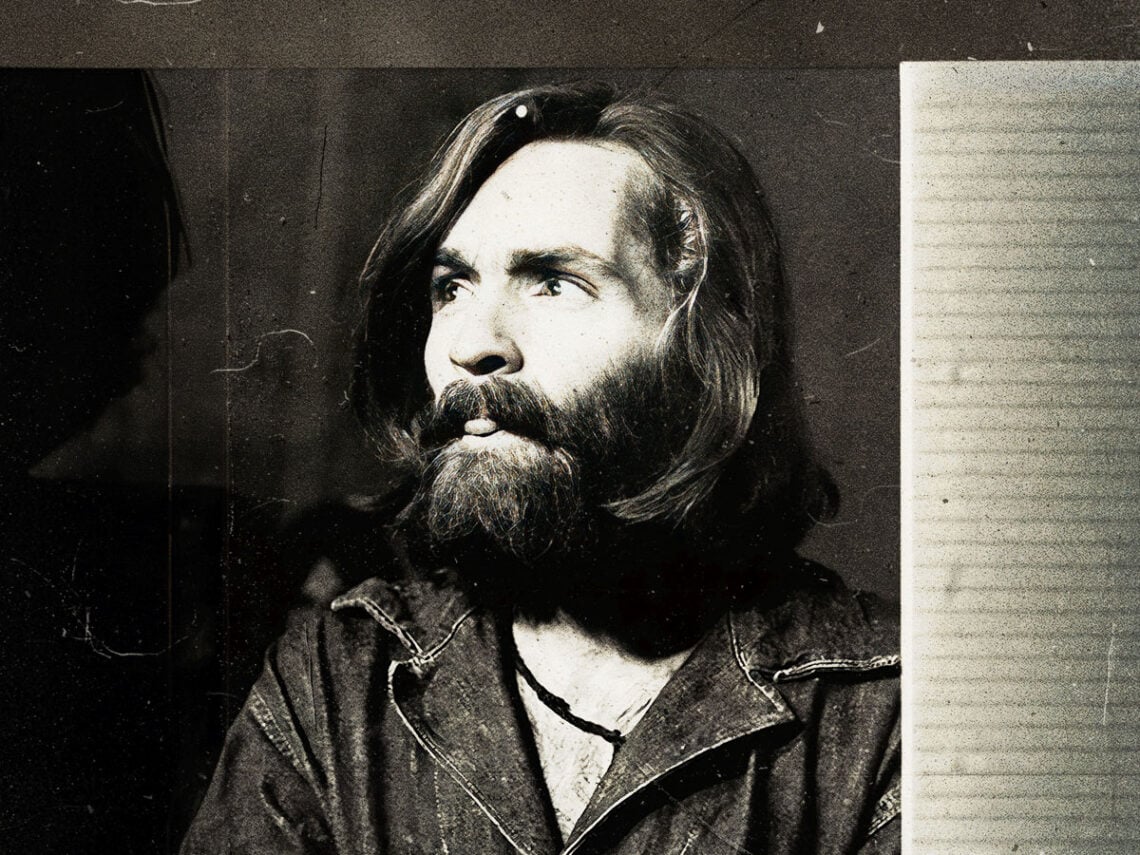
How Charles Manson haunted the 1960s music scene

Joan Didion once wrote, “Many people I know in Los Angeles believe that the sixties ended abruptly on August 9th, 1969, ended at the exact moment when word of the murders on Cielo Drive travelled like brushfire through the community”. Writing about the cultural impact of the Manson Family murders, her essay The White Album deals with Charles Manson as a kind of central, haunting figure that loomed over the ’60s long before the murders and stopped its optimism short immediately after.
The infamous cult leader Charles Manson has gone down in history as a critical figure in the 1960s counterculture movement. His band of loyal and deranged followers, known as his ‘family’, carried out the brutal murders of film star Sharon Tate, her hairdresser Jay Sebring, friends Abigail Folger and Wojciech Frykowski, as well as Leno and Rosemary LaBianc under Manson’s instructions on the night of August 9th, 1969.
In The White Album, Joan Didion writes of the murders as a kind of inevitable ending to a strange decade, claiming that when the murders happened, “no one was surprised”. America was going through a significant transition with the sexual revolution, gender and race protests and a general breaking down of the more conservative American values that the older generation held dear. It seemed something had been brewing for a while as the music, art and films of the decade became increasingly violent. To many, looking at the overwhelming optimism of the decade when hippies reigned supreme, it seemed that at some point, what went up would have to come down, and something terrible had to be lurking around the corner. Manson, to Didion, was that eventual reckoning, writing, “The tension broke that day. The paranoia was fulfilled”.
But as a wanna-be rockstar, nowhere was Manson lurking more than in the music of the 1960s. Casting a shadow over the decade, Manson haunted the music scene in both LA and further afield.
It all started with the music. At first, the Manson Family was nothing but an abusive, patriarchal commune where Charles Manson took in wayward hippies that he deemed easy to control. Plied with drugs and forced to do precisely what Manson demanded through the classic form of cultish abuse, the family became increasingly violent. But initially, their existence wasn’t murderous and was purely attempting to enable Manson’s music career.
Manson’s desperation to be a rockstar is well documented, as is his connection with Dennis Wilson and The Beach Boys. Becoming friends with Wilson after a party and then using the sexual favours of the women in the family to keep him onside as the family moved into Wilson’s home, Charles Manson believed Denis would land him a record contract or at least allow him to work with The Beach Boys producer, Terry Melcher.
There is some truth in this. Dennis Wilson believed in Manson as an artist because, in 1968, The Beach Boys even recorded one of Charles Manson’s songs. Originally titled ‘Cease To Exist’, the blues-infused, seductive track was recorded until the title ‘Never Learn Not To Love’, using Manson’s lyrics but never involving him in the process. Listening back to the track now, it’s a bizarre cut. With the context of the cult, lyrics like “Cease to resist, come on say you love me, Give up your world, come on and be with me” or simply “submission is a gift” send shivers down your spine. Knowing that Manson would go on to physically threaten Dennis Wilson, sending him bullets in the post when the offer of a record deal fell through, Manson’s terrifying aura seems to torment the song along with all of The Beach Boys 20/20 record as the band attempted to join the more alternative sound of the late ’60s.
Manson’s haunting of The Beach Boys legacy is made even more chilling with the knowledge that Terry Melcher used to live on Cielo Drive, and Manson was, in fact, probably looking for him when he instead found Sharon Tate and company.
But Manson’s eerie loom of the music of the 1960s doesn’t stop there. Once his dreams of securing a record deal appeared to die, Manson turned his attention to another music-themed scheme. Believing The Beatles were sending him messages, the 1968 White Album became a vital piece of the Manson Family story. Through tracks like ‘Sexy Sadie’, which Manson thought was speaking directly about Family member Susan Atkins, who had been nick-named Sadie, or ‘Honey Pie’, which Manson believed to be the band telling him he needed to come to England – Charles Manson took the album to be rife with hidden messages about an upcoming race war which Manson and his family would be the sole survivors of.
Hatching a plan called ‘Helter Skelter’ after the spiralling, heavy album track of the same name, it was this scheme that would result in the infamous murders, with ‘healter skelter’ left written, incorrectly, in blood on the walls of Sharon Tate’s home.
After the murders, Manson’s relation to the 1960s music scene only seemed to increase. As his face was scattered across the news and his name went down in history, more and more stories of Manson’s interactions with musicians like Jim Morrison, Cass Elliot and Neil Young started coming out. In fact, Neil Young once jammed with Manson and praised him as a musician, later releasing the track ‘Revolution Blue’ inspired by Manson and the murders, singing ”I hear that Laurel Canyon is full of famous stars, But I hate them worse than lepers and I’ll kill them in their cars.”
To round off a decade of haunting the music scene, Charles Manson’s own album, LIE, was released in 1970 by the family while he was awaiting trial. Going on to be a cult piece of dark, twisted music history, it features Manson’s own original version of The Beach Boys track he now haunts.
