


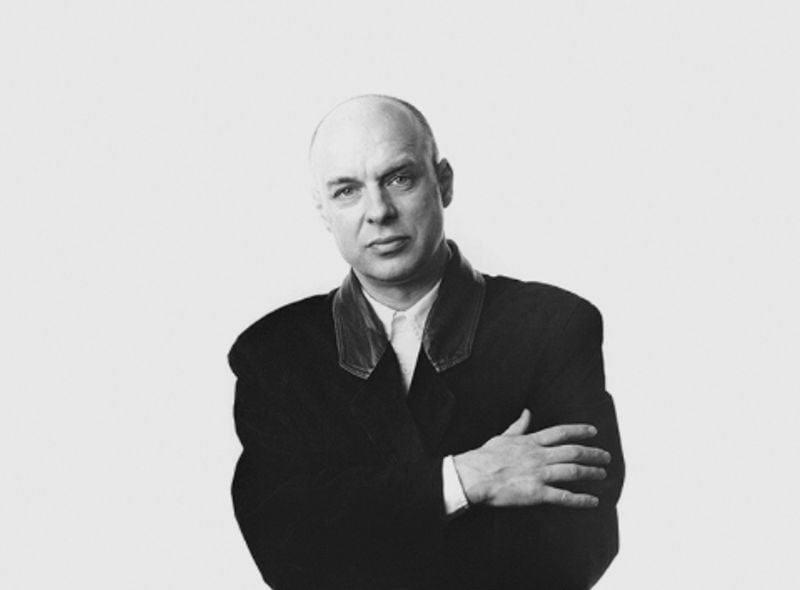
How Brian Eno first started working with U2

As far as legendary producer-musician team-ups go, few partnerships have been more critically acclaimed and commercially successful as the one between Brian Eno and U2. Along with co-producer Daniel Lanois, Eno helped elevate U2 from a scrappy post-punk band to one of the most fascinating and eclectic groups of the 1980s and 1990s. With an eye and an ear towards atypical sounds and unconventional approaches, Eno helped redefine how U2 saw music. As a result, U2 then showed the rest of the world a fresh way to approach rock and roll.
U2 were heading in a harder and heavier direction after the release of 1983’s War, but the band wanted to change their sound. “We knew the world was ready to receive the heirs to The Who,” Bono said in 2006. “All we had to do was to keep doing what we were doing and we would become the biggest band since Led Zeppelin, without a doubt. But something just didn’t feel right. We felt we had more dimension than just the next big anything, we had something unique to offer. The innovation was what would suffer if we went down the standard rock route. We were looking for another feeling.”
Even though it was a successful collaboration, U2 opted not to work with producer Steve Lillywhite for a fourth consecutive album. Instead, they became fascinated with the ambient works of Eno. For his part, Eno had experience with rock music, having performed in Roxy Music and produced the likes of Talking Heads and Devo. But Eno was uncertain about working with U2.
“I think he was intimidated by the lack of irony in what we were doing,” The Edge observed to Q Magazine in 1998. “He’d come from Talking Heads, the Rhode Island School of Design, living in New York, and here was this Irish band hitting everything full-on, completely earnest, hearts on sleeves, no irony at all.”
Eno brought along Lanois, ostensibly as a potential engineer, under the assumption that he could convince U2 to work with Lanois instead. During the meeting, Eno reacted with ambivalence towards their most recent live album, Under a Blood Red Sky, and once again tried to pitch Lanois as their producer. U2 were insistent that Eno was their guy, and eventually, Eno was won over by their willingness to experiment. All parties came to an agreement: Eno and Lanois would co-produce, with Lanois working directly with the band and Eno coming in at different intervals to contribute ideas and help steer U2 away from cliches.
The results were 1984’s The Unforgettable Fire. Unlike their previous work, U2’s fourth LP showcased a softer and more open sound, inspired by Eno’s work in ambient music. Synthesisers played a larger role in creating soundscape and textures, while Lanois preserved the more rock-centric elements of the band’s sound. The change in sound was lauded, while the hit single potential of songs like ‘Pride (In the Name of Love)’ and ‘Bad’ allowed the album to connect with the mainstream. The collaboration was so successful that Eno and Lanois would continue to work with U2 off and on for the next two and a half decades.
