


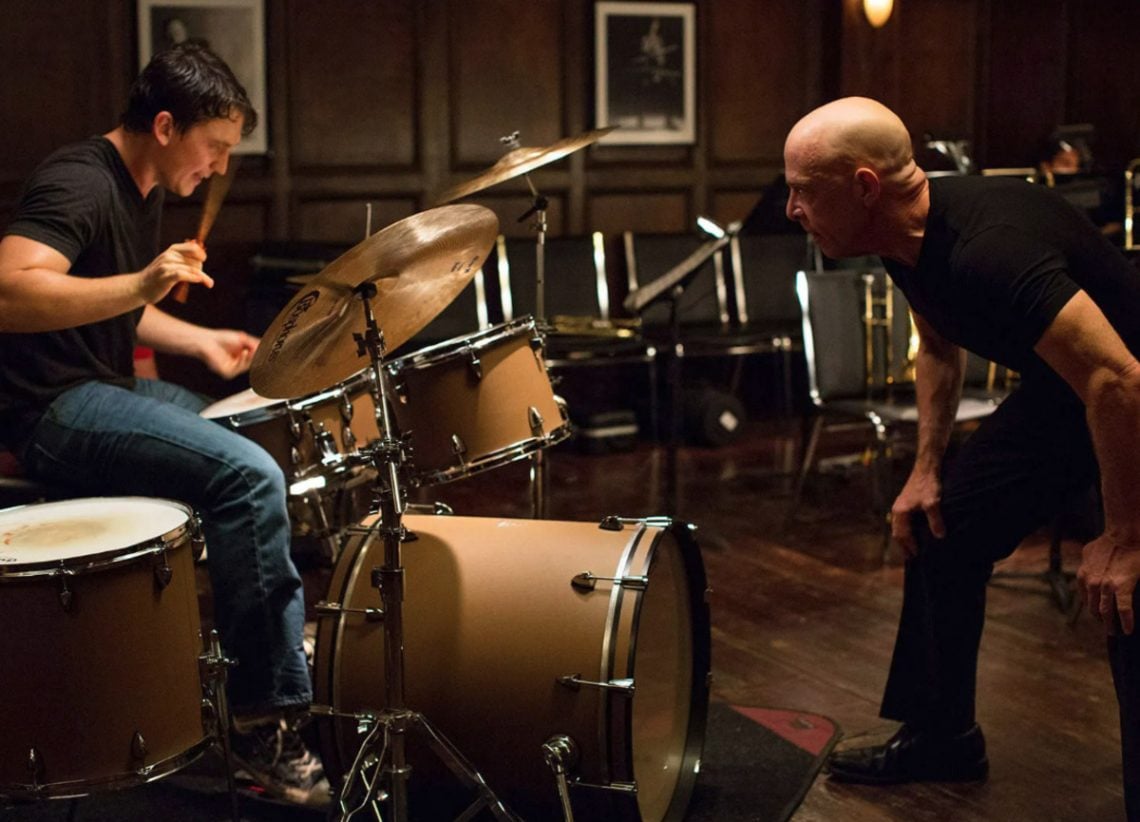
How ‘Black Swan’ inspired ‘Whiplash’

Comparisons between Damien Chazelle’s Whiplash and Darren Aronofsky’s Black Swan have been rife for years now. The two modern classics each tell the story of an artist determined to become the best in their trade.
While Whiplash follows Miles Teller’s Andrew Neiman on his quest to supersede Charlie Parker as the greatest jazz drummer of all time, Black Swan follows Nina Sayers, played by Natalie Portman, as she endeavours to become the perfect ballerina. Each film features artistic obsession to the point of self-harm, exacerbated by a villainous mentor. It’s understandable that the two have been compared and contrasted by film fans and critics alike.
Whiplash director Chazelle once revealed how the anxious obsession of Black Swan made him feel seen as a devoted musician and inspired his own direction. Speaking with Stand By For Mind Control, Chazelle shared that, as a naturally anxious person, he was pushed to the point of panic attacks while drumming at college.
Like his protagonist, Chazelle was spurred to obsession by a conductor who he deemed both his “boogeyman” and the “best teacher” he ever had. As he recalled: “I have fond memories of those days, but I also remember feeling utterly terrified of this man every day. And I know I wasn’t the only one.”
It’s a memory that could be applied to either protagonist in Whiplash or Black Swan. Chazelle’s own experiences of musicianship, then, were a major inspiration for the film, but he first felt seen by Aronofsky’s take on the subject, as well as Stanley Kubrick’s 1987 war film, Full Metal Jacket.
Chazelle recounts seeing the latter while he was in the band and thinking, “I had finally seen something that corresponded to what band felt like to me.” It’s a bold statement to make, but he suggests that the competition found in practice rooms is comparable to the anxiety found in a war movie.
When Chazelle watched Aronofsky’s Black Swan, which focused on the subject within the domain of arts, he felt even more seen to the point of flashbacks. He shared: “I watched that in a state of heightened dread. It’s funny: Black Swan is such a fantastical story, bordering on horror. It’s a ‘non-realistic’ movie, but it felt more true to my personal experience as a musician than most ‘realistic movies’.”
He continued to explain: “That’s what it feels like to be a musician in a competitive climate. It feels like you’re in a war movie or a horror movie, and you don’t know if you’re going to make it out alive or not. It’s a naturally over-the-top state of being because your emotions are constantly at 10 or 11, and you’re constantly vulnerable to attack. ‘That’s what it feels like. You’re living life at full pitch.'”
Whiplash channelled that same energy of heightened anxiety and over-the-top emotion – it makes jazz feel like life or death, perfectly encapsulating the plight of the obsessed artist. Though each film puts the subject in a different setting, their main focus is obsession to the point of harm, and it’s an endlessly thrilling story to watch.
