


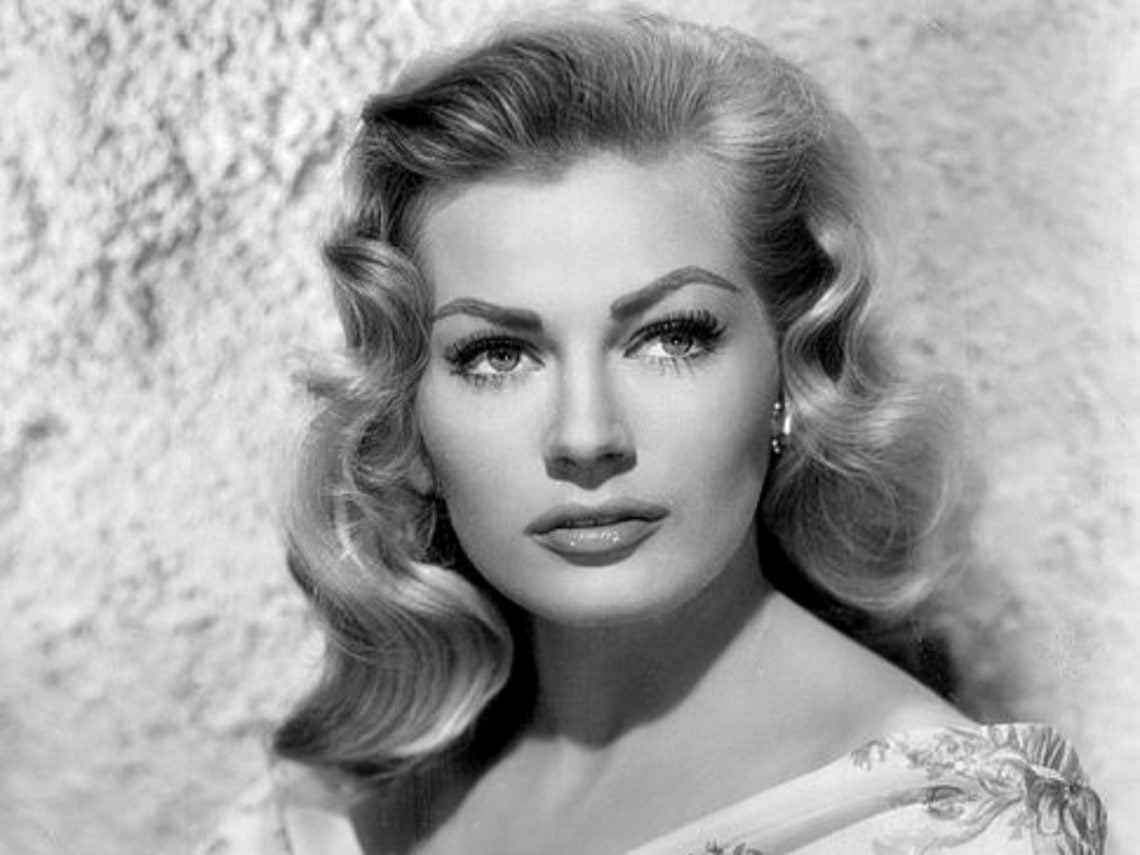
How Anita Ekberg came to resent ‘La Dolce Vita’

In the winter of 1960, Anita Ekberg stepped into Rome’s Trevi Fountain and entered the annuls of cinema history. The scene from Federico Fellini’s La Dolce Vita made the hardy Swedish actor (she never once felt the cold, apparently) a huge star, allowing her access to the high society parties so satirised in Fellini’s celebrated film. However, with fame came a narrowing of opportunity – a reminder that the film industry has always cannibalised its female stars. While her fountain playmate, Marcello Mastroianni, was handed the world of a silver platter, Ekberg was given only the opportunity to parody herself time and time again.
Ekberg’s cinema career began after she won the Miss Sweden competition in 1950. She subsequently left her home nation to seek fame in the US, where, after being dropped by Universal after just six months, she ended up working with the likes of John Wayne in films such as 1955’s Blood Alley. The following year, she landed a part in War and Peace opposite Audrey Hepburn. The production was shot in Rome, and Ekberg would later return to La Città Eterna to star as the seductive Zenobia in 1959’s Sheba and the Gladiator.
From there, she stayed in Rome to star as the unattainable American Sylvia Rank in La Dolce Vita, who was to be the object of Marcello’s obsession. By this time, she was already a huge star in Rome. Indeed, Ekberg would later attempt to reclaim the narrative surrounding La Dolce Vita, arguing: “It was I who made Fellini, not the other way around.” The Roman paparazzi were obsessed with Ekberg’s platinum beauty, but La Dolce Vita sent it worldwide. The Trevi Fountain scene, in which she and Marcello Mastroianni embrace under the sculpted chin of Neptune, is as iconic as it gets, helping to cultivate the touristic image of Rome as the sun-baked city of love.
In 1959, shortly after production had wrapped on Sheba and the Gladiator, Ekberg was asked if she had other ambitions beyond playing historical queens and “dancing girls”. Detailing further, she added: “I’d much prefer to have a modern story. I have a chance with Federico Fellini – he’s making a picture in February – and the part that I’m supposed to play, that I might be playing, is modern and it’s dramatic and it’s a step forward.”
It may have been a step forward at the time, but it ended up feeling more like a step backwards. Not only was Ekberg hounded by the paparazzi – to the extent that she was forced to threaten the photographers with a bow and arrow – she also claimed that things became rather dull. Directors didn’t want Anita Ekberg; they wanted the seductive Sylvia. Yes, the roles came flooding in, but they were all the same character, the same blonde-haired, unattainable temptress. In 1962’s Boccaccio 70, she performs what seems like a parody of Syliva. The same goes for 1963’s 4 For Texas, 1965’s Who Wants to Sleep? and 1966’s How I learned to love Women, reminding us that, sometimes, fame closes doors rather than opens them.
