


“The best band in the history of rock”: How an album changed Jack Black’s life

In his youth, while his mother was busy working on nuclear missile guidance systems, Jack Black was busy attempting to head-bang to heavy metal until snot poured out of his nose.
When he headed into his teens, his parents’ divorce furthered his devotion to self-induced whiplash of the head-banging variety. But as he bounded around, landing teenage roles in the likes of The X-Files and Picket Fences, he noticed a certain backwash of suppressed emotions breaking against his typically upbeat soul. Soon, an album, devoid of knee-slides and riddled with complexity, would help to unlock them and change Black’s life.
This is not an unfamiliar musical transition. It’s a universal truth that good things come to those who wait. All the best things in life are an acquired taste. How can you truly appreciate the triumph of a last-minute winner without first sitting through a slew of tedious draws?
To reach the wondrous relief of a cathartic cold beer after a hard day at work, you must first gag your way through warm cans as a brave-faced teenager. And I refute the proposal that anyone enjoyed their first delicious olive. The same can be said for the world of music. Not every masterpiece knocks your socks off from the first listen.
These slow-burning displays of brilliance are the bane of a reviewer’s workload. And they are the gift that keeps on giving in your record collection. Often, the LPs that require repeat listens are the ones that survive the test of time the best. They see us delving back in time and time again.
In a way, this phenomenon makes perfect sense. If you have to wade into them tentatively, then the implication is that there is more depth. Is obfuscated beauty ultimately not more captivating than a quick, lusty flash?
According to Jack Black, it most certainly is, though it might have taken him a while to reach this conclusion. Don’t get him wrong, he also loves the immediate invigoration of AC/DC, but only one record has prompted the Nacho Libre star to proudly proclaim, ”It’s the best band in the history of rock,” and it took a little bit of time before he was confident enough to make the pronouncement. That album was Radiohead’s second record, The Bends, from 1995.
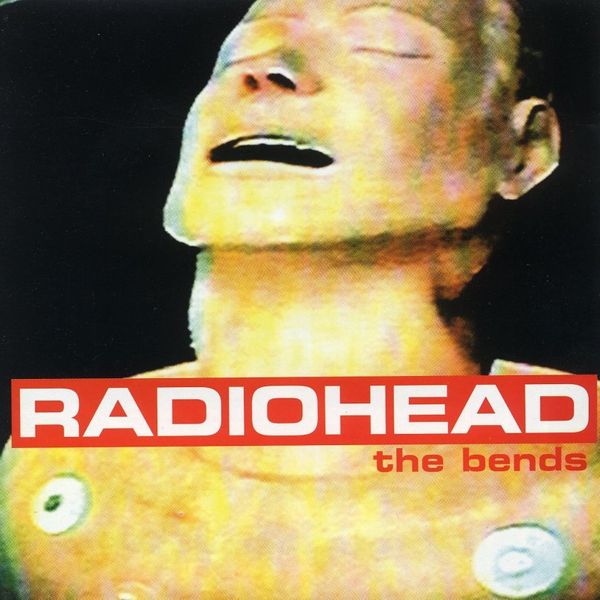
“If you want concept, you go OK Computer,” he said when championing the group as one of his all-time favourites for Entertainment Weekly, “But if you wanna rock – if you want straight-up fucking songs – you go The Bends. The first few listens, I was like, ‘I don’t understand… My brain’s not computing…’ Then it clicked in: ‘Ohhhh, I see! It’s the best band in the history of rock!’”
Once he stuck with the record, he found himself captivated by the intricate mystery of it all. It’s dense and deep, yet catchy and flighty; it’s experimental and complex, yet it’s laden with riffs and a semblance of rock ‘n’ roll purity. Perhaps, above all, it’s cinematic.
The thespian’s band of choice?
Which is maybe why it hasn’t just enamoured Black, but also his fellow actor Brad Pitt. The Fight Club star once declared in a Rolling Stone interview, “What is so important about Radiohead is that they are the [Franz] Kafka and the [Samuel] Beckett of our generation.”
“Thom Yorke and the rest of Radiohead are precisely that,” Pitt dotingly continued. “What comes out in them I don’t think is anything they could actually articulate, but I would certainly say that it’s that which we all know is true somewhere when we’re in our deepest sleep. That is their importance, and this movie hits on the same level.”
That same mystic truth untold enraptured Black, and he’s been stalking the band ever since. As the Tenacious D star stated, “I worship Thom Yorke. We were on the bill of a Neil Young benefit concert in San Francisco, the Bridge School Benefit, and Thom Yorke was doing a solo performance, playing Radiohead songs on his acoustic guitar and on Neil Young’s piano, and, yeah, that was one of the best things I had ever seen. It was so good.”
That feverish devotion all began with The Bends, and like all the best things in life, it took a while for Black to see the true beauty in it. Even the title itself implied a patient ascent was necessary to bask in its heavenly heights. As Yorke expressed with the disappointment of Pablo Honey, “We just came up too fast.” The band were determined to take their time with The Bends, and transfigure that slow-burn into music that keeps on giving.
This was the non-conformist answer to commercialism that he had been waiting for. He had grown weary with MTV in his youth, explaining, “MTV was good for good-looking bands. But obviously, some of the best musicians and rockers are butt-ugly, so as soon as you cut away all of those people, your music is automatically half as good as it used to be.”
Radiohead readily decided not to play that game, and angled themselves towards experimentalism. For Black, as an aspiring star who didn’t naturally fit into the Hollywood machine, that inspirational move proved life-changing. He figured he could be an unshaven rock ‘n’ roll lead star after all.
