


How a filmmaker John Wayne only worked with once might have killed him: “I was fucking mad”

Audiences had spent decades being conditioned to believe that John Wayne was as close to immortal as a movie star could be, with the actor spending decades as one of the industry’s top box office draws and very rarely allowing himself to be killed onscreen.
That notion was only reinforced when ‘The Duke’ defeated cancer in the early 1960s, or as he put it, “licked the ‘Big C,'” returning to work not long after surgery to remove his left lung. He was a heavy smoker, a hard drinker, and a man who struck equal amounts of fear and respect into the hearts of those he worked with, but he wouldn’t be able to beat it twice.
His final starring role in The Shootist was also his most poignant, with Wayne starring as a veteran gunslinger struggling to get to grips with the modern world. Even if his character hadn’t been battling terminal cancer, much like he was in real life, it would have still stood as a monument to his final years.
The Academy Award-winning actor and Hollywood icon would ultimately die of stomach cancer in 1979 at the age of 72, and there’s a school of thought that traces it right back to the set of a single film. It sounds fanciful at first glance, until you realise just how many people who worked on 1956’s The Conqueror developed symptoms or died from the disease.
The epic period piece, which also suffered the ignominy of being Wayne’s worst-ever movie, was shot in and around nuclear test sites. While nobody expected there to be any repercussions at the time, by 1980, over 40% of the crew had developed cancer symptoms, and almost 50 of them had passed away as a result.
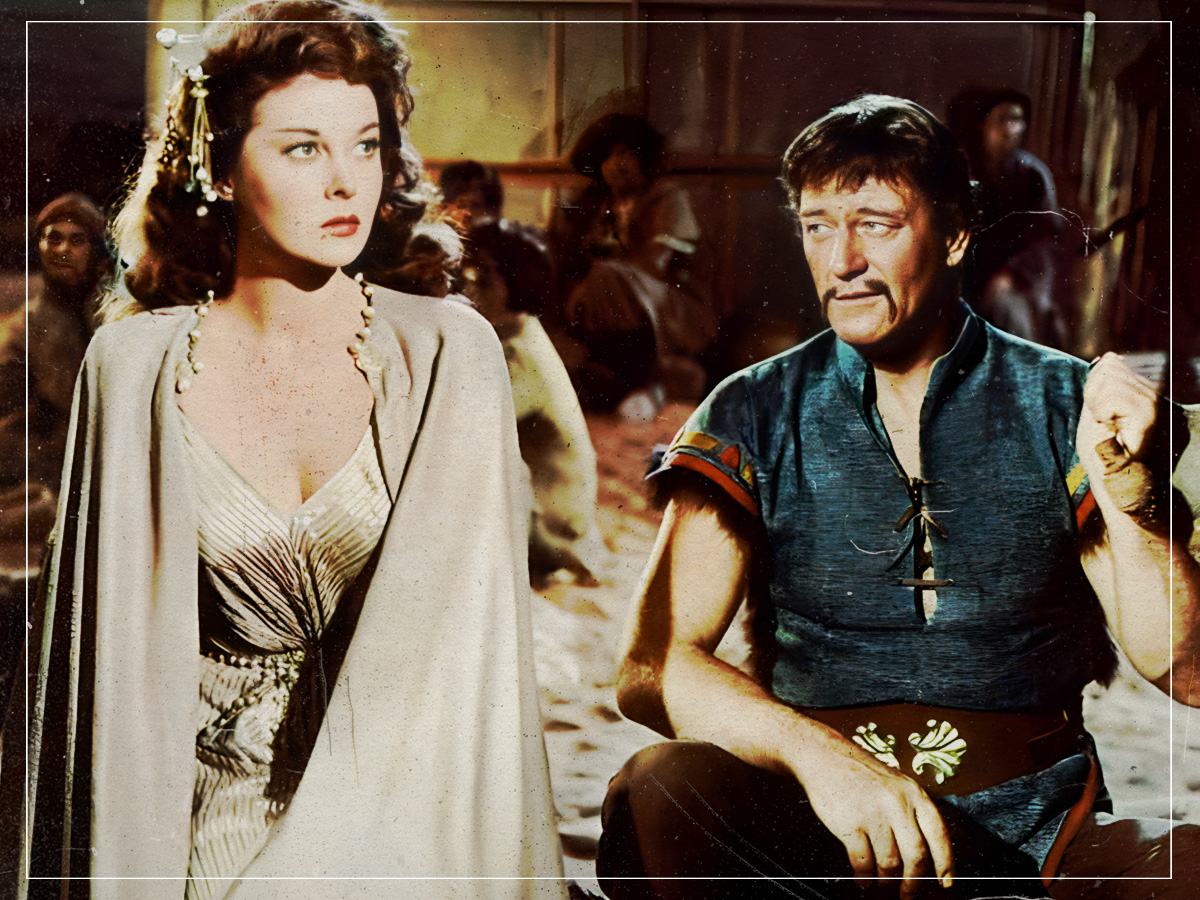
While it’s impossible to point the finger of blame exclusively at The Conqueror for being the culprit behind the star’s demise over 20 years later, it’s not stretching the limits of credulity to think that things may have turned out very differently for ‘The Duke’ had Howard Hughes pulled his finger out of his arse.
The eccentric mogul fancied himself as an aspiring Hollywood heavyweight, and he put his money where his mouth was. Although Hughes only directed two features, 1930’s Hell’s Angels and 1943’s The Outlaw, he produced countless more, and even bankrolled some films that he wasn’t actively involved with, other than a ceremonial credit. He funded 1951’s The Flying Leathernecks with Wayne in the lead, and the pair had a loose agreement to reunite for another.
Several years later, and it still hadn’t materialised, starting an unfortunate domino effect. “His delay was really getting me into deep fucking water,” ‘The Duke’ told Michael Munn. Hughes hadn’t even told him what the picture would be, all while Warner Bros was breathing down his neck and threatening to sue for breach of contract since he also owed the company a movie.
“I was fucking mad, and I wrote to Howard and told him that it was his studio’s responsibility to have scripts ready for me on the dates he had promised,” he explained. As fate would have it, a meeting at RKO’s head office solved his problem. “I saw a treatment lying around for something called The Conqueror,” he recalled. “I took a cursory look at it and thought, ‘This might be interesting’. I kind of liked it.”
When he found out Dick Powell was directing, he was sold. “I kind of took him by surprise, and he said, ‘Are you serious?'” Wayne explained. “I said, ‘Sure, why not?’ So he said, ‘OK’, and we shook hands on it.” That would be the only film starring the icon that credited Hughes as a producer, although Jet Pilot did get a ‘Presented by Howard Hughes’ tag, and it was also the picture that may have killed him.

Never Miss A Tale
The Far Out John Wayne Newsletter
All the latest stories about John Wayne from the independent voice of culture.
Straight to your inbox.