


Horror movies need to stop relying on viral marketing campaigns and let success happen organically

Before the easing of cinematic censorship allowed horror movies to become grislier than ever, scary films had the potential to become quite popular.
Look at the 1942 effort Cat People, which became one of the highest-grossing movies of the year, or the Universal Monsters media franchise that popularised many cult horror figures on the silver screen, from Jekyll and Hyde to Frankenstein’s monster. The same goes for Hammer in Britain, which delivered many beloved horror titles for several decades, proving that people were more than willing to indulge in tales about ghosts, ghouls, and everything in between.
However, as cinema rapidly progressed in the 1960s and ‘70s, horror became more of a niche. It’s rare to see a horror movie earn an Oscar nomination (let alone win), even if it’s terrifically directed or acted, with many people deeming it a lesser genre. Perhaps certain audiences see stories designed to scare as less intelligent, with the genre’s historic popularity among low-budget and B-movie spheres not helping its case. Yet, horror can be the perfect medium for poignant social commentary, as the best scary movies have demonstrated, and they don’t have to rely on cheesy gimmicks or jump scares to succeed.
In the current cinematic landscape, however, it feels as though horror movies are increasingly relying on manufacturing viral marketing moments to attract viewers, which reflects a rather dire state for the scary movie. Why can’t a good horror movie simply succeed based on the premise alone? By relying on viral moments that will get people talking on social media, a film becomes more of a lesson in ‘marketing 101’ than being a work of cinema.
While this isn’t exclusive to horror movies, of course, and it’s not necessarily anything new, it does feel like the genre is increasingly resorting to crafting these potentially viral moments to persuade viewers that a movie is worth their time. Most of the time, these marketing gimmicks get people talking, but at what cost? It might allow a movie to rake in more ticket sales, but it feels woefully inauthentic and, quite frankly, an insult to the artful medium of horror.
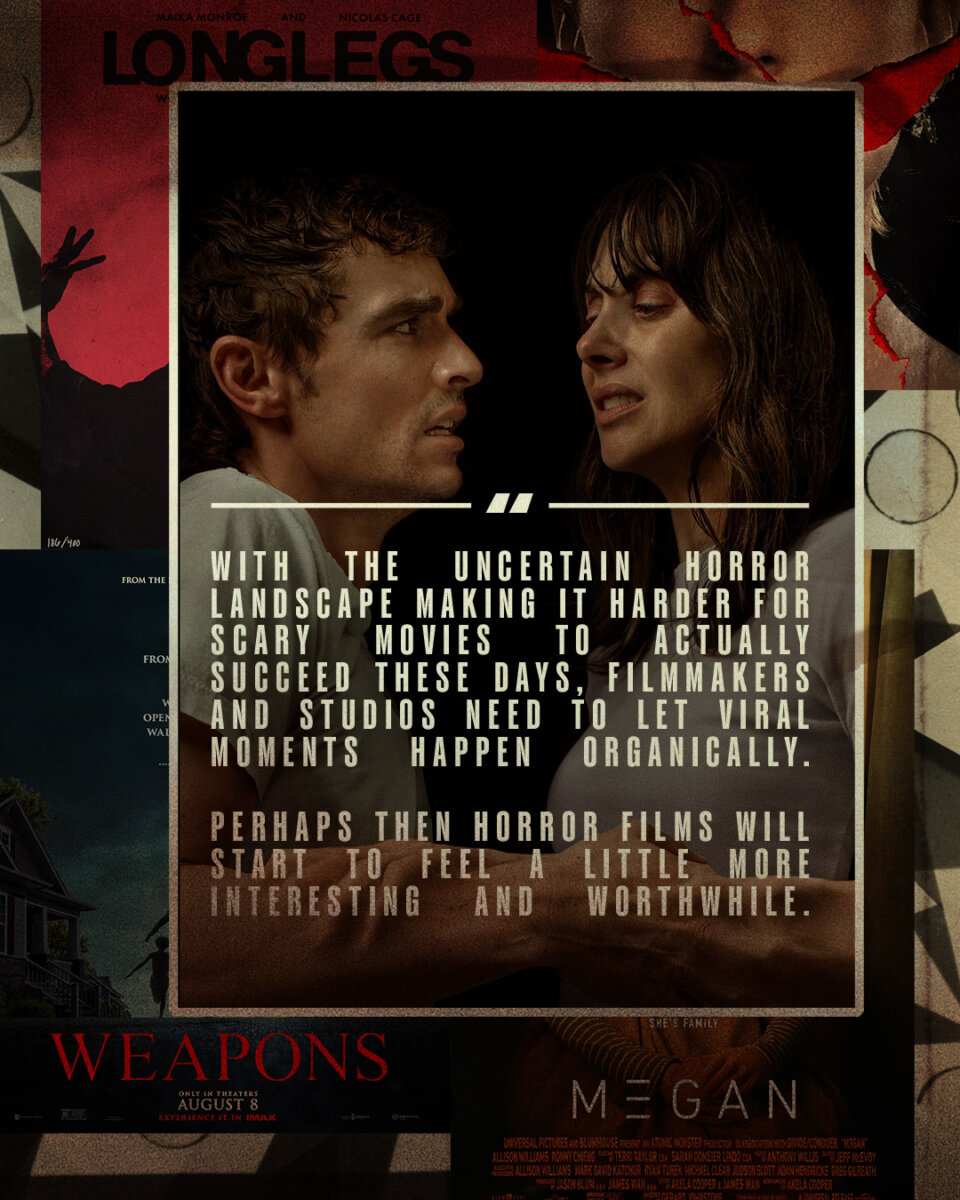
I’m not talking about the kinds of silly gimmicks that filmmakers like William Castle used back in the ‘50s and ‘60s, which directly immersed audiences in the scary world playing out on the screen in front of them. Rather, the marketing gimmicks that are being used by recent films like Longlegs, M3GAN (and its sequel), Smile, Weapons, and Together suggest that horror movies need something more to them to convince you to watch them.
It becomes cliché and tiresome, and at least for me, it just makes me not want to watch them. Social media marketing does help attract a larger audience, where, in an interview with Far Out in 2023, M3GAN screenwriter Akela Cooper acknowledged the virality of the movie on TikTok ahead of its release, stating, “There was such a huge response from young people”.
While some of these movies are genuinely good, do we really need people creepily smiling in videos destined for TikTok virality to prove that you should go and see Smile? And do we need bombarding with memes or annoying videos of real-life couple Dave Franco and Alison Brie for the promotion of their body horror romance Together?
In the social media age, it seems like a horror movie has to rely on a mysterious gimmick to be advertised correctly, but I’d argue that this is only contributing to the current fatigue settling around the genre. While certain horror movies have recently received significant buzz, like Sinners and Weapons, many other 2025 releases have flopped significantly, including M3GAN 2.0, Drop, and Opus.
Can horror survive in the current climate without a clever viral marketing moment? It seems like even those that do use them, like M3GAN 2.0 with its bizarre collaborations with The Secret Lives of Mormon Wives, aren’t guaranteed to succeed.
The Substance was the horror movie on everyone’s lips last year, but did the arthouse body horror rely on cheesy gimmicks? No. Advertising for the movie was pretty straightforward, with the fact that Demi Moore would be appearing in a gore-filled tale of beauty standards and celebrity working without the need for tiresome viral TikToks. The buzz that came with the film simply emerged through word of mouth, and it was subsequently taken seriously as an Oscar contender, earning five nominations and winning ‘Best Makeup and Hairstyling’.
Clearly, if a movie is actually good, it can stand on its own without memes constantly forcing the film in our faces before it has even been released. While no shortage of memes and online attention emerged with the film’s eventual release, this was predominantly the work of fans who had seen and loved The Substance.
With the uncertain horror landscape making it harder for scary movies to actually succeed these days, filmmakers and studios need to let viral moments happen organically. Perhaps then horror films will start to feel a little more interesting and worthwhile.
