


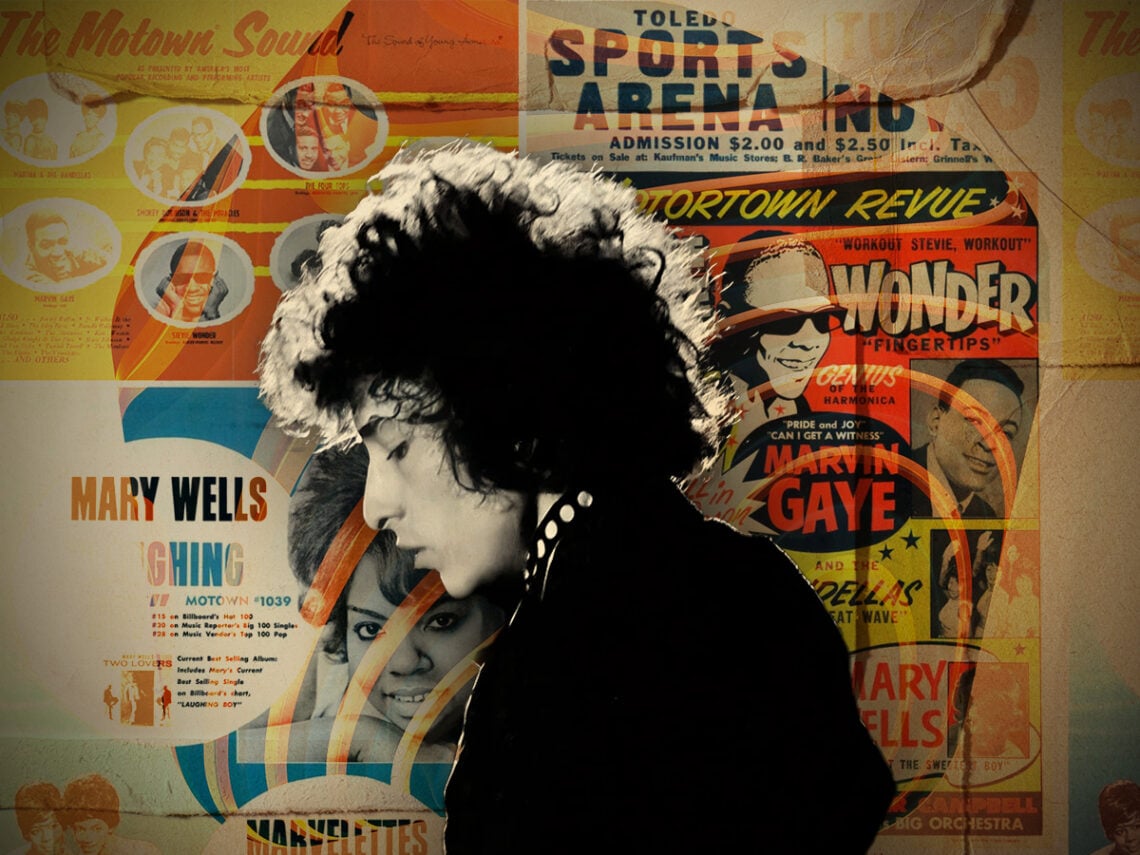
The hit Motown masterpiece inspired by Bob Dylan: “He was the poet”

The main reason 1960s Bob Dylan was something of a god was because he inspired everyone and anyone to pick up a guitar. Not all of those turned out to be successful sonic protégés, of course, but his grasp on the musical landscape was such that the whole world was eating out of the palm of his hand.
Much like Dylan himself, whose transition between folk and rock music came at a pivotal point in his tenure, his omniscience was so potent that it proved to stir even the unlikeliest of souls – and it was for this reason that the songwriter somehow managed to inspire one of the greatest masterpieces of Motown.
As much as the Four Tops and Dylan may seemingly not have had a lot in common on the surface, there was always an energy which pulsated between the two on some intrinsic level, and most patently in the Motown quartet’s seminal hit ‘Reach Out (I’ll Be There)’. This was a song which changed the course of the genre and came to be recognised as one of the most precious gems of its history, but as it turns out, it was Dylan who held the real key to its mastery.
This is not to suggest that the ‘Tambourine Man’ was suddenly going on a side quest to Motown’s studios and swooping in as some kind of songwriting saviour, because the rightful onus for that squarely lies with the prodigal trio that were brothers Eddie and Brian Holland, with Lamont Dozier. They were the ones who, nearly single-handedly, defined the sound of Motown throughout the 1960s, penning hits for the Four Tops to The Supremes as if it were child’s play.
But naturally, even though folk-rock was, on the face of it, an entire world away from the rich soulfulness they were trying to cultivate, the influence of the cultural zeitgeist was never far from view – and at that moment in 1966, there was only one man who ruled as king. With Dylan in the crux of his most prolific period, in the form of his home run with Bringing It All Back Home, Highway 61 Revisited, and Blonde on Blonde, he was undeniably the one force in the music industry that anyone sought to worship.
This was true even for the height of Motown, as Dozier explained in 2013 how the songwriting messiah had his influence on ‘Reach Out (I’ll Be There)’. “Back in ’66, we were listening a lot to Bob Dylan,” he said.
Adding: “He was the poet then, and we were inspired by his talk-singing style on ‘Like a Rolling Stone’.”
But more than just merely appreciating his wisdom, there was something greater in the orbit of his genius that the Motown masterminds wanted to capture. Dozier continued: “Dylan was something else—a guy we looked up to. We loved the complexity of his lyrics and how he spoke the lines and sang them in places. We wanted Levi [Stubbs] to shout-sing ‘Reach Out’s lyrics—as a shout-out to Dylan.”
As such, through one very simple callback to a style seemingly so different from their own, a whole new edge was granted to Motown, soaring beyond the rudimentary romance of fawning love and instead branching into desperate yearning and lust. There is a true fight at the heart of a song like ‘Reach Out’, something single-handedly communicated by the aggressiveness of Stubbs’ vocal delivery – but who’d have thought that this was all thanks to Dylan.

Never Miss A Tale
The Far Out Bob Dylan Newsletter
All the latest stories about Bob Dylan from the independent voice of culture.
Straight to your inbox.