


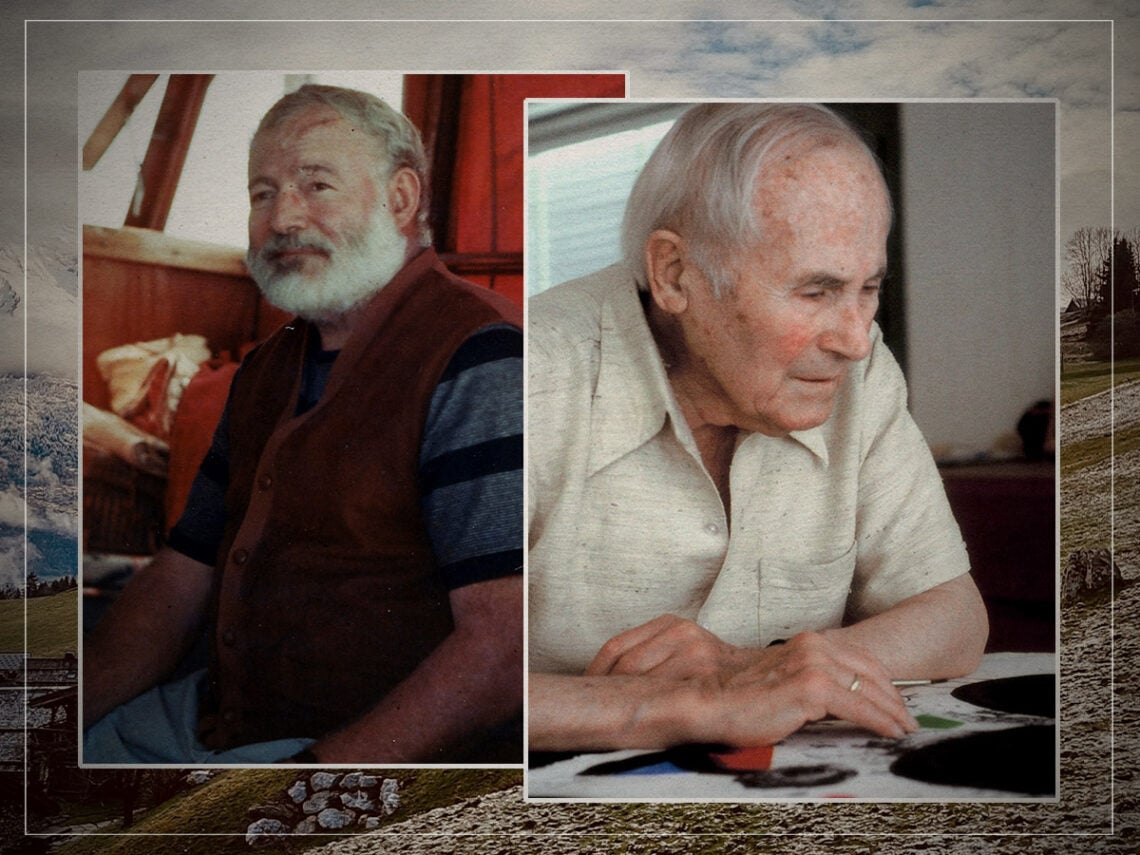
An unlikely bromance: Ernest Hemingway and Joan Miró in Paris

Long before The Old Man and the Sea cemented his legacy, Ernest Hemingway was already cultivating a quieter, more personal obsession: art collecting. In the smoky salons and sunlit studios of 1920s Paris, Hemingway wasn’t just a rising writer—he was a passionate patron of the avant-garde. His modest apartments became galleries in their own right, showcasing works by Georges Braque, Juan Gris, André Masson, and Paul Klee. But of all the art he collected, one painting stood out: The Farm by Joan Miró.
The story of The Farm is one of chance, friendship, and deep mutual recognition between two men who couldn’t have looked more different—physically or artistically—but understood the struggle of becoming a successful artist. Hemingway, a robust, tall man, had the presence of a prizefighter, while Miró, slight and quiet, was a painter of dreamlike, symbol-laden worlds. Yet they bonded over boxing at the Cercle Américain on Boulevard Raspail, introduced by none other than the American novelist Gertrude Stein. Over shared meals and sparring matches, the two forged a bond of artistic brotherhood.
Miró, then unknown outside a small Parisian circle, had laboured for nine months to complete The Farm, a saturated, stylised portrait of his family’s land in Montroig, Catalonia. Despite its brilliance, the painting languished in cafés and dealers’ offices, unsold and uncelebrated.
“My stories would all come back with rejection slips, and Miró’s unsold canvases were piled up all over his studio,” Hemingway later wrote, highlighting their parallel struggles.
The Farm is rich in colour and contradiction. A flat, cloudless blue sky bears down on wilting crops and brown soil, exuding the arid heat of a Spanish summer. In this simple farmyard tableau, a horse’s behind inexplicably pokes out of the door of a house; a bright green lizard, so brilliant it seems of an exotic breed, darts through the dust; a newspaper lies incongruously in the field. It was more realistic than Miró’s later works, but still conveyed a hint of the surrealist energy that would later define him.
“It has in it all that you feel about Spain when you are there and all that you feel when you are away and cannot go there,” Hemingway wrote of the artwork.
In 1925, came a turning point. Hemingway’s friend, novelist and poet, Evan Shipman, arranged for a dealer to price The Farm. Though the latter intended to buy the painting himself, he changed his mind after seeing how deeply Hemingway loved it. They rolled dice to settle the matter and to his happiness, Hemingway won. For 5,000 francs (about $250), he bought the painting and gifted it to his first wife, Hadley, for her birthday. They brought it home like they had found treasure, shielding it in an open taxi as though it were a ship’s sail, letting the driver creep along the cobblestones to avoid damaging it. It was hung above the couple’s bed for years to come.
At this time, Hemingway was writing A Farewell to Arms, one of his most recognised literary works. Its opening lines, “of dust, leaves, and sun-bleached stones”, recall a similar visual language to Miró’s painting, and many scholars have traced an artistic resonance between the two.
Years later, in 1929, Hemingway visited Miró’s farm, and the imagery stayed with him. In a haunting poetic reflection, he described the landscape and a visceral moment: “In front of the barn a woman held a duck whose throat she had cut and stroked him gently while a little girl held up a cup to catch the blood for making gravy… the duck seemed very contented, and when they put him down… he waddled twice and found that he was dead.” Even in death, there was a strange sense of tranquility, just like in Miró’s painting, where chaos and calm co-exist.
After Hemingway’s death, his fourth wife, Mary, inherited The Farm and later gifted it to the National Gallery of Art in Washington, DC. Today, it is recognised as the cornerstone of Miró’s artistic legacy. A work that, once ignored, now stands as one of the most influential (and expensive) paintings of the 20th century. Its complexity became symbolic of how these two artists’ lives came to be intertwined: the painter and the writer, the Spaniard and the American, both struggling to be seen. It says as much about as shared kinship as it does about art.
