


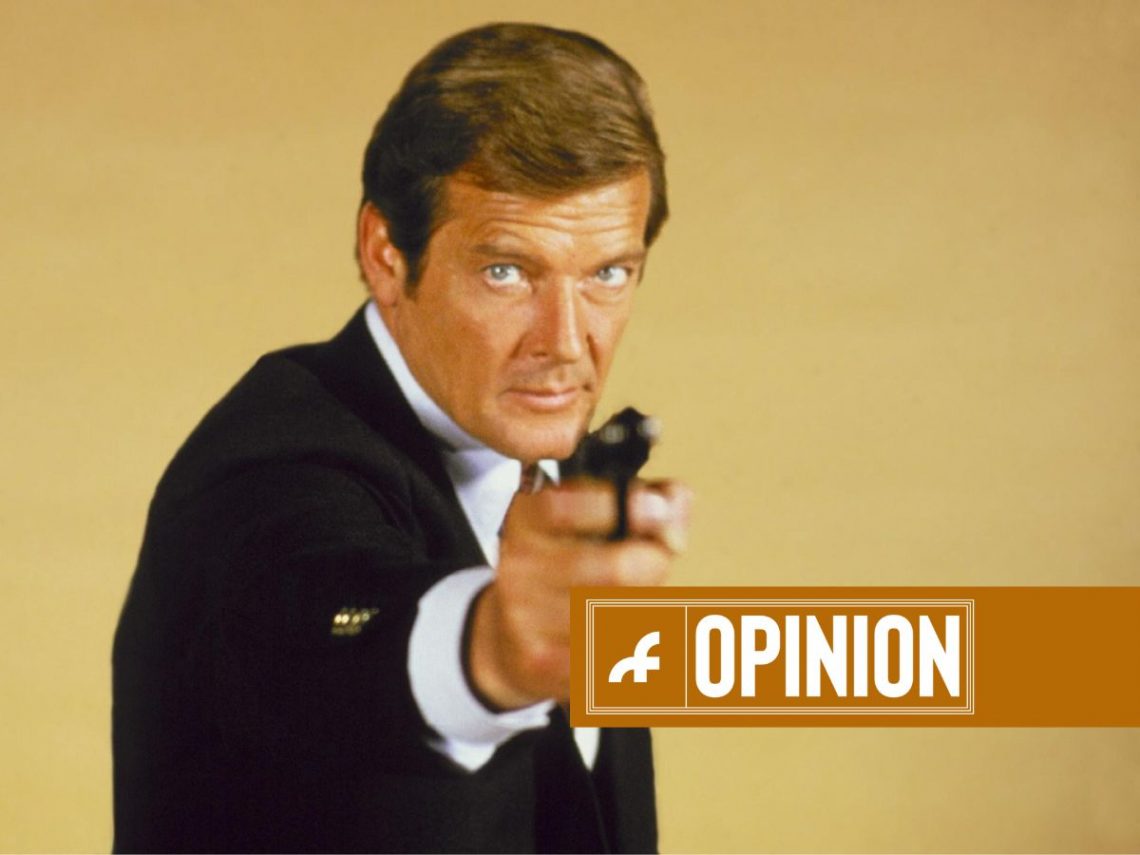
Hear Me Out: There is room for Roger Moore’s James Bond in our modern world

In the extensive discourse surrounding the James Bond film franchise, nothing is more polarising than discussing which iteration is the ultimate one. Older audience members usually back Sean Connery’s original version, the embodiment of the old world when Britain still had an empire and knowing your whiskey and cigars was a real sign of class. On the other hand, modern viewers tend to throw themselves behind Daniel Craig’s version – a gritty, more worldly reading of Ian Fleming’s character that oozes panache.
Some, however, differentiate from these extremes. These are your James Bond hipsters tending to go for the suave Timothy Dalton era or the much-maligned and overtly campy Roger Moore tenure.
Despite Moore having seven outings as 007 (equalling Connery’s tally) and his films being wildly successful, the Roger Moore version of Bond often gets unfairly dismissed in light of the modern propensity to take ourselves and culture very seriously.
First of all, we have to be clear. The Moore era was brimming with incredibly strange moments, including many extremely dated and offensive racial stereotypes. Take Octopussy, a film that sees Moore handing an Indian man some money before quipping: “That’ll keep you in curry for a few months!”
If that wasn’t enough to make the hairs on the back of your neck stand up, in Moonraker, after throwing a Japanese enemy through a window into a piano, Moore purs: “Play it again, San.” This was not the end of this grotesque facet either. Racial stereotypes aside, in The Man with the Golden Gun, when Bond fights the dwarf henchman Nick Nack, he locks him in a suitcase.
However, Moore’s Bond is not even the most questionable. It is Connery’s where the old-world-styled British sense of superiority and a heavy dose of misogyny course through it, as it was a close adaptation of Ian Fleming’s original novels, which are guilty of the same. There’s racism, hints of colonialism, violence towards women and even “turning” the lesbian Pussy Galore because the alpha male Bond is simply too tempting. These combine to make this iteration of the famous agent practically unwatchable.
We only need to mention that scene in You Only Live Twice for the point to become readily apparent – if it wasn’t already. Connery’s notorious off-screen persona compounds this distasteful vibe, which adds an uncomfortable authenticity to his Bond. It only makes me glad that this is a world that does not exist anymore.
When Connery’s Bond was followed up with Roger Moore’s comparatively less brutish performance, people quickly knew it was going to be a different era for the super spy. As with every version of Bond, there are many criticisms that it can be subjected to, but I would argue that there is room for Moore’s chapter in the modern era. If we can get past the obvious, it provides a respite from all the grit and overblown Hollywood FX of what was to come.
As epitomised by the differences in his first outing, 1973’s Live and Let Die, which came complete with an iconic Paul McCartney and Wings theme tune, and his last, 1985’s A View to a Kill, Moore’s Bond has much more to it than some would have us believe. Live and Let Die and other moments such as Moonraker, which are almost entirely absurd, suggest that the campy, self-aware aspects make them behave as parodies. This came courtesy of the 1970s getting real as the Swinging Sixties had ended up in oblivion due to the collective lack of self-awareness and the dire socio-economic environment that the decade presented us with.
Then we come to the real dramatic understanding that Moore showed at points, which unfortuantely gets overshadowed by the more incomprehensible parts of his films. He expresses genuine regret and pain at the Countess’s death in For Your Eyes Only, a departure from the earlier moments in his tenure. However, it was in A View to a Kill that he showed us all that he could really do.
The movie contains a hefty dose of that 1980s cheese and has many pitfalls, but one is not Moore’s Bond. This is the most steadfast and severe Moore’s Bond ever got. Whether it be his visceral interactions with Grace Jones’ May Day to his decision to never smile around the villain Max Zorin, this was a fitting way for Moore to bow out.
In truth, all James Bond movies will never be perfect as the subject material comes from a time increasingly alien from our own. However, when revising them, it is only fair to see them for what they are. In the case of the Roger Moore era, for the most part, it’s time to readdress them as the campy, lighthearted romps they are. Perhaps, it’s also time to give Moore’s acting more credit than it gets.
