


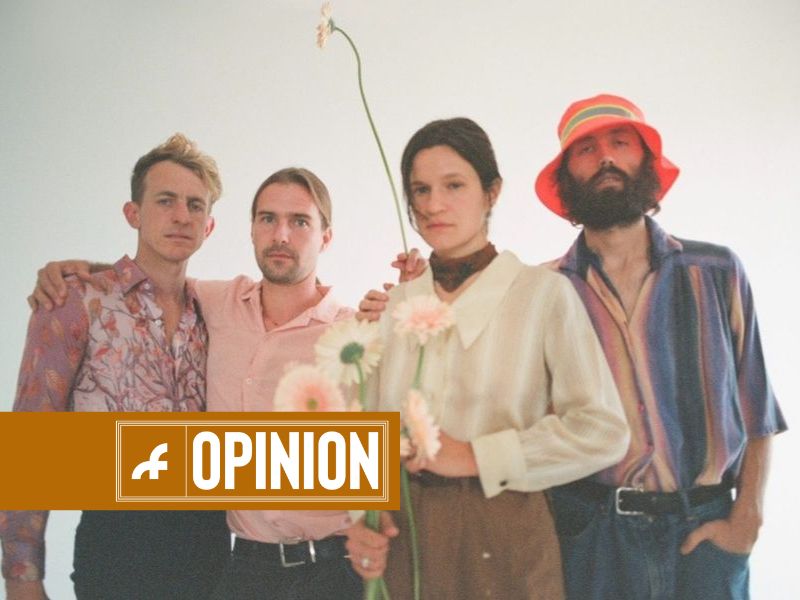
The healing vulnerability of Adrienne Lenker and Big Thief

When I first managed to have a proper listen to Big Thief back in the summer of 2020, something struck me with deep profundity. Not only did the sonic textures and compositions of the band astound one with their simultaneous juxtaposition of complexity and simplicity, but they also managed to sensitively explore the more intimate and vulnerable moments of human life.
I was rather late to the party when it came to Big Thief, and when I had been driving back from a camping trip in a van with two friends that summer, one said to the other, “Stick Big Thief on, man.” The selection from the band’s catalogue that day was their third studio album U.F.O.F., and as the album’s open ‘Contact’ began to build and ring out patiently, all I could think was, “Wow.”
Big Thief’s origins go back to 2013 when Adrienne Lenker and Buck Meek began performing as a duo, having met at a concert in Boston. After touring for around two years, they enlisted Max Oleartchik on bass and James Krivchenia on drums, who had also been students at Berklee College of Music in Boston.
The band’s debut album, Masterpiece, arrived in 2016 and was a well-crafted indie-rock record that was highly lauded upon its release. Big Thief followed this up in 2017 with their sophomore effort, Capacity. Three albums have since followed, the ‘twin’ records U.F.O.F. and Two Hands, and this year’s Dragon New Warm Mountain, I Believe In You.
Most of Big Thief’s tracks are written by singer Adrienne Lenker, which are then offered up to the band in rehearsal, and they compose them together. The compositions are masterfully created and defined by Krivchenia’s loose drumming style, Lenker’s complex open tuning fingerpicked patterns and Meek’s layers of guitar sound.
But enough of the mere biography of the band. The critical point when it comes to Big Thief is that they seem to encompass a band whereby their audience and fans can feel part of a showcasing of vulnerability. Much of this is owed to Lenker’s confessional style of writing, which is arguably most evident on her 2020 solo album Songs.
Songs is undoubtedly a breakup album and was primarily written in solitude in a cabin in upstate New York. The songs are just about the most intimate captures of what it is like to experience the end of an intense relationship ever made. When I saw Lenker perform the album solo in Hackney earlier this year, there wasn’t a dry eye in the audience.
‘Change’ from Big Thief’s most recent album is arguably one of the most beautiful songs written in recent times, and several people I had spoken to – particularly those who had recently experienced the end of a relationship – reported that it had made them break down (in a positive and healing way).
Elsewhere what I took from ‘The Toy’ from Two Hands was an examination of the first experience of existential dread, particularly with the lines “In the sphere, that’s where we all die / In the eye, that’s where I’m living / The toy in my hand is real.” This experience is one of particular importance, and thankfully Lenker is on hand to give it the artistic expression it deserves.
The truth is that Big Thief foster an environment where audiences can feel comfortable expressing their feelings. Lenker has captured the hearts of thousands of people worldwide by creating a sense that when you see her or her band live, you are coming together in union under the knowledge that we are all susceptible to the slings, the arrows, and the vicissitudes of human life.
“I sometimes equate intimacy with turbulence, which is familiar,” Lenker said back in 2020. And that’s it; intimacy and vulnerability are turbulent, they can be traumatic, but by accepting them, making them open to not just those close to you but to strangers too, Lenker facilitates a time and space whereby people can come to share in the music, share in the experience and, in turn, heal.
