


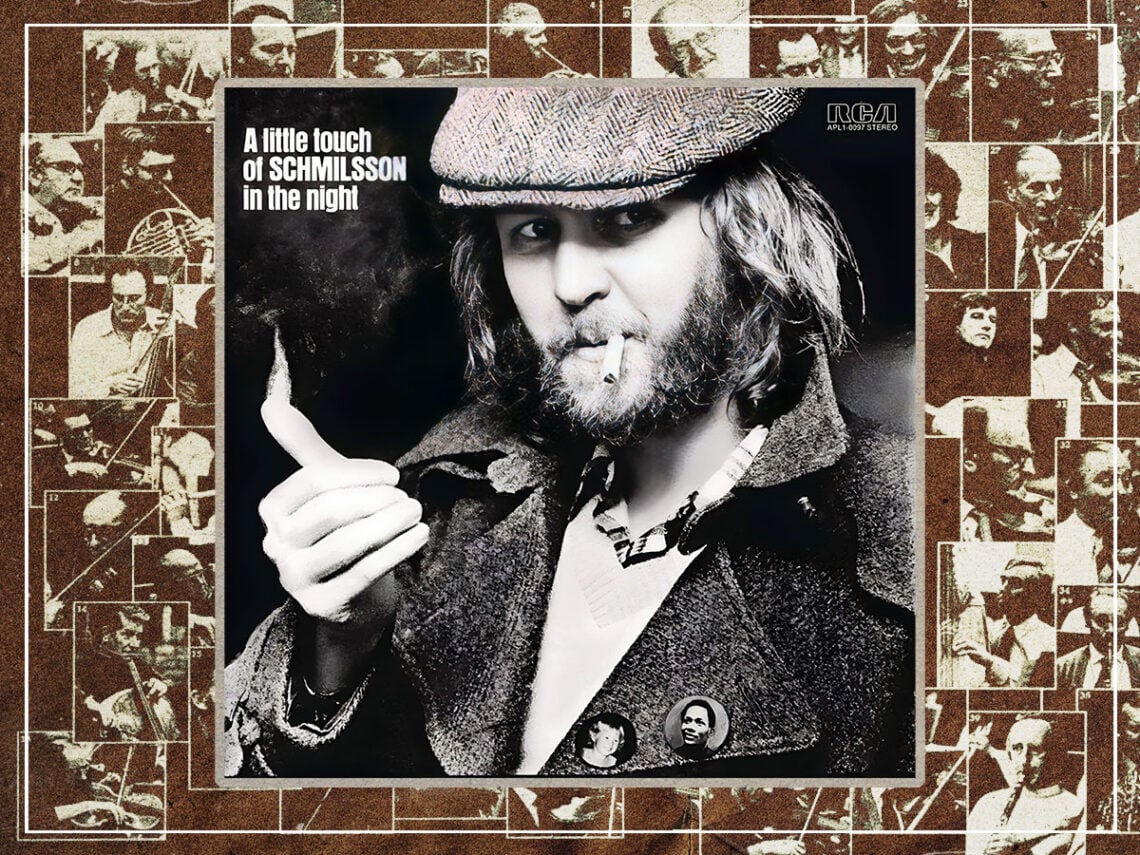
Harry Nilsson – ‘A Little Touch of Schmilsson in the Night’

It was hard to see it any other way: Harry Nilsson was on a suicide mission in the mid-1970s. The American musical genius had already done it all – he invented the mashup song, befriended The Beatles in the process, recorded the theme tune for Midnight Cowboy, and scored a transatlantic number one hit with a cover of Badfinger’s ‘Without You’. His voice was in pristine condition, his reputation was sterling, and he had the helping hands of John Lennon to see him through.
That would turn out to be more of a blessing than a curse. Through a haze of drugs and alcohol, Nilsson and Lennon created 1974’s Pussy Cats, an album that remains the sonic equivalent of throwing away a natural gift just to see what would happen. Nilsson shouted himself ragged throughout the recording sessions, permanently damaging his voice in the process. After Lennon’s murder in 1980, Nilsson largely stopped recording music altogether, bringing a premature end to a career once filled with endless promise.
But that’s not what we’re talking about here. Everybody’s talking, and we’re talking about Nilsson’s unexpected turn right before he trashed his golden voice beyond repair. 1973’s A Little Touch of Schmilsson in the Night is a completely unique entity: a sophisticated collection of traditional pop and jazz standards from the early 20th century, played with a full orchestra and arranged by Frank Sinatra’s right-hand man, Gordon Jenkins. For the man who wrote and sang ‘Coconut’, there was no winking, no nudging, and no irony involved.
The traditional pop genre that Nilsson was paying tribute to had been out of fashion for decades. Sinatra and his Rat Pack survivors were playing Las Vegas. Artists like Linda Ronstadt and Bob Dylan wouldn’t resurrect the jazz era for at least another decade. Nilsson was one of the most mysterious and hardened rock and roll spirits in the world. What the hell was he doing recording ‘As Time Goes By’ and ‘Makin’ Whoppee’?
The truth was that Nilsson was a crooner at heart. Having grown up on a mix of traditional jazz and the American Songbook, Nilsson had gotten into rock and pop by circumstance. Deconstructing his songs reveals a keen ear for harmony and classic chord progressions that owe more to Irving Berlin than Little Richard. His early career as a staff songwriter in New York bridged the gap between traditional pop and modern pop, but Nilsson never forgot the charms of employing full orchestras to back up a jazz singer.
As if there was any doubt, A Little Touch of Schmilsson in the Night mainly serves to highlight Nilsson’s remarkably adaptable voice. Throughout much of the album, Nilsson spends the majority of the time sounding completely relaxed and at ease, rarely (if ever) getting above forte dynamics. Whether he’s crooning ‘It Had to Be You’ or ‘Lullaby in Ragtime’, Nilsson keeps his cool and lets his voice slip into the perfect tonality for the chosen material.
Nilsson’s song choices are fascinating. For every well-known track like ‘It Had to Be You’ and ‘As Time Goes By’, there is another that has been lost to time. Jenkins gets his own nod with his composition ‘This Is All I Ask’ appearing toward the end of the LP. Long-forgotten music figures like Gus Kahn and Sylvia Fine Kaye get their due as Nilsson avoids some of the more obvious choices throughout the album.
Nilsson’s picks of ‘What’ll I Do’ and ‘Nevertheless I’m In Love With You’ turned out to be prescient choices, with everyone from Cher to Rod Stewart doing their own renditions after Nilsson’s. Hell, Bob Dylan eventually covered them both, putting them on separate studio albums (Dylan’s rendition of ‘What’ll I Do’ appears on 2015’s Shadows in the Night, while ‘Nevertheless’ showed up on 2016’s Fallen Angels).
For modern audiences, the languid tempos and relative sameness of the material on A Little Touch of Schmilsson in the Night can make the album a bit of a bore. In truth, the album isn’t terribly engaging on its own merits. As a background piece for cocktail hour, it’s superb. But Nilsson’s dedication to replicating the old-school sounds of jazz-pop keeps A Little Touch of Schmilsson in the Night from being anything more than novelty.
But what a magnificent novelty it is. With the grace and understated suaveness that would have impressed Sinatra himself, Nilsson reveals yet another side of his musical mind that was highly advanced and uber-talented. A Little Touch of Schmilsson in the Night works as a completely serious traditional jazz-pop vocal album.
Nilsson would turn away from the delicate whimsy of A Little Touch of Schmilsson in the Night more or less immediately, entering a voice-shredding spiral that would help facilitate the end of his career roughly a half-decade later. But if you need to prove just how great of a singer Harry Nilsson was, A Little Touch of Schmilsson in the Night remains his most fascinating moment of showing off.
