


The guitarist Rick Rubin proclaimed the “Jimmy Page of our time”

Every rockstar guitarist of the past 50 years has probably fantasized about being Jimmy Page at least once.
Even though his time in The Yardbirds was the same as any other guitarist on the rock scene, his transformation into a guitar god with Led Zeppelin is the kind of thing you only hear about in rock legends, being the reclusive guitarist always found with a bottle in his hand and lighting his fretboard on fire whenever he got onstage. Rick Rubin may have had Zeppelin down as one of his main reference bands, but who needs a Page clone when you have an answer to him in Tom Morello?
That comparison isn’t just about technical ability, but about mindset. Like Page before him, Morello approached the guitar less as a traditional instrument and more as a tool for experimentation, constantly searching for new textures and sounds that could redefine what rock music could be.
In that sense, the lineage between the two feels more spiritual than stylistic. While their playing couldn’t be more different on the surface, both guitarists share the same instinct to push beyond convention, treating innovation as the true benchmark of greatness rather than simple virtuosity.
When Rubin first got started in the world of hip-hop, though, Morello was already taking notes from his production style. Since half of the best hip-hop albums of the 1980s were made with the help of Rubin, like Public Enemy’s It Takes A Nation of Millions and Run-DMC’s Raising Hell, Morello asked one question that seemed impossible: how do I get those sounds on a guitar?
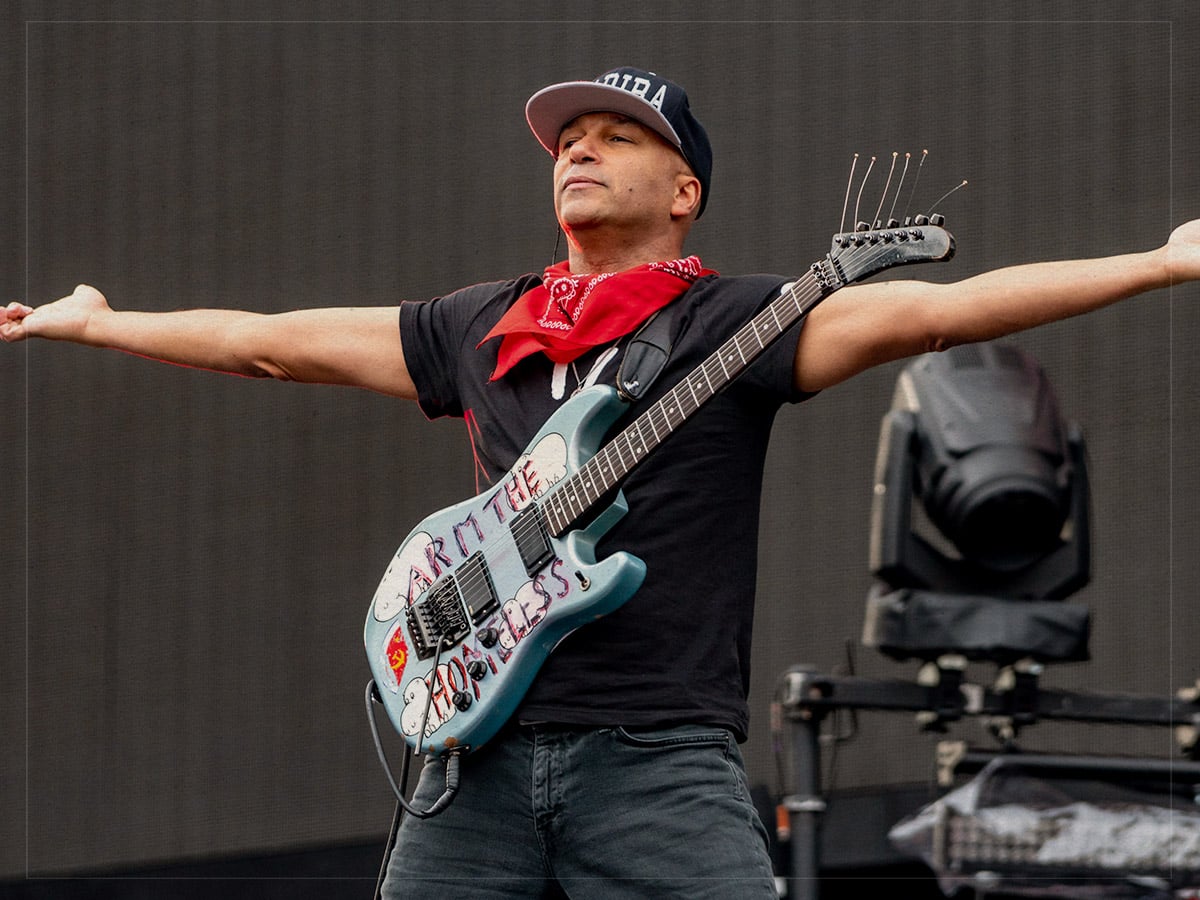
Throughout his work in Rage Against the Machine, Morello sculpted himself as the DJ of his band, making sounds that made you want to check the liner notes to make sure that it was all being played on a guitar. When Rubin heard him, he thought he had found the most exciting player since the 1970s.
When assembling the supergroup Audioslave, the producer said that Morello could take the band to a level that hadn’t been seen since the 1970s, saying in Rick Rubin In the Studio, “[This] could turn into a Yardbirds-into-Led Zeppelin scenario. In many ways, Tom Morello is the Jimmy Page of our time”.

That’s not to say that working on Audioslave would be easy. While Morello could be the mad scientist behind the fretboard, the main draw was getting Chris Cornell in his first proper band since Soundgarden, further adding to the idea that the band would make colossal hard rock just like Zeppelin did.
If Cornell was known as the Robert Plant of the group, there are many ways in which Morello surpasses Page in creativity alone. Compared to the thousands of altered tunings that Page used throughout his career, Morello’s approach to the instrument feels like doing more with less every time he approaches a song.
When you listen to a Rage Against the Machine song or Audioslave track, there’s no telling what trick Morello’s going to pull out, either bringing out the Whammy pedals on certain songs or making the entire band explode when tackling pummeling riffs on songs like ‘Cochise’ or ‘Like A Stone’.
It’s not like Morello doesn’t have the technical chops to pull off something like this, either. Before he had even gotten involved with Audioslave, songs like ‘Take the Power Back’ were proof enough that he could shred with the best of them, playing the kind of sweeping solos that most people would have to go to Steve Vai to hear.
Either way, both Page and Morello have each benefited from thinking about the guitar in a far different way. Compared to others who see it as an instrument, both guitarists know that this is just a few pieces of wood with strings on it, and whatever you want to do with it is really up to you.

Never Miss A Beat
The Far Out Led Zeppelin Newsletter
All the latest stories about Led Zeppelin from the independent voice of culture.
Straight to your inbox.