


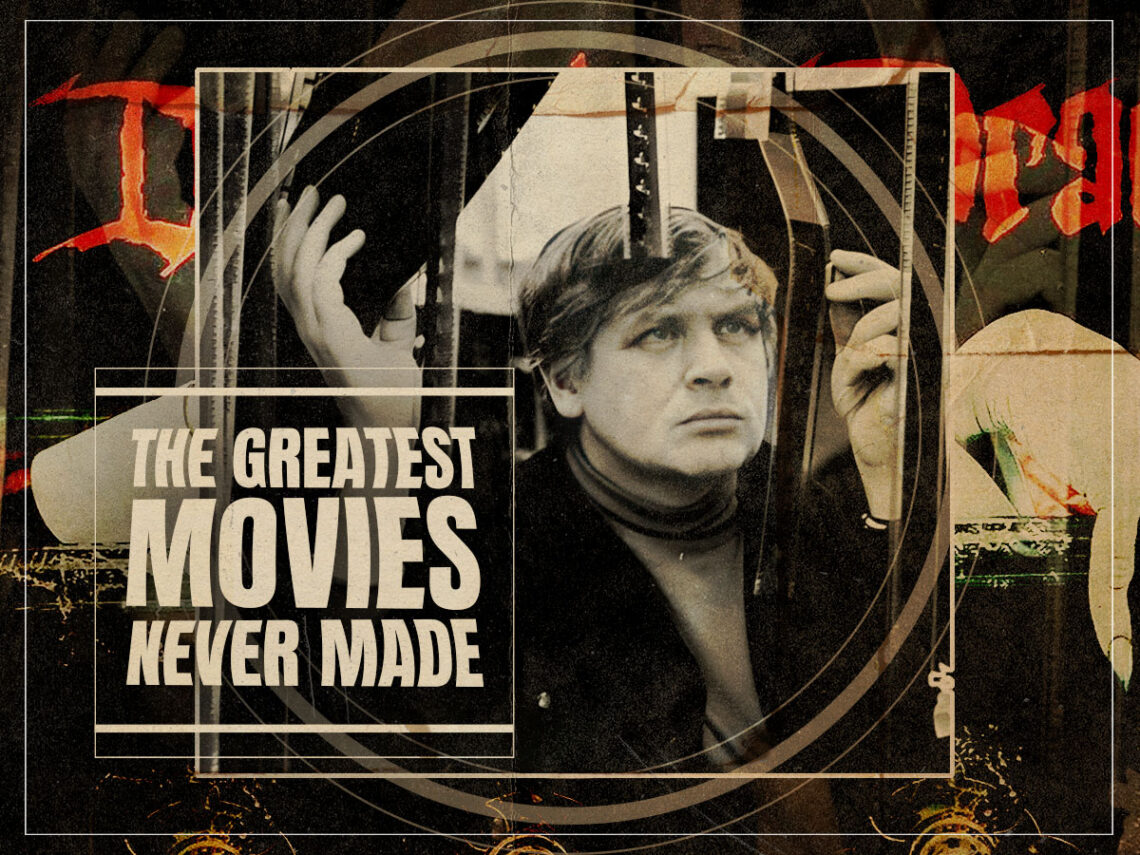
The greatest movies never made: Ken Russell’s ‘Dracula’

As one of the two most heavily-adapted fictional characters in history alongside Sherlock Holmes, audiences have been treated to plenty of Dracula adaptations over the years. There’s always another one coming just around the corner, but Ken Russell deserved the chance he never got to make his.
Everyone knows the story regardless of whether they’ve read Bram Stoker’s novel or not, with the Transylvanian tyrant burned deeper into the collective pop culture consciousness than any other vampire. By extension, fresh takes on the tale are increasingly difficult to come by, but Russell had a novel idea of his own that would have differentiated his Dracula from the rest.
Already a versatile filmmaker who’d crafted romantic drama The Music Lovers, musical comedy The Boy Friend, and biopic Savage Messiah, Russell turned his attention to Dracula in the period after the release of the Golden Globe-nominated visual odyssey of The Who’s star-studded rock opera, Tommy.
He persevered through several drafts, occupying himself in the interim by scripting and directing the surreal Lisztomania and the sexually charged Valentino, but by the time he began work on the sci-fi horror Altered States, the opportunity had passed him by. It’s a shame because there was evidently no genre Russell couldn’t turn his hand to and master.
For the most obvious reason why his Dracula would have been a thing of beauty, look no further than The Devils. Hugely controversial at the time of its release, the psychosexual period piece was deeply entrenched in the themes of lust, love, spirituality, oppression, corruption, and repression prevalent in the iconic gothic fable, balancing visual daring with narrative provocation.
This being Russell, there was inevitably going to be a heavy element of eroticism, with the one sweeping change he was planning to make from the source material underlining how his approach to such a well-known story sought to counteract the familiar with something fresh.
Relocating the action from the 1890s to the 1920s, this Dracula would have refitted Mina Murray’s best friend Lucy Westenra as a diva-like opera singer suffering from terminal leukaemia. That development alone would have altered their dynamic into a mutually beneficial one, making her more of an interesting and complex character than usually depicted.
The title character would have masqueraded as an artist to get closer to Mina, with Russell viewing him as more of an antihero than the out-and-out horror villain prone to chewing on the scenery he’d become. “If you had lived for centuries, would you go weak at the knees at a picture of a dull clerk’s fiancée and lock yourself away in a gloomy castle? I wouldn’t,” he suggested. “I’ve come up with a reason why Dracula would want to live forever.”
The filmmaker was even hoping to reunite with his regular collaborator Oliver Reed, and he’d have made for a suitably salacious Vlad the Impaler. Instead, Universal opted to give the go-ahead to John Badham’s Dracula with Frank Langella in the lead, leaving Russell in the dust. He did get around to vampires and Dracula eventually in a way with 1988’s The Lair of the White Worm, but his legacy lived as speculation and whispers have claimed.
Russell’s biographer Paul Sutton alleged that Francis Ford Coppola plagiarised many aspects of the abandoned Dracula for his own 1992 version, which ironically became one of the more memorable adaptations in recent history. It was opulent, extravagant, and animalistically erotic, but there are plenty of reasons to believe it would have paled in comparison to what Russell was cooking up.
