


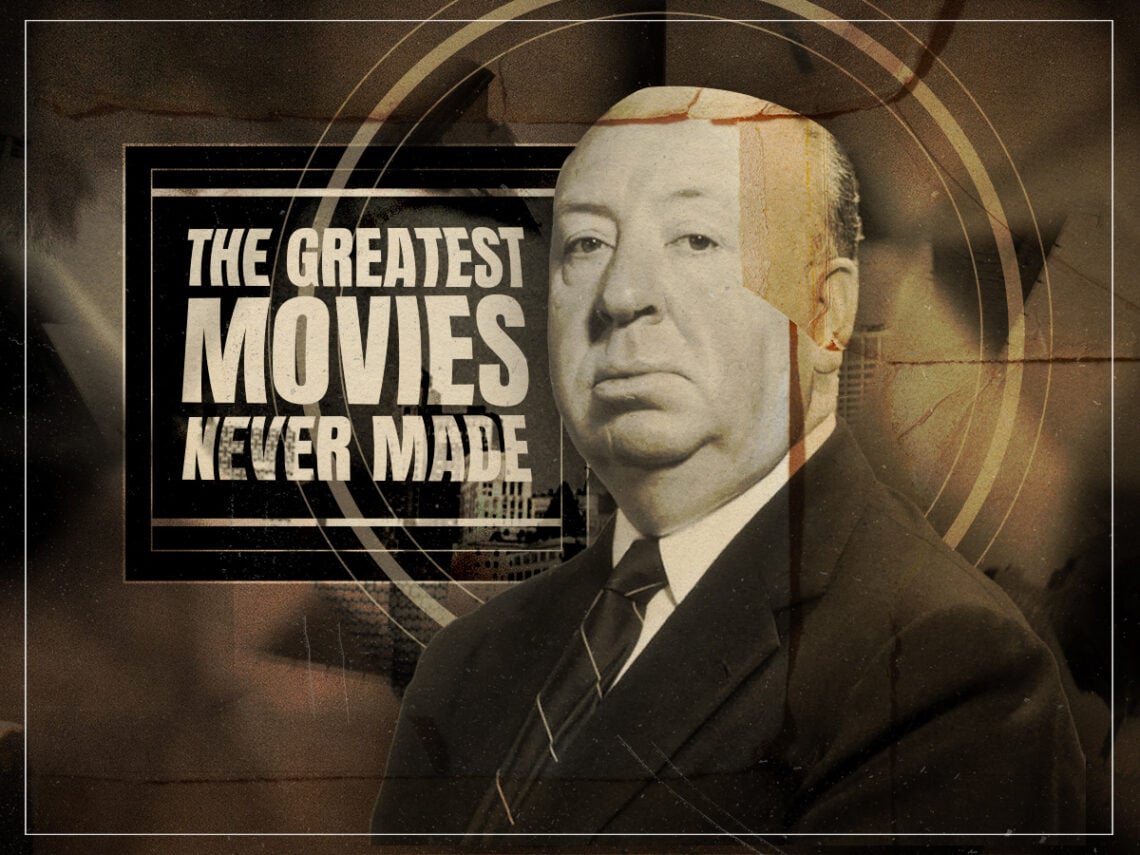
The greatest movies never made: Alfred Hitchcock’s ‘Kaleidoscope’

Common wisdom would dictate that because he was one of cinema’s most famous and acclaimed directors, Alfred Hitchcock faced no issues making whatever kind of movie he wanted. Even for the ‘Master of Suspense’, though, Kaleidoscope was a bridge too far.
Seeking to recharge his batteries after the back-to-back disappointments of Marnie and Torn Curtain, Hitchcock wanted to recharge and refresh his creative batteries with a completely original story the likes of which the industry had never seen. To do so, he planned to break through uncharted boundaries, which was one of the major reasons why the project ended up falling apart.
Even though he was no stranger to defying convention and adopting groundbreaking techniques, Kaleidoscope was destined to shock. He invested so much time and effort into a film that never ended up happening that it led to the longest sabbatical of his career. The three-year gap between 1966’s Torn Curtain and 1969’s Topaz found him preoccupied with the picture that wasn’t to be.
Registering a story outline with the Writers Guild of America in 1964, Kaleidoscope would have been a serial killer thriller with a taboo-shattering twist. Inspired by real-life murderers Neville Heath and John Haigh. The protagonist and antagonist would have been young, handsome bodybuilder Willie Cooper, and making a serial killer the main character was a guaranteed controversy magnet from the start. The plan was to stage three major – and explicitly gruesome – set pieces, all tied together by the central figure’s fear of water.
Hitchcock envisioned a trio of crescendos tied together by a single overarching theme: a United Nations employee would be killed by a waterfall, a second murder would take place inside a rusting and dilapidated warship, and the last would unfold at an oil refinery. The kicker was that the third and final ‘kill’ would be a setup, with the victim actually a police detective who risks her life to capture the killer.

Making a serial killer a semi-sympathetic central figure wasn’t the only part of Kaleidoscope set for controversy, either. Hitchcock would have heavily implied Cooper was gay, with his mother catching him in the act of masturbating to bodybuilding magazines. There was going to be plenty of nudity, too, something that was always going to push buttons.
Kaleidoscope should have marked an experimental new era for Hitchcock, who intended to shoot the film with a cast comprised largely of unknowns, utilising handheld cameras, naturalistic lighting, and on-location shoots, but the largest obstacle to overcome was finding a willing backer.
Even though he promised he could make it for under a million dollars and held a meeting with Universal where he painstakingly detailed his creative plans through photographs, test footage, and an exhaustive screenplay annotated with mountains of notes, his request was flat-out rejected by the studio.
If anything, Kaleidoscope was too ahead of its time. By the late 1970s, the slasher boom was in full swing, with a new generation of filmmakers maximising minimal resources to tell blood-soaked tales of death and dismemberment. As the elder statesman, it’s reasonable to assume Hitchcock would have blown all of them out of the water.
In hindsight, a major studio declining the chance for an experimental psychological thriller being made on a miniscule budget by one of the all-time greats is about as boneheaded as decisions can get, but it was a different time then. Sex, nudity, sympathetic murderers, homosexuality, and geysers of blood all existed outside of mainstream cinematic sensibilities individually, and not even a talent like Hitchcock could convince the money men to combine them as one.
