


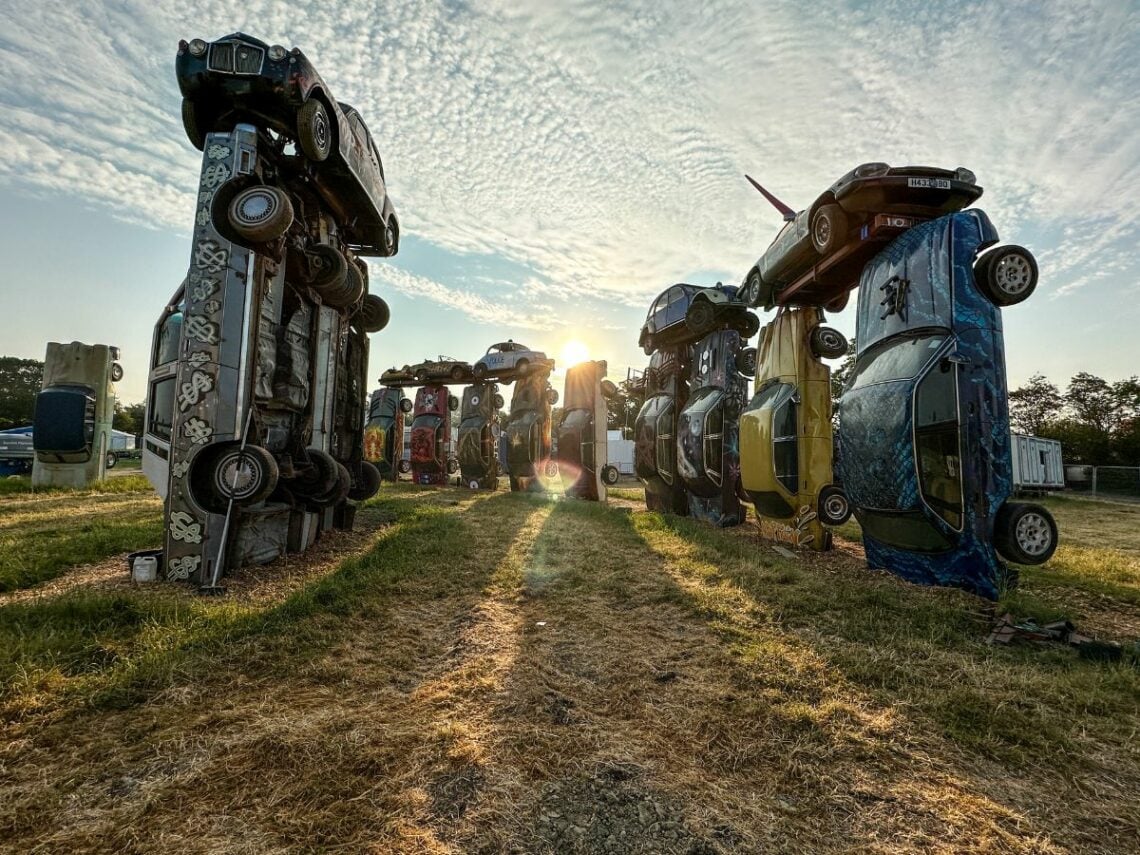
Glastonbury 2023: Artist Joe Rush discusses ‘Carhenge’ exhibition

In 1985, Joe Rush’s illuminating story with Glastonbury Festival began. While Rush might not be a household name or receive the recognition he deserves, the artist is a crucial figure who has helped make Worthy Farm unlike any other music event on the planet.
This year, Rush has created Carhenge, which recreates Stonehenge with 24 vintage cars stacked on top of each other. This project has been 38 years in the making for Rush, who has only now been able to make this installation become a reality and see his vision come to life. The area pays homage to many of his heroes, such as transgender icon Quentin Crisp and Vivienne Westwood, who embodied the spirit of the festival.
Rush planned to be at Stonehenge Free Festival, but the Battle of the Beanfield broke out, which ended up being the catalyst for the Carhenge installation and his decades-long relationship with Glastonbury, which got off on the wrong foot but led to the striking art that stands in William’s Green.
“We were coming out of London on burned out bus we’d turned into a giant skull with a ribcage down the back moves,” Rush explains to Far Out. Their plans were then changed “drastically” due to the actions of the police and Margaret Thatcher’s government. However, Rush and his friends decided to make their way to Glastonbury instead for a wild three-day non-stop party which cultivated in the creation of the first Carhenge.
During Rush’s first venture to Glastonbury, he had a “big argument” with Michael Eavis, which is understandable considering the chaos that ensued. However, he was still invited to return the following spring to begin working on artistic projects for the festival. After 1987, their relationship became fractured, and Rush stopped working with the festival before finally returning in 2001 with a memorial to Joe Strummer, who died earlier that year.
On his Glastonbury highlights, Rush casts his mind back to his contribution to The Rolling Stones’ legendary performance in 2013 and proudly recalls: “I built a giant phoenix on top of the pyramid stage with an 80-metre wingspan which spat fire and popped up when The Rolling Stones played ‘Sympathy for the Devil’.”
He continues: “That was the best because that song, I’ve known it all my life, and I love The Stones, it’s just fantastic. I’ve always wanted a rock star, but I can’t sing to save my life, so it’s the closest I’ve ever got to being a rockstar.”
More recently, Rush created a giant pier which he refers to as “Glastonbury-On-Sea”, and a drive-in-cinema. Although neither installation no longer exists, the latter, fortunately, provided him with the infrastructure to recreate Carhenge and take a trip back to 1985.
“This was probably serious six months,” Rush says of the work which went into making Carhenge go from a starry-eyed idea to something tangible. “We started in January; a lot of planning goes into it, a lot of budgeting, and then we have to take everything out of the car.”
There were “constantly around six or seven” people who were working on Carhenge over the last six months, and in total, it took over 120 people to bring the installation to Worthy Farm. People like Rush are the heartbeat of Glastonbury, and while the headline acts receive the majority of the attention, there’s much more to the festival than the music.
While he admits his months of hard work going under the radar by many in attendance at Glastonbury, Rush believes it impacts festival-goers on a cerebral level. He concludes: “They might not realise it intellectually, but I believe that all that energy we put into it, you can’t destroy that. So all the energy we put into making the show is received by people when they come, which is why it’s such a lovely and positive place.”


