


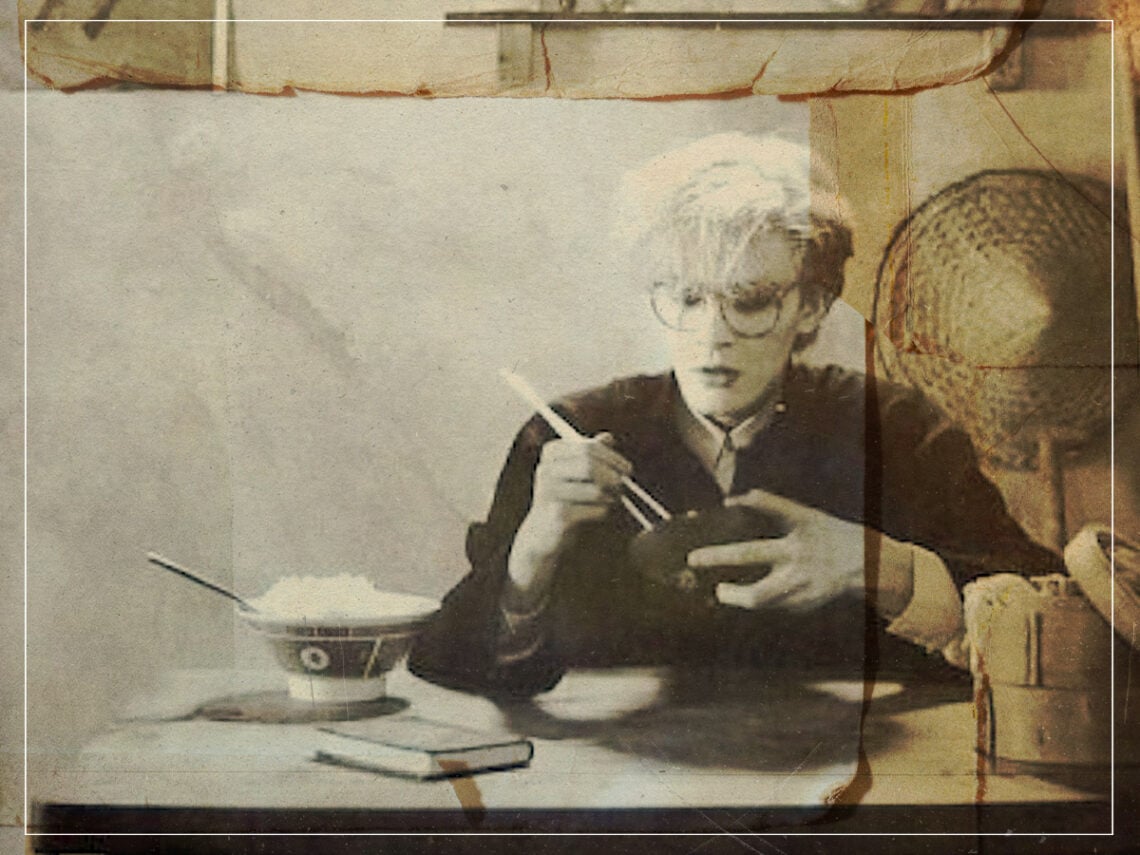
‘Ghosts’: How did Japan create the most audacious song to reach the top 10?

There’s arguably no better example of a band calling it quits at such a creative and commercial peak as the London art-pop outfit Japan. Disbanding off the success of Tin Drum in 1982, its third single ‘Ghosts’ cemented their effortlessly inventive arrangements and confident pop shine, a hauntingly austere meditation on life’s crossroads and the paths one must traverse to evolve, indebted to musique concrète composer Karlheinz Stockhausen over the New Romantic fashionistas that frontman David Sylvian and his band were frequently lumped with.
Future leftfield chart smashes seemed way off from their inception as a glam rock band. While their namesake country fell in love with them, selling out Tokyo’s Budokan Theatre in 1979, the UK press wrote Japan off as little more than a stodgy glam rip-off of Roxy Music and New York Dolls five years too late, dolloping a vague new wave twist that John Foxx’s Ultravox had already perfected with their two albums to date.
After a collaboration with Italo-disco producer Georgio Moroder on ‘Life in Tokyo’, the introduction of synthesizers in their work greatly informed the sonic character of 1979’s Quiet Life, exorcising the electronic washes from David Bowie’s Berlin trilogy and marking a shift toward Sylvian’s baritone croon from the prior strutting rock stylings.
This synth direction and androgynous flair saw them reluctantly ride the Blitz Kids wave that provided the ‘scene’ to the synthpop explosion despite publicly rejecting such associations. The pop climate forged around Covent Garden’s flamboyant crowd helped, however, the era’s new wave domination embracing Japan’s increasing sonic sophistication and finding label rescue with Virgin Records after being dropped from Hansa.
From 1980’s Gentleman Take Polaroids, Sylvian began taking the helm of the recording sessions, the band following his conceptual vision and with little collaborative input on the increasingly personal songwriting, and the synths grew even more prominent, the Prophet-5, Oberheim OB-X and Roland System 700 crucial hardware in realising their most lauded single. While Tin Drum explores buoyant percussion and Eastern Asian instrumentation, 1982’s ‘Ghosts’ wanders an icy fog of marimba plinks and cavernous electronic tones in an exercise of evocative minimalism that’s never been surpassed for creative audacity. It was a smash, too, reaching number five on the UK Singles chart and earning them a slot on Top of the Pops and a memorable performance on The Old Grey Whistle Test.
It looked like global stardom was theirs for the taking and on their creative terms. However, with internal disgruntlement over Sylvian’s control of the band, Japan dissolved after a few months of their unlikely hit. Sylvian would go on to forge a successful solo career, lending vocals to Ryuichi Sakamoto’s ‘Forbidden Colours’ and releasing albums with Robert Fripp and Holgar Czukay. It’s ‘Ghosts’ that serves as Sylvian’s most pivotal moment, however, a fascinating mark of a band in evolution and a pointer to Sylvian’s unreined jump into ambient improvisation that would fuel his life’s output.
“I had begun achieving the goal, the band was becoming successful, but I was finding myself no happier than when I had started, even if I had gained a sense of self-sufficiency,” he told Mojo in 2009, reflecting on his state of mind when conceiving ‘Ghosts’. “My experience of the world was very cloistered. I didn’t like being held in. I didn’t like being documented. I didn’t like people walking in my footsteps. I found the experience of the modicum of fame I had underwhelming. It wasn’t what I wanted, and that was a revelation.”
He concluded: “But again, it was a means of survival and a means of trying to find a purposeful existence. ‘Ghosts’ sort of pre-empts all that. By disbanding the group, it enabled me to move in any direction I wanted without compromise.”
