


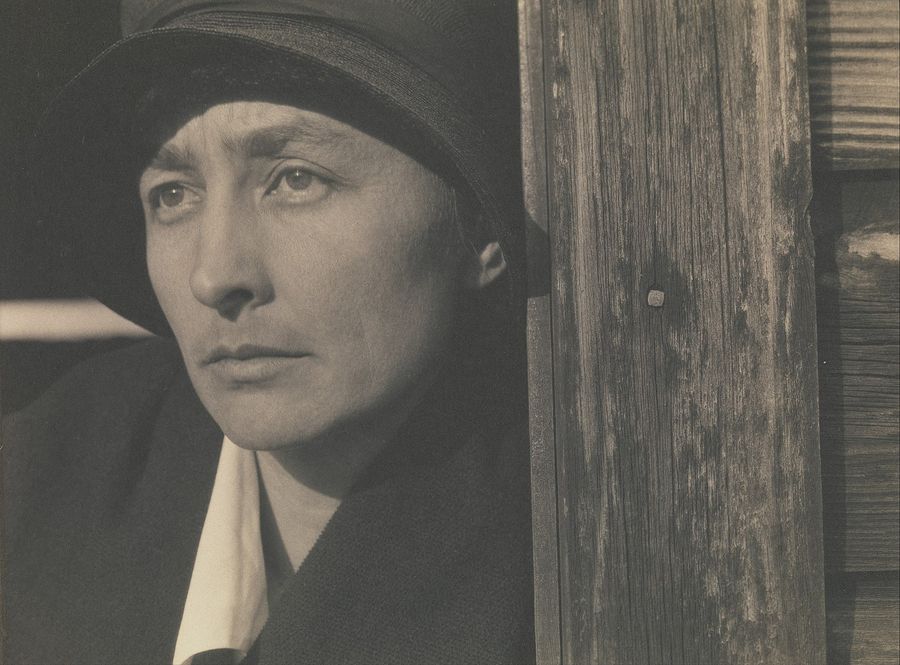
An icon who changed the landscape of the 20th century: The life and legacy of Georgia O’Keeffe

“I’ve been absolutely terrified every moment of my life – and I’ve never let it keep me from doing a single thing I wanted to do.”
Question: When is a painting of a flower, not just a painting of a flower? Answer: When it’s also a painting of a vagina. Evocative opening lines aside, Georgia O’Keeffe’s art was not merely an attempt to effeminise every budding flower, erect mountain or horny skull into some gaping orifice or proud appendage of emboldened sexuality, but rather to get to the very core of a single subject matter. Admittedly, the “deeply vaginal” cliché has entered the lexicon of the critical coterie for good reason, but there is a grander notion at play than merely transposing a spasm chasm onto a buttercup – O’Keeffe’s attempt was to unearth the inner feminity or masculinity of the ‘everyday’ in an interesting display of vibrant colour and shape.
Her stance was that behind everything, there is an inner essence to be coaxed out, “Nobody sees a flower – really – it’s so small it takes time – we haven’t the time,” she once said, “And to see takes time, like to have a friend takes time.” This, in many ways, is the encapsulation of O’Keeffe’s approach. She would paint the same object many times over until she seized something close to the core of it. If, in the process, she had transmuted the original subject matter into something almost unrecognisable – then that was part of the beauty of it. To put it in rather cutesy terms, the transfigured extraction of her final result was the culmination of simply trying to get to know something a little better.
Whether it was her early work painting flowers or the angular skyscrapers she crafted from her Manhattan apartment, she distilled her worldview down, stripping all the superfluous visuals of realism away into some core abstraction of the vital feel of the thing. In the process, she changed the landscape of the 20th century, literally.
This singular approach to painting was seeded from the marriage of a curious youth and an indifference to the status quo of art in early adulthood. Proof of the fact that her art was derived from the unique composition of inner identity and latterly woven into place by the mystic figures of fate is that her works evolved wildly in terms of subject matter over the years, but the modus operandi of execution never changed.
This very singular worldview started in childhood. She was a farm girl raised on the American postcard prairies of Wisconsin. The wild canvas-like open space that surrounded her gave her license to roam, but O’Keeffe’s view, even at an early age, was that there was as much to explore in the miniaturised universe of a single flower, as there was in the macrocosm that they were part of. The reverberations of this philosophy can be seen in the ripples that continue to roll out from the epicentre of Modernism.
When it comes to modern artists, in general, the importance of the piece is not limited to the picture alone but deeply entwined with the artist behind it. The legacy of O’Keeffe defies the scope of her work alone with its cultural impact. O’Keeffe was a feminist who sat right at the precipice of the emergent frontier of female art.
This inner sense of defiant liberation was heavily rooted in her youth. Interestingly this usurps a notion we often uphold of feminism as a sort of urban battleground of ties and trouser suits, rebelling against the patriarchy, well away from the seeming conservatism of rural life.
However, O’Keeffe’s rural upbringing planted a resolute stem of autonomy within her. Her own mother had hoped to be a doctor, and several of her aunts never married and chose instead to pursue independent careers.

Since her birth on November 15th 1887, this empowered ‘go your own way and reap what you sow’ upbringing imparted in her a sense of fortitude that abided right up to her death aged 98 on March 6th, 1986.
This forthright resilience was at the core of her feminism as she wove her way into the male-dominated world of the turn of the 20th-century art world. She was a vital figure in liberation not just through illuminating a necessary need for equality, but through a passionate propagation of self-expression that stretched beyond egalitarianism and elucidated the human need for creativity.
This burgeoning exigency to express herself led her to rally against the realist recreation of nature that she was being taught at the School of the Art Institute of Chicago in 1905. “I found I could say things with colour and shapes,” she explained, “That I couldn’t say any other way – things I had no words for.” It was a radical approach that drew upon the arising boom of ‘abstractionism’, but it was through a quirk of fate that her insular view would open like a budding flower and breathe its beauty on the world at large.
In 1915 Georgia made a series of simple abstract charcoal drawings and sent them to a friend. Without Georgia’s permission, this friend took the pictures to the renowned photographer Alfred Stieglitz who displayed them in his art gallery. Her anger that her private work was suddenly made public soon dissipated as she found not only a home for her art and all it entailed but also a muse, companion and husband in Alfred Stieglitz, with whom she remained married until his death in 1946 after 22 years of marriage.
From their meeting in 1915 up until the sad passing of Alfred, the couple documented their devotion in over 25,000 pages worth of letters. One such letter, sent by O’Keeffe when she was 28 and mostly unknown working as an art teacher in Texas, to Alfred who was 52 and already one of the most important figures in the New York art world, charmingly reads: “I’m getting to like you so tremendously that it scares me.”
Likewise, Stieglitz was so enamoured with O’Keeffe and her bohemian brilliance that he decided to defy the discriminatory male bourgeoisie of the art world by hosting a full exhibition of her works. This catapulted her to acclaim, and yet O’Keeffe herself remained as enigmatic as ever. She remained largely private, revealing her philosophy through her artwork which transitioned from the flowers of her youth to the skyscrapers of New York and then to the landscapes of New Mexico, as well as a very peculiar fascination with one specific door.
What she shares with her work is a complex microcosm of identity and an attempt to snatch the elusive from the ether, inviolable to external prejudices and extraneous noise. It is this defiant liberation embodied by a singular approach, the undeniable skill with which it was emancipated and presented to the world, and the subtly subversive power of her art, that makes her a preeminent figure in the tapestry of 20th-century culture. The ‘Mother of Modernism’ was an icon who changed the world.
