


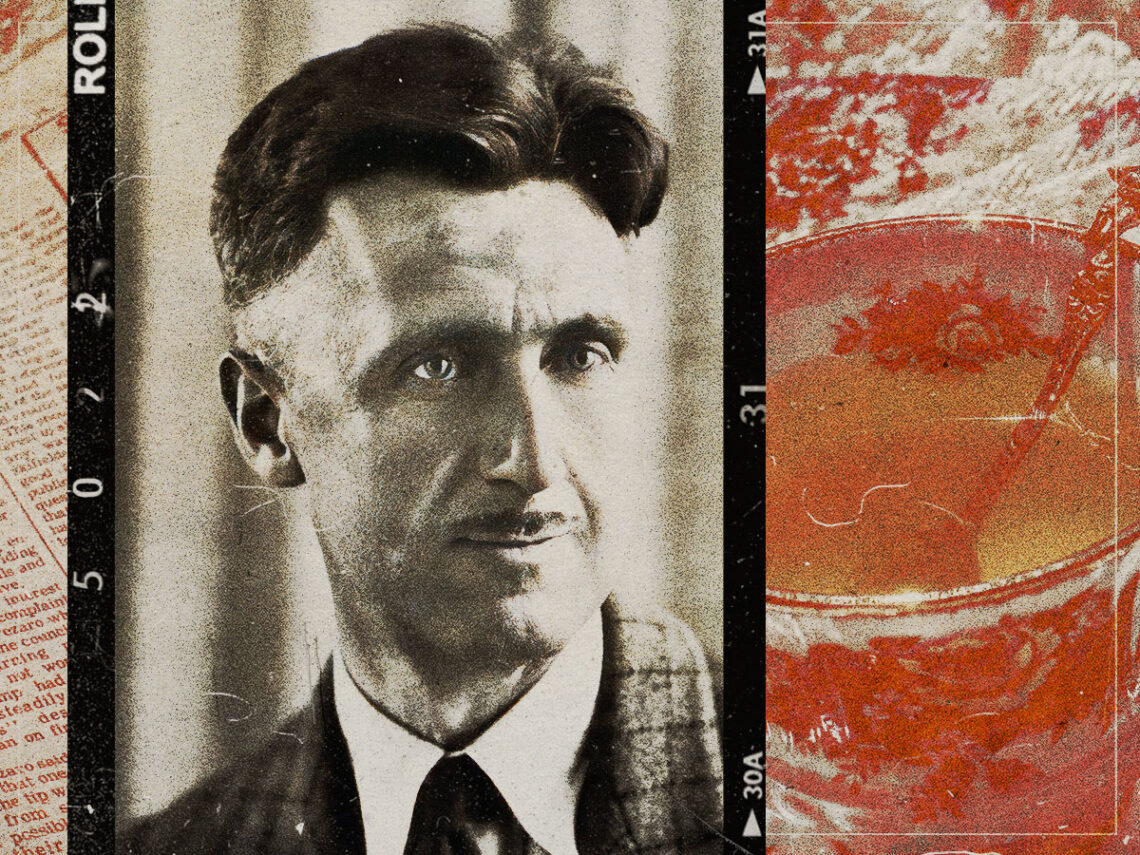
Dystopian Desert: George Orwell’s famous recipe for Christmas pudding

First, the Lord giveth, then he taketh away. Or so says the Bible, so it seems fitting that on the holiest day of them all, the greatest dinner is followed by the worst desert. Christmas pudding is the flaming sham of the holiday season—a dense mess that tastes like a lady’s perfume perenially served up a perverse tradition. So, it also seems perfectly fitting that a fellow who knew more than a thing or two about society’s ills turned his hand towards a recipe to reinvent the dreaded ball of despair.
Every year around this time, the air is fragrant with the delicious smells of cinnamon, chocolate, charred meat and freshly baked cakes. It’s a time when we sniff around the house, taking in a lungful of aroma, a time when we find our appetites doubling and a time when we can’t wait to be at the dinner table. And yet, most of us still can’t muster much more than a spoonful of Christmas pudding.
Perhaps Orwell’s round heap might offer more? The recipe is “special” for several reasons. Who would have thought that such a serious writer like Orwell, who wrote satirical social criticisms, protested against the totalitarian state and churned out novels like The Animal Farm and Nineteen Eighty-Four containing heavy dystopian traits and political allegories, had a MasterChef hidden inside him?
It turns out Orwell was quite interested in the culinary world and fiercely defended British cuisine in his own quirky way. In an unpublished 1945 essay called The British Cookery Orwell opened with a quote from Voltaire, the mono-named French critic, that mockingly stated that Britain is a land with “a hundred religions and only one sauce.”
Orwell begged to differ when he wrote that it “was untrue” then and “is equally untrue today”. However, being the diplomat he was, he also pointed out what exactly was wrong with the culinary world of Britain, saying: “Cheap restaurants in Britain are almost invariably bad, while in expensive restaurants the cookery is almost always French, or imitation French.”
For Orwell, this implied a lack of culinary pride. Seeing as though cooking and eating is a central part of any culture, this lack of pride has interesting implications. However, there is one area where we excel, and we damn well know it: sweet treats. In Orwell’s delectable opinion, we mastered the art of the pudding, and he dabbled in making them himself.
In the same essay, which predominantly surveys the British palate, Orwell provided a number of dessert recipes such as treacle tart, orange marmalade, and plum cake, ending with the Christmas pudding. So, it seems like a timely moment to share the author’s own take on the dish in the hope that you can compare it to the abomination you have to endure.
Find the recipe in full below.
George Orwell’s Christmas pudding recipe:
Ingredients:
- 1lb each of currants, sultanas & raisins
- 2 ounces sweet almonds
- 1 ounce sweet almonds
- 1 ounce bitter almonds
- 4 ounces mixed peel
- ½ lb brown sugar
- ½ lb flour
- ¼ lb breadcrumbs
- ½ teaspoonful salt
- ½ teaspoonful grated nutmeg
- ¼ teaspoonful powdered cinnamon
- 6 ounces suet
- The rind and juice of 1 lemon
- 5 eggs
- A little milk
- 1/8 of a pint of brandy, or a little beer
Method
“Wash the fruit. Chop the suet, shred and chop the peel, stone and chop the raisins, blanch and chop the almonds. Prepare the breadcrumbs. Sift the spices and salt into the flour.
“Mix all the dry ingredients into a basin. Heat the eggs, mix them with the lemon juice and the other liquids. Add to the dry ingredients and stir well. If the mixture is too stiff, add a little more milk. Allow the mixture to stand for a few hours in a covered basin.
“Then mix well again and place in well-greased basins of about eight inches diameter. Cover with rounds of greased paper. Then tie the tops of the basins over the floured cloths if the puddings are to be boiled, or with thick greased paper if they are to be steamed.
“Boil or steam for 5 or 6 hours. On the day when the pudding is to be eaten, reheat it by steaming it for three hours. When serving, pour a large spoonful of warm brandy over it and set fire to it.”

