


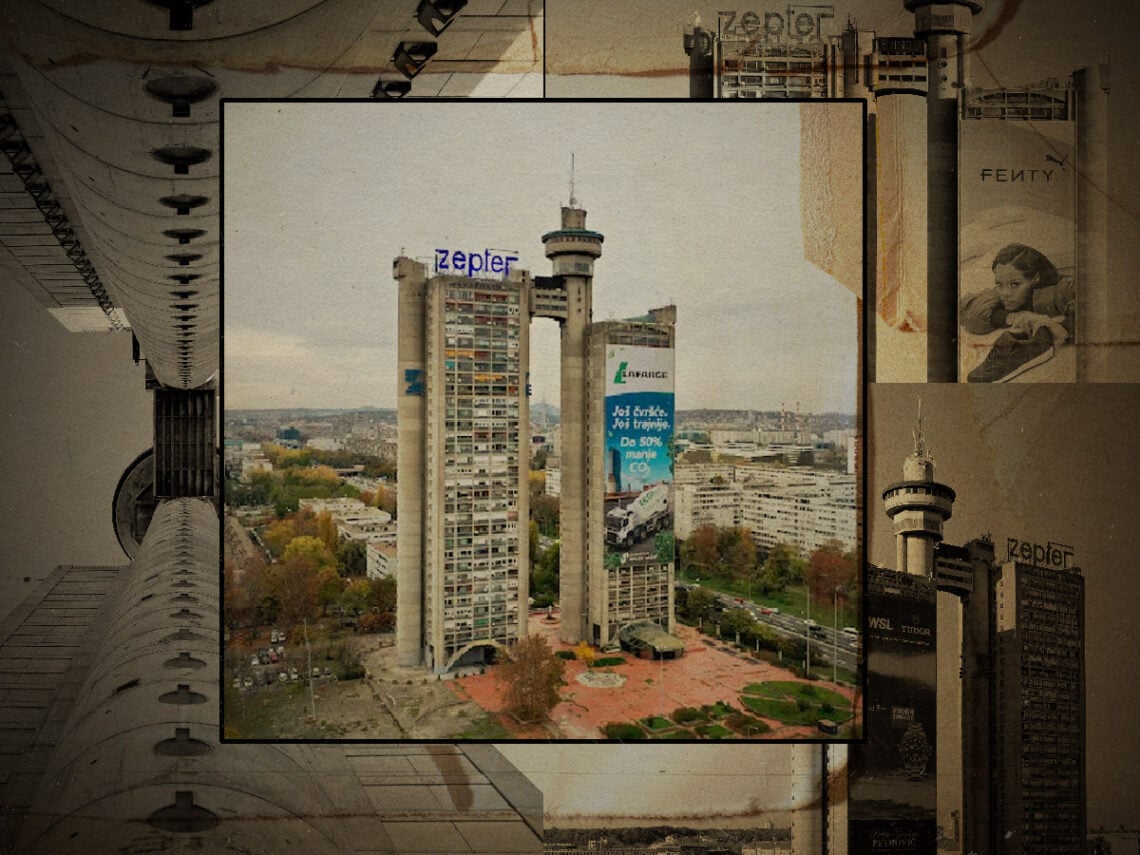
Genex Tower: Belgrade’s brutalist masterpiece

Love it or loathe it, when it comes to the buildings around us, there’s nothing that polarises opinion like brutalist architecture, a building style that’s rampant from London to America, from former Soviet nations in Central Asia and across the Balkans to Serbia and Albania.
Emerging from the death and destruction of World War II, this modernist movement focused on affordability and function over beauty and artistic flair. Deriving from ‘béton brut’, the French word for raw concrete, it’s a style renowned for huge, angular, grey concrete structures, such that the architecture isn’t warm or inviting but rather cold and alienating, mostly seen on large-scale public developments like apartment blocks, government buildings and universities.
Once hated, it’s become appreciated over the years, and in Belgrade, you can see one of the finest examples in the Balkans, if not Europe as a whole, in Genex Tower.
Before the Genex Tower, there was Novi Beograd (New Belgrade), and in 1948, with the dust settling on World War II, the city needed to grow. Opposite the old town of Belgrade and the fortress that sits high in Kalemegdan Park, were miles and miles of marshland situated between the Sava and Danube Rivers, so over the following 20 years, these lands were developed and turned into a brutalist marvel, with concrete apartment blocks, libraries and more.
New Belgrade was a showcase for Yugoslavia that gave President Josip Broz Tito a chance to show the world how modern and forward-thinking his socialist state was, and by developing the area, it allowed not only Belgrade to grow but the country to exhibit just how modern urban living could look.
However, one thing was amiss: a true statement piece, an icon on the skyline to stand out and scream Belgrade, and hence, Yugoslavia’s largest export-import firm, Genex, decided to commission a new corporate headquarters, one which would display their power and the country’s wider economic growth.
They commissioned Mihajlo Mitrović to design the Genex Tower, and what he came up with was an eye-catching statement of socialist ambition and, in many ways, a building that defied convention, with its two concrete towers, not quite equal in height and joined near their summit by a two-storey connecting bridge, bringing both sides of the building together. Connect to each pipe-like, circular tower was more traditional rectangular blocks, wherein one side was to be turned into residential properties and the other to be used commercially.
On top of it all sits a disc that was a restaurant and observation point, and looking like a UFO, this gives panoramic views across Novi Beograd’s vast blocks and buildings, with the American-style grid system very visible, such that you can see further afield across the Sava to the old part of the city.
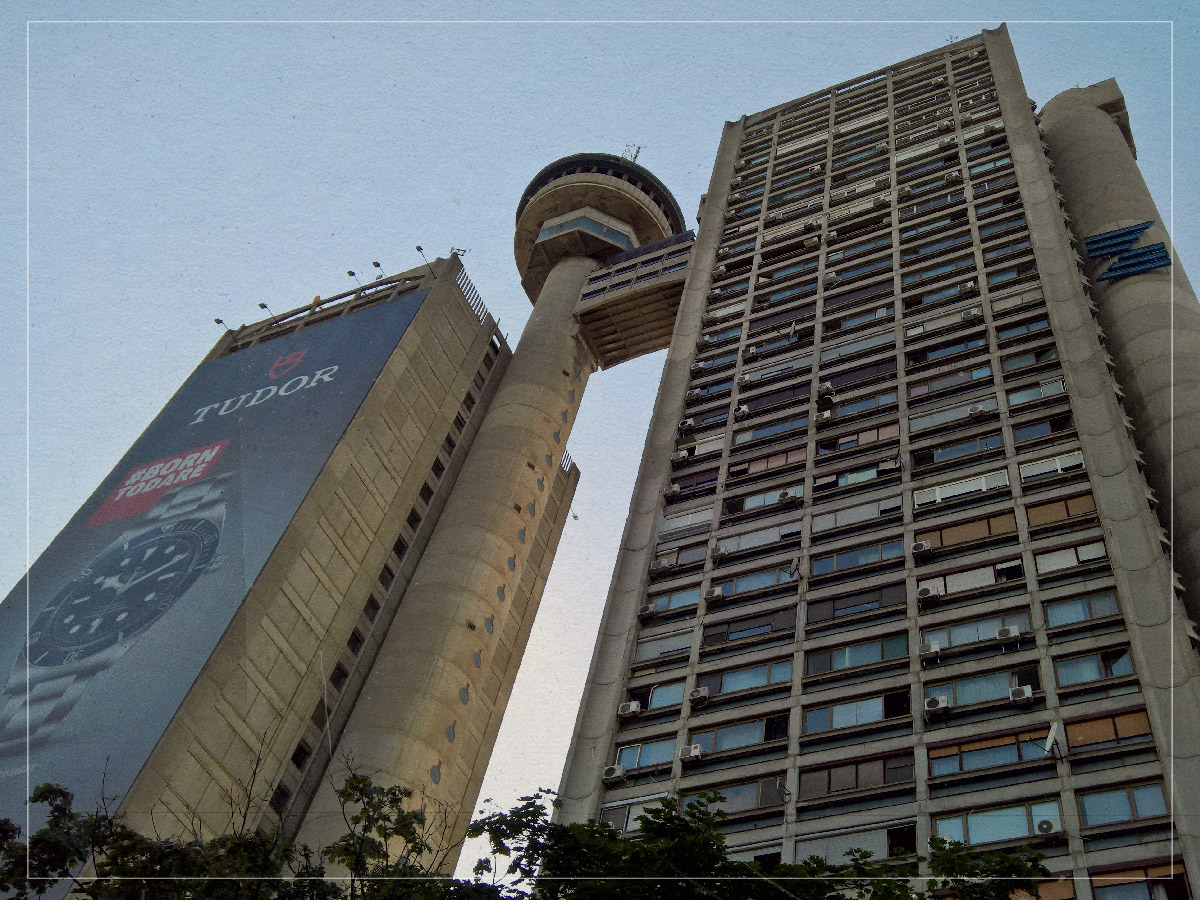
From the exposed concrete to the strips of windows along the side, the alien aesthetics of the disc that sits on top, to the circular towers that act as the core, this is a truly unforgettable building, such that in the two connecting buildings, you can see its lineage in London’s Trellick Tower, designed by Erno Goldfinger, which opened five years earlier in 1972.
When the Genex Tower opened in 1977 after seven years of construction, the 36-floor, 124-metre building gave Belgrade a new landmark and Yugoslavia a new symbol to show its growing status in the world, thus, sadly, its fall from grace beginning in the 1980s tracks the wider decline of the region, both politically and economically, starting with Tito’s death to the start of Yugoslavia’s breakup in 1991, through the wars of the 1990s and the economic hardship that followed.
The country, like the Genex Tower, suffered a decline that it hasn’t long recovered from, with issues of ownership within the tower, a lack of investment and an extreme lack of maintenance, all of which first saw the famous panoramic restaurant fall into disuse. While the residential side of the building has largely remained occupied throughout the years, with some properties available on Airbnb now, the commercial side of the building remains abandoned, mostly empty, with security sitting in its hallway waiting to turn any potential curious explorers away, something I can confirm with my own eyes!
Even now, the Genex Tower has a huge cultural impact: it’s an architectural emblem for not only Yugoslav modernism but also brutalist architecture at large, holding a place as a literal signpost into the city, with its other name, Western Gate, welcoming people into New Belgrade.
It can be divisive, with some seeing it as part of their local identity and others hating it, but it is nonetheless a key piece of Yugo-nostalgia, as opinions range from considering the tower a symbol of a better time, a signifier of social investment and a strong Yugoslavia, to acting as a reminder of the failures of that regime.
For those of us with no connection to Serbia or Yugoslavia, it stands as an architectural marvel, beautiful and ugly, cold and distant yet inviting, all at the same time, and while the Genex Tower can provoke debate about architecture and its role in memory and projecting political power, we can’t also forget that it’s just an incredible, unique building; so, whatever your view, it’s impossible to gaze upon its two towers and not feel something.
