


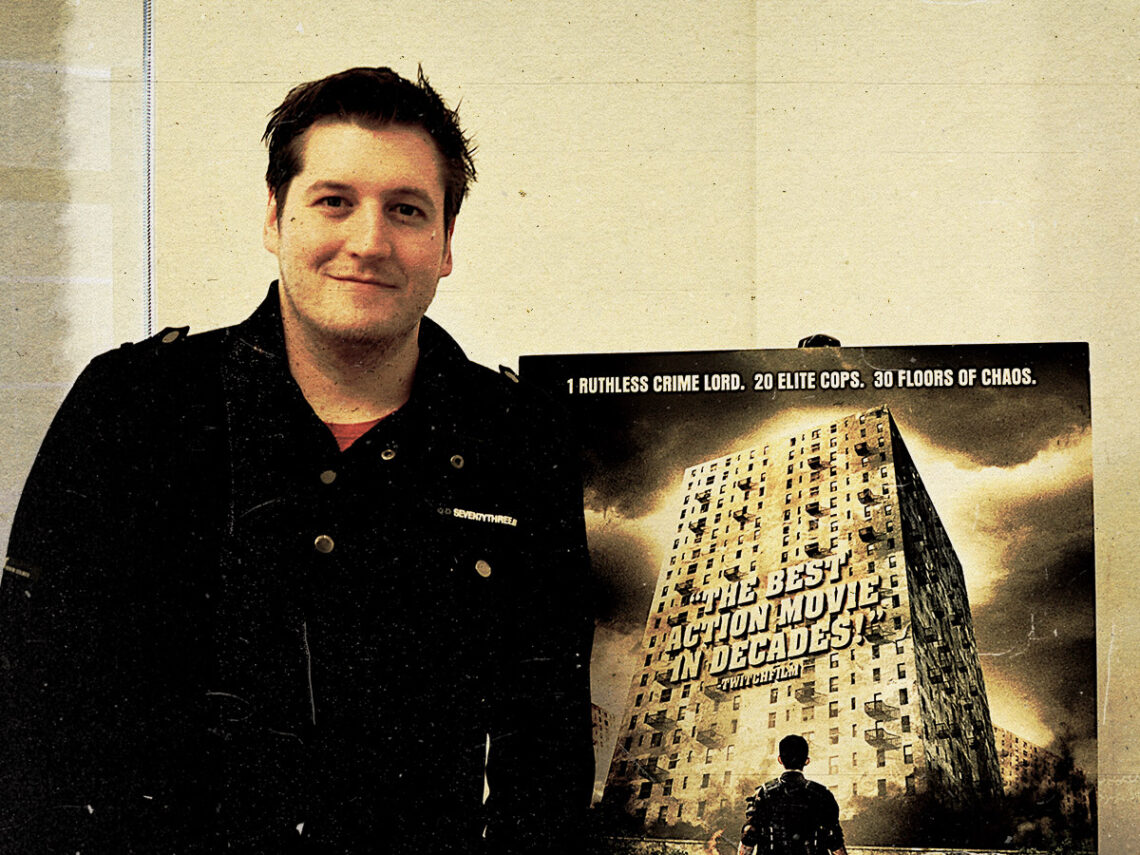
Gareth Evans names the movies that inspired ‘The Raid’

There aren’t many action films that can be credited with contributing something genuinely new to world cinema, and even fewer Welsh filmmakers have made their mark in Indonesia. Director Gareth Evans, with his 2011 film The Raid, achieved both. After leaving the UK at 27 to live with his Indonesian-Japanese wife’s family, Evans—who had seen little success as a screenwriter in Wales—found himself in Indonesia making a documentary on the country’s traditional martial art, Pencak Silat. This experience would pave the way for the groundbreaking action choreography and intense storytelling that The Raid became known for.
While working on this documentary and falling in love with Indonesia, Evans described a new ambition for himself, which was to introduce Silat to a Western audience. Talking to Chud in 2011, Evans explained that he had “always been a huge fan of martial arts films” but had “never seen Silat before. It struck me as this thing where I felt this needs to be in films.”
The result, The Raid, was choreographed specifically, in Evans’ words, as a “showcase, a thrill-ride” for the Indonesian martial art form. The movie held its debut at the Toronto International Film Festival and was picked up for distribution in the United States by Sony Picture Classics, achieving Evans’ aim of bringing knowledge about Pencak Silat beyond Indonesia.
Although rooted in the inspiration Evans felt during his six months as a documentarian in Indonesia, the international success of The Raid can be attributed to the wide array of action inspirations that Evans drew upon in creating his ‘showcase.’ In the interview, Evans first cites the 1985 Arnold Schwarzenegger vehicle Commando as a model, saying: “I love that film so much. And what I love about it is that once it starts it doesn’t stop. From the first three minutes, it sets itself up, then BOOM, it carries on all the way until the end. And it never stops to go, ‘Oh, let’s do a flashback’. It keeps moving forward all the time.”
Commando provided the relentless pacing that Evans sought for his martial arts showcase. Another crucial aspect of The Raid’s intensity is its setting in one building. Once Evans had committed to a restricted, claustrophobic set, he went back to the classics of the genre that used the same device.
He added: “I go back and watch Die Hard, Assault on Precinct 13, [REC) 1 and 2, you take a look for the gun play at the whole ending of Hard Boiled, where they’re in the hospital for like 50 minutes. And it is about how to maintain and sustain the audience’s interest.”
Evans’ list of influences reveals the diversity of his inspirations. While Die Hard is an expected inclusion—having inspired nearly every action movie since its release—the appearance of Assault on Precinct 13 is more surprising. Directed by John Carpenter and made on a modest budget of just $100,000 and it remains an independent cult favourite. Also notable are [REC] 1 and 2, a Spanish found-footage horror series, and Hard Boiled, a Hong Kong action thriller directed by John Woo. These choices highlight Evans’ appreciation for both genre-defining classics and more unconventional, internationally acclaimed films.
The beauty of world cinema is rarely so well encapsulated as in this story of a Welsh filmmaker drawing on the films of America, Europe and Hong Kong for the purpose of bringing his cinematic showcase of Indonesian martial arts to an international audience.
