


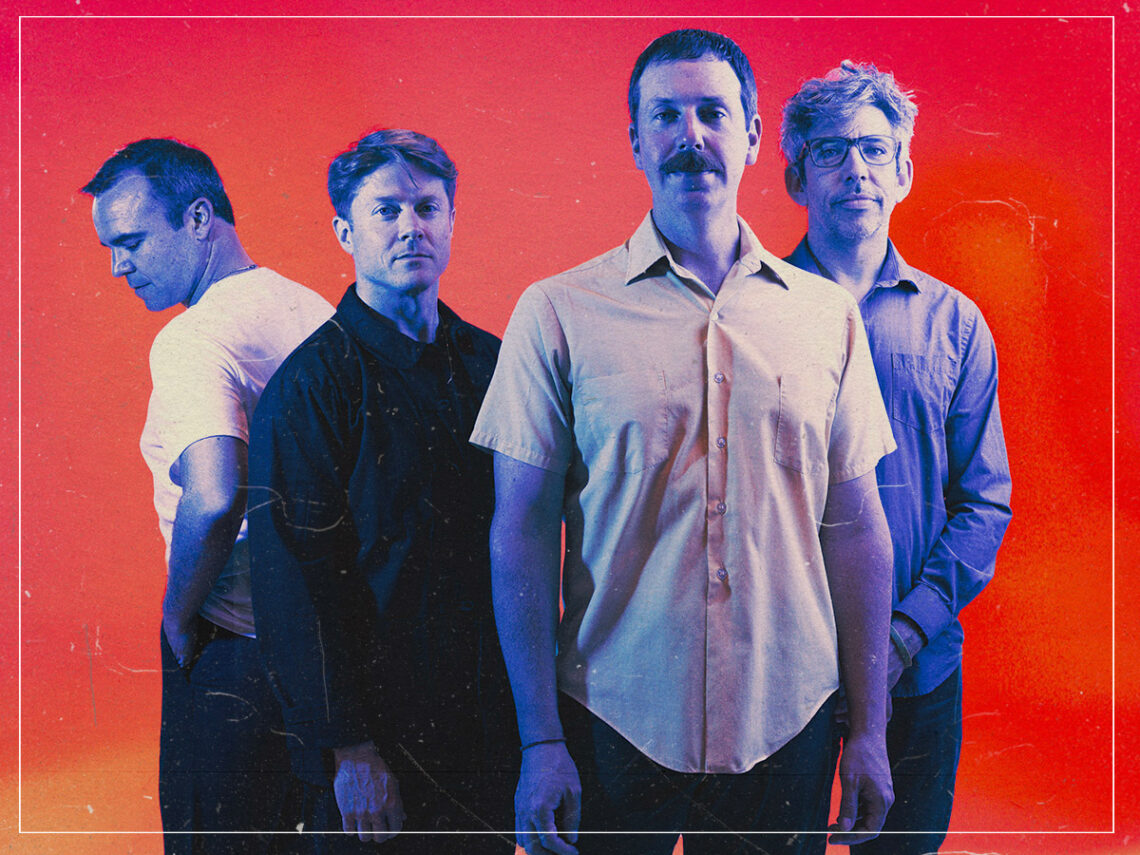
Future Islands – ‘People Who Aren’t There Anymore’ album review: a flabby reminder of synth-pop frailties

THE SKINNY: As it approaches ten years since Future Islands broke into the collective consciousness with their now-legendary performance of ‘Seasons’ on David Letterman’s late-night show, the band are back with their seventh full-length effort, People Who Aren’t There Anymore. It’s a record filled with loss, mourning and genuine grief. However, looking beyond the melodrama, it’s hard to see anything other than the group’s demise.
As with any outfit that has managed to maintain a successful career for an entire decade, especially one with such a nuanced and niche output as the Baltimore band, there is certainly an audience out there for this record. Its synth-pop sentiment, highly emotional lyrics and dedication to taking themselves incredibly seriously are still there. But, with the passing of time, a flabby dullness has started to gather.
In 2014, Samuel F. Herring and his band captivated an audience unaware of the new shapes about to be thrown at them through the television. Herring was a unique prospect, a relic of the past who saw leading the line of a synth-pop band as a chance to spotlight his supreme commitment to art — swinging dance moves and all. That performance of ‘Seasons’, easily the group’s defining anthem, perfectly encapsulated the group as a cinematic gift.
There are moments where the band deliver on this long-held promise, too, with bombastic synths that layer across uniquely penned lyrics. However, largely, with this new record, the sheen of 1980s arena rock brilliance has faded.
The insistence on hiking up the earnestness of every lyric feels misplaced and unwanted. It might just be that the lyrics and the music within the album feel wildly misaligned. If one were to meet the other more convincingly, then the tragedy about which Herring sings might be given the desired platform. As it is, however, this confusion leads the audience down the wrong path.
For fans of: Finding the seriousness in fantasy fiction and pretending that the whole world is a poorly rendered vision of a clunky and oddly oppressive 1980s movie.
A concluding comment from Tom’s mother: “This is my cup of tea. Reminded me of Orchestral Manoeuvres in the Dark, but a weirdly scary version that I’m not sure is entirely suited to synth-pop.”
People Who Aren’t There Anymore track by track:
Release date: 27 January | Producer: Future Islands and Steve Wright | Label: 4AD
‘King of Sweden’: An opener that will delight synth-pop fans fearing Future Islands has taken a new route, the track pushes towards a crescendo that is just about lands. [3/5]
‘The Tower’: This is where things start to take a downward turn. A light approach highlights the truth behind every vocal: a desire to be loved like a pop star. Elsewhere, simple structures give way to nonsense lyrics. [2/5]
‘Deep In The Night’: A sense of taking oneself too seriously is always troubling when coupled with a 1980s-focused synth arrangement, which makes this piece feel closer to an off-Broadway Lord of the Rings musical. [1.5/5]
‘Say Goodbye’: Rejoice! A hook-worthy of being snagged upon. Easily the most infectious song on the record, ‘Say Goodbye’ has earworm potential and the kind of rhythm that originally made Future Islands so appealing. [2.5/5]
‘Give Me The Ghost Back’: Memorialising a lost friend is always a tender moment, and it’s a moment in the record where the band’s uniquely bombastic sell is turned down for good. [3.5/5]
‘Corner Of My Eye’: Melodrama has always been a key facet of Future Islands output, but despite the potent message of mourning within the record, it is on tracks like this that the whole schtick becomes incredibly tiresome even with the euphoric-adjacent crescendo. [1.5/5]
‘The Thief’: Songs like ‘The Thief’ highlight the internal battle at the heart of People Who Aren’t There Anymore. Herring may be desperate to make his point about grief and love lost, but they hit abrasively against the sonic structure of the group. [2/5]
‘Iris’: There’s nothing particularly wrong with ‘Iris’, and to ignore the clear sadness Herring emanates through his lyrics is to be plainly obtuse. But it is equally difficult to listen to this song, having digested the previous seven. [2/5]
‘The Fight’: Future Islands have allowed a few changes, however. Their sound is now accompanied, on occasion, by a six-string guitar. Here, it works well with Gerrit Welmer’s synth to create something more special. [3/5]
‘Peach’: The power of Future Islands is to create wildly cinematic music. When they concentrate on this, the group deliver music capable of soundtracking their audience’s lives for years to come, just like ‘Peach’. [3.5/5]
‘The Sickness’: The slow build of ‘The Sickness’ offers very little in the way of audio reward. However, there is a clearly sentimental message within the lyrics that Herring’s vocal sometimes renders inaccessible. [2/5]
‘The Garden Wheel’: Unlike classic rock or indie, paint-by-numbers synth-pop is one such genre that can barely get out of the blocks to please its listener. ‘The Garden Wheel’ provides a similarly disappointing end to the record. [2/5]

Never Miss A Beat
The Far Out New Music Newsletter
All the latest New Music from the independent voice of culture.
Straight to your inbox.