


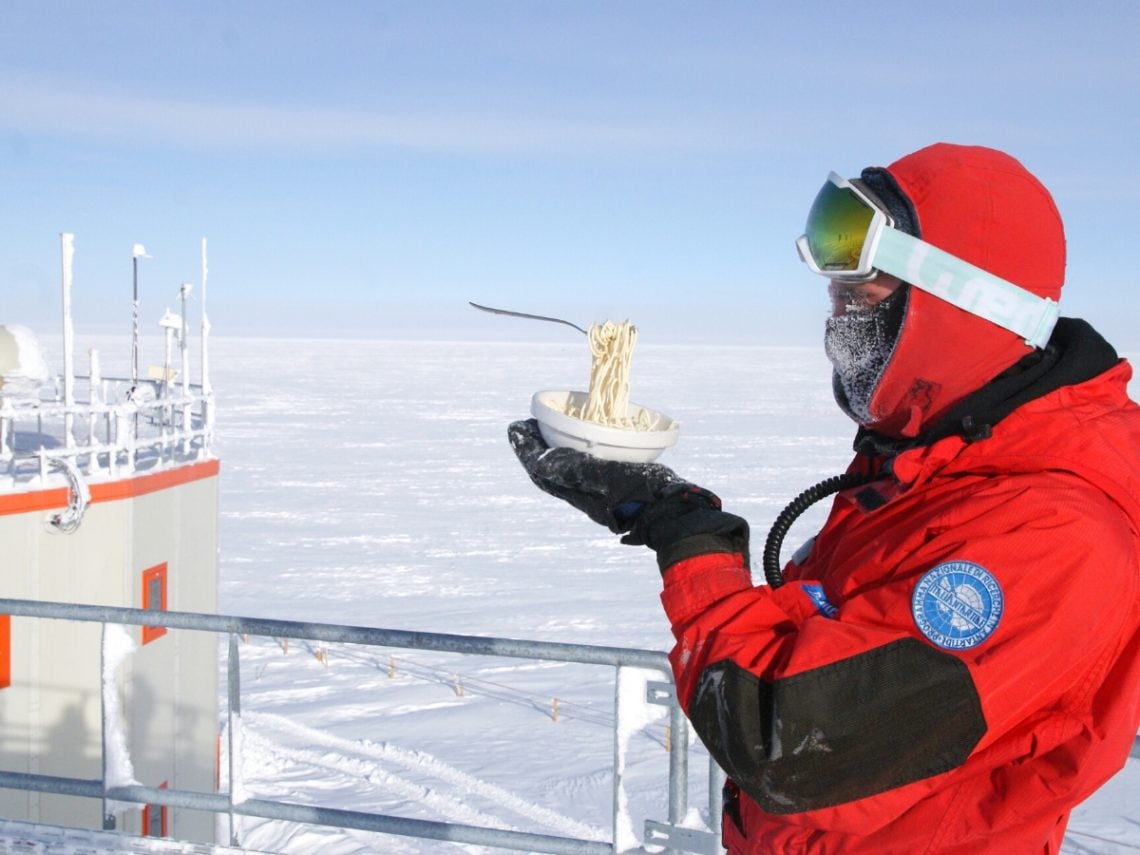
A frosty feast: Food becomes art in Antarctica

The ingrained image of Christmas consists of snowy landscapes, jolly elves and sleighs – although the sleighs on Christmas cards are rarely making much use of the snow. This overpowering image, compounded by the likes of Clement Moore, Charles Dickens, Kevin McCallister and Buddy the Elf, manifested because the northern latitudes tilt away from the sun over the winter months. By December, most of Europe and Northern America is plunged into the depths of winter, leaving many of us, like Mr. Crosby, “dreaming of a white Christmas”.
Whether you’re sat by an open fire in Aspen or fanning yourself in the baking heat of Alice Springs with a polar bear Christmas card on the mantlepiece, the tradition has been decided as a hearty roast dinner. A turkey or an enormous ham is traditionally orbited by the usual suspects of sprouts, pigs in blankets, broccoli, carrots and stuffing. Once plated up, sane people like to drown the lot in thick gravy, but what if the gravy freezes solid in mid-air and the boat is left aloft on a meaty icicle?
This might seem like a feat of pure science fiction – or liquid nitrogen – but it’s a common issue for people like Cyprien Verseux and Carmen Possnig, who are lucky enough to have walked the remote sweeps of Antarctica.
Verseux, the kind Frenchman we contacted for these marvellous photos, made great use of his camera in the Antarctic downtime, but that’s not why he braves the cold. As an eminent astrobiologist and head of the Applied Space Microbiology Laboratory at ZARM (a German scientific institution of the University of Bremen), he conducts research to find life support systems on Mars. Fortunately, Antarctica is cold and desolate enough to serve as a proxy for some of our neighbouring planet’s hostile conditions.
As seen in the images below, the temperatures encountered by Santa Claus at the North Pole are child’s play compared with those of the South. During their 2018 research trip to Antarctica’s Concordia outpost, Verseux and Possnig battled against ambient temperatures as low as -80°C (-112°F).
While I’ll concede that your steaming hot, salty gravy would likely survive a meal in its desired state of form in these conditions, let alone the fall from the boat, the images below reveal the true gastronomic hurdles of outdoor dining in Antarctica.
If you attempt to prepare an outdoor meal in these ludicrous conditions, a newly cracked egg will turn to solid rock within 60 seconds. That spaghetti you spent time, water and energy to make floppy will become as rigid as Nelson’s Column.
While raw eggs and honey sandwiches might not be your traditional Christmas dinner, Antarctica just has a way of making everything look a little more festive.


