


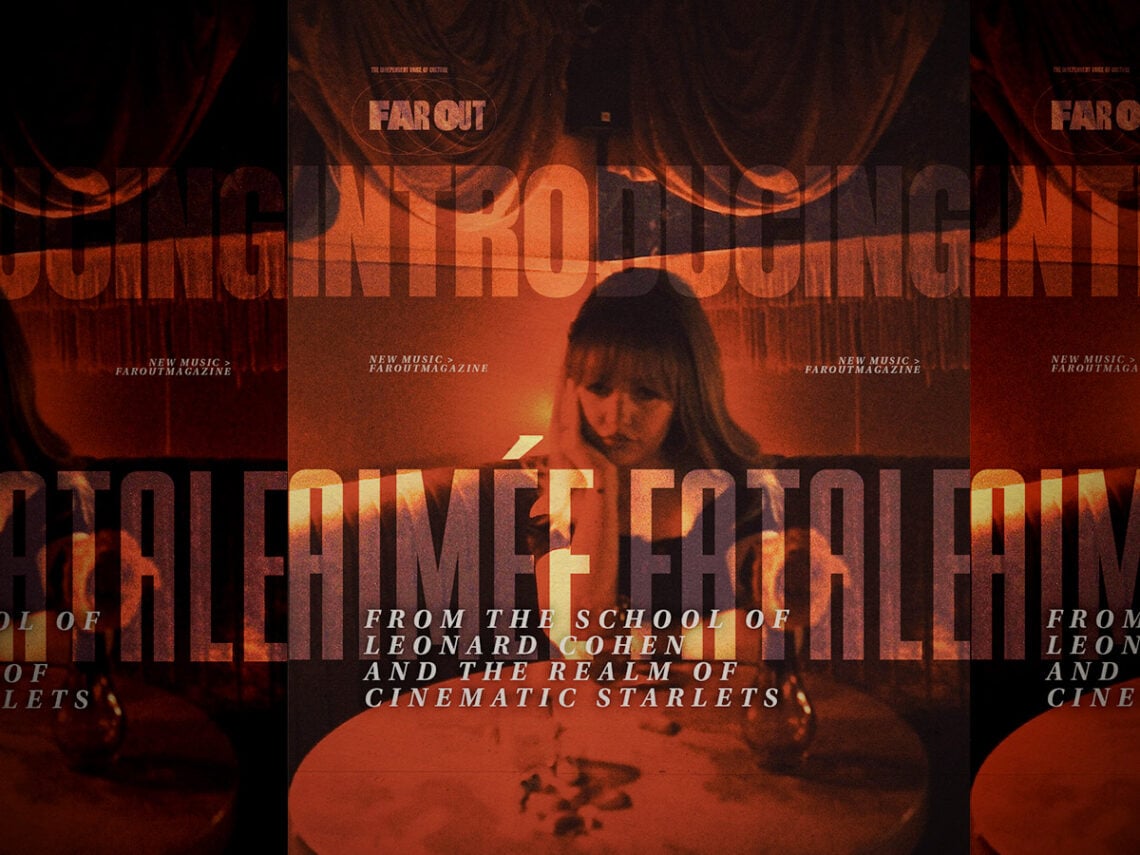
From the school of Leonard Cohen and the realm of cinematic starlets: Introducing Aimee Fatale

In a room painted entirely pink, seated at a vintage wooden desk holding an omnichord, a typewriter, and various photos of idols arranged like a classic Hollywood shrine, Aimee Fatale is reflected in a Marilyn Monroe mirror as she writes her songs. With nothing released yet, the tracks sitting on her laptop or being crafted on the scattering of instruments around her brim with potential. From the glimmers her growing cult of fans have heard, there’s something truly special here.
“I’ve made my flat sort of a physical representation of the inside of my head, and I can’t really write anywhere else now,” Fatale tells me, looking around her own space somewhere in Hull. I already see it from the square of our Zoom call. Like a dusty pink boudoir of cinematic dreams, the singer is in the centre with perfectly bouffant hair, surrounded by vintage lamps and frames on the wall housing images of idols.
It’s like a dream dollhouse in which the ultimate cinematic starlet would live; it’s a scene Sofia Coppola would create, that David Lynch would’ve dreamed up, that Marilyn Monroe would’ve inhabited. So naturally, Fatale’s music exists in the intersection of the three: angsty, theatrical, seductive, and poetic, but above all else, atmospheric in a way that is utterly her own making and the ultimate product of the energy she holds and manages to get across even on a glitchy laptop screen.
But while Fatale looks, sings, and carries herself like a starlet, Leonard Cohen acts as the patron saint of her project and her artistic ethos. His influence is found in her process first, as she’s a student of his school of belief that a writer must be a worker. “I’m writing every day, essentially, even when I’m not really inspired or not in the mood. I’m trying to treat it like a job because I feel like you have to do the rubbish stuff to get to the good stuff,” she said. Just as Cohen sang off, Fatale, too, is just paying her rent every day in the Tower of Song.

He’s in the sound, too. Out of the two songs out there in the world for people to hear, ‘It Could Be Better (But It’s Good Enough)’ bears the clearest Cohen influence and grants her new tools as an artist. Having previously been in bands, typically sticking to the standard guitars and pianos when it came to songwriting, her idol’s later era gave her the tools that are now the most inspiring things she has in her arsenal.
“I think I’ll know when the time is right.”
Aimee Fatale
“The main things that really inspire me are the instruments I use,” she tells me. “I use this omnicord, which is just like the most insane little thing in the world. They started off as toys in the ’80s, and now they’re really sought after because they sound kind of rubbish but you can do so much with them so easily. It’s the same with these Casio keyboards I use which, again, are toys from the ’80s that you can get for like £40 on eBay.”
While plenty of people turn their noses up at Cohen’s late 1970s and ‘80s eras, with all its cheesy sign-of-the-time sounds, Fatale is a fan. “‘It Could Be Better’ started out as an early Leonard Cohen folk ‘60s thing, but after listening to a lot of ‘I’m Your Man’, I fell in love with that whole kitschy, ‘80s sound,” she said. She bought her omnichord and Casio, and they’ve ruled her process ever since.
“There’s something special and sort of naive about them that I find really inspiring,” she said. Similar to Fatale’s clear vibe, clear sense of self and certain understanding of the type of artist she wants to be, that dedication to singularity is reflected in her instruments as she explained, “They sort of speak to you and have their own voice.” In short, they won’t be melded or adapted, but they fit perfectly into Fatale’s world.
Crucially, though, her world has yet to truly open. She’s released nothing beyond two live sessions on YouTube, a scattering of short covers on social media and a few teasers of things to come. But there’s no date or clue when they might arrive. In a world hungry for instant gratification and a music industry now dominated by speed and demand, Fatale is rebelling against it in order to do things right. Though she already has a growing huddle of fans eager to add her tracks to their playlist, she won’t be rushed.
“I’m building a really big catalogue of songs, and then I think I’ll know when the time is right,” she said. “I’ve been working on this very slowly, but surely, like building it up and taking my time just because it’s so reflective of me and who I am that I want to do it properly, you know.”
Things are building even without a release date in sight. Fatale’s fan base is swelling as more and more people stumble across her online, paused in their tracks by her angelic voice, sharp lyricism and obvious aura. Her live shows are becoming more and more sought after as those same people grasp the chance to hear more. It’s building in the way things used to, in the way the school of Leonard Cohen taught her: work hard, work consistently and watch it slowly come together.
“You can only launch once,” she says with a smile, and I smile back, both knowing that the day she does will be the birth of the start of something special that’s already moving towards greatness.
