


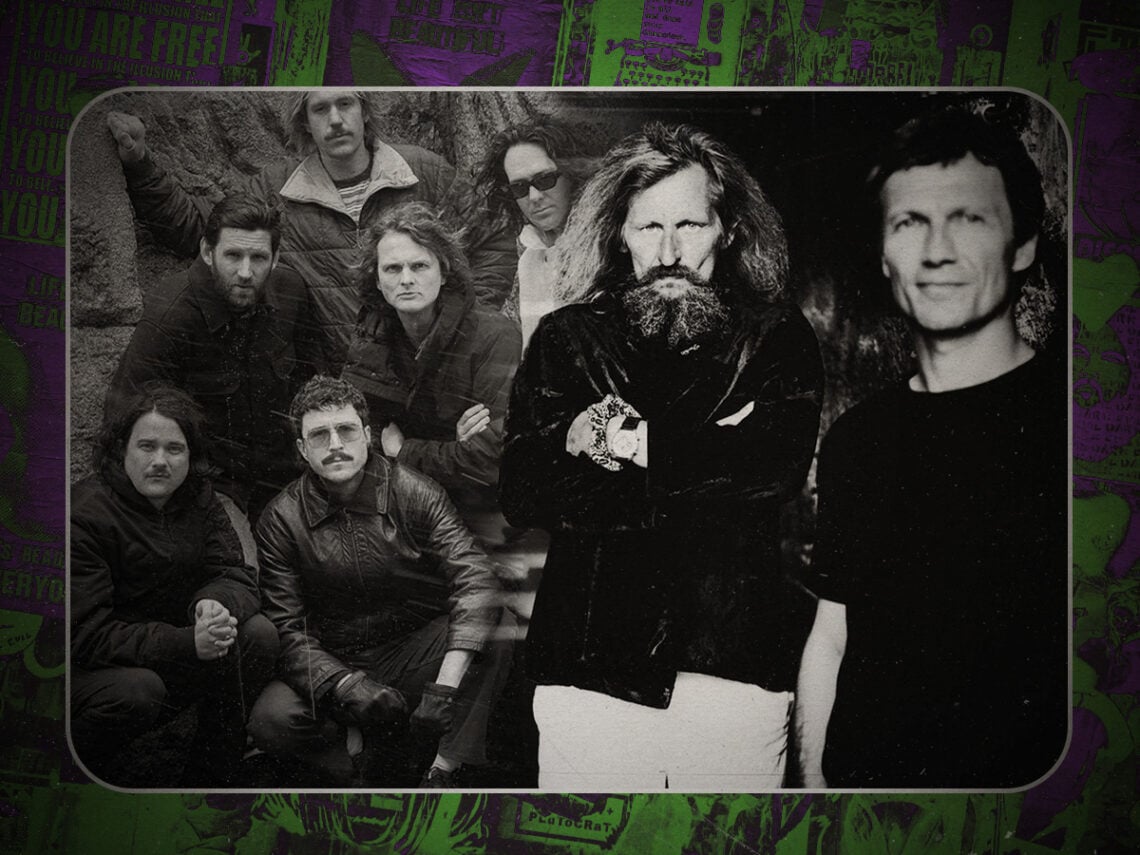
From Neu! to King Gizzard: What is the motorik beat?

It won’t take long for anyone with the faintest interest in the convergence of psychedelia and post-punk to stumble on the mysterious motorik beat.
Like shoegaze, it’s perhaps overused by lazy music journalists, but the art of motoriking has held a long and influential impact on the world of rock and pop and its surrounding avant-garde, prompting such foundational stature that Brian Eno once remarked that motorik formed the essential trinity of 1970s percussion along with James Brown’s funk and Fela Kuti’s Afrobeat.
Some say its roots can be traced back to Moe Tucker’s primal drumming style for The Velvet Underground, but motorik is most associated with the Krautrock explosion that surged amid the West German underground between around 1969 and 1974. It’s by no means a defining feature, the likes of Tangerine Dream and Cluster often frequently lacking any drums whatsoever, but motorik would forever be intertwined with the scene’s Can and Neu!, Jaki Liebezeit and Klaus Dinger respectively universally accepted as the two key motorik pioneers.
Soon enough, the pair’s drumming flair would inspire everybody from post-punk first wavers Siouxsie and the Banshees, Joy Division, and Public Image Ltd, through to today’s Osees and King Gizzard & the Lizard Wizard via Stereobeat and LCD Soundsystem. Wherever you are in the alternative world, the motorik beat is never too far.
So, what is a motorik beat?
There’s no strict, formal breakdown of what exactly constitutes motorik, but the term’s coinage gives a decent clue. German for “motor skill”, the celebrated drumming pattern essentially follows a stolid 4/4 time signature and little else save varying the tempo when necessary.
With such a simple but driving beat, the motorik drums power along with a propulsive trajectory, evoking a linear and forward dynamism, enjoying the sonic traverse of the piece rather than waiting for the destination. Free of fills, showboating, or heavy solos, motorik’s nimble accelerant is the perfect frame to hang all the surrounding proto-punk noise or electronic wanderings together during Krautrock’s experimental heyday.
For the ultimate examples, a listen to anything from Can’s Ege Bamyasi or Tago Mago is a decent introduction, but the first three Neu! albums are exemplary motorik, the opener to their eponymous debut practically textbook. 1972’s ‘Hallogallo’ sees Michael Rother’s furtive guitar and Conny Plank’s taut production precision all gel and mingle with Dinger’s relentless percussion lift.

Steady, focused, and brimming with momentum, the ten-minute opus perfectly illustrates the motorik beat’s binding agent, allowing the piece to take its explorative, meditative trip with amorphous haze but always anchored to Dinger’s elastic rigidity.
Dinger himself never cared much for the motorik tag, preferring his own “Apache beat” naming, but always insisted that his visionary drumming dwelled in something far more organic than the countless journalists who labelled the motorik beat as robotic ever recognised. “That sounds more like a machine, and it was very much a human beat,” he said. “It’s essentially about life, how you have to keep moving, get on and stay in motion.”
