


From greatness to irrelevance: Have Gorillaz lost their touch?

In 2001, the arrival of Gorillaz felt like the beginning of something radical and enormous.
It was a two-pronged attack at greatness. On one side, you had Damon Albarn, still king of the world on the Britpop high, and on the other, you had Jamie Hewlett and the intriguing idea to make a band that didn’t really exist.
That attack was also boosted by the element of mystery. When the first single, ‘Clint Eastwood’, came out, Albarn hadn’t mentioned anything about it, and instead, it was the cartoon characters of 2-D, Murdoc Niccals, Noodle and Russel Hobbs who led the way as the track landed with the first view of them in the first instalment of the many animated videos Hewlett would make for this collaboration.
But it was obviously Albarn’s voice. It was instantly recognisable, especially at a time when he had dominated the previous decade through Blur. Naturally, the song exploded as listeners tried to figure out who this mysterious virtual band really were and what this new chapter meant for Albarn, so far removed from his usual rock and roll persona. The result was a chart hit, with ‘Clint Eastwood’ debuting at number four, an impressive feat for a band many people were still unsure even existed.
That first era of Gorillaz was golden. Albarn came out swinging, stepping beyond Blur to create something far broader and more adventurous. The self-titled debut pulled in everything from dance music to cinematic rock, with tracks like ‘Double Bass’ showing just how expansive the project could be. Then the second album raised the bar even higher.
With Demon Days, they reached another level. The mystery no longer carried it, because by then everyone knew who was behind it. Instead, the focus was simply on great songs. ‘Feel Good Inc’ climbed to number two, and ‘Dare’ followed soon after, taking the top spot.
When they staged a residency to support the album, the band remained in silhouette while their animated counterparts danced across giant screens above them. Every show sold out. At that point, the sense of possibility felt electric. Albarn was making music without restraint, and alongside Hewlett’s fully realised cartoon universe, which both mocked and commented on the emerging digital age, it seemed as though Gorillaz were poised for complete domination.
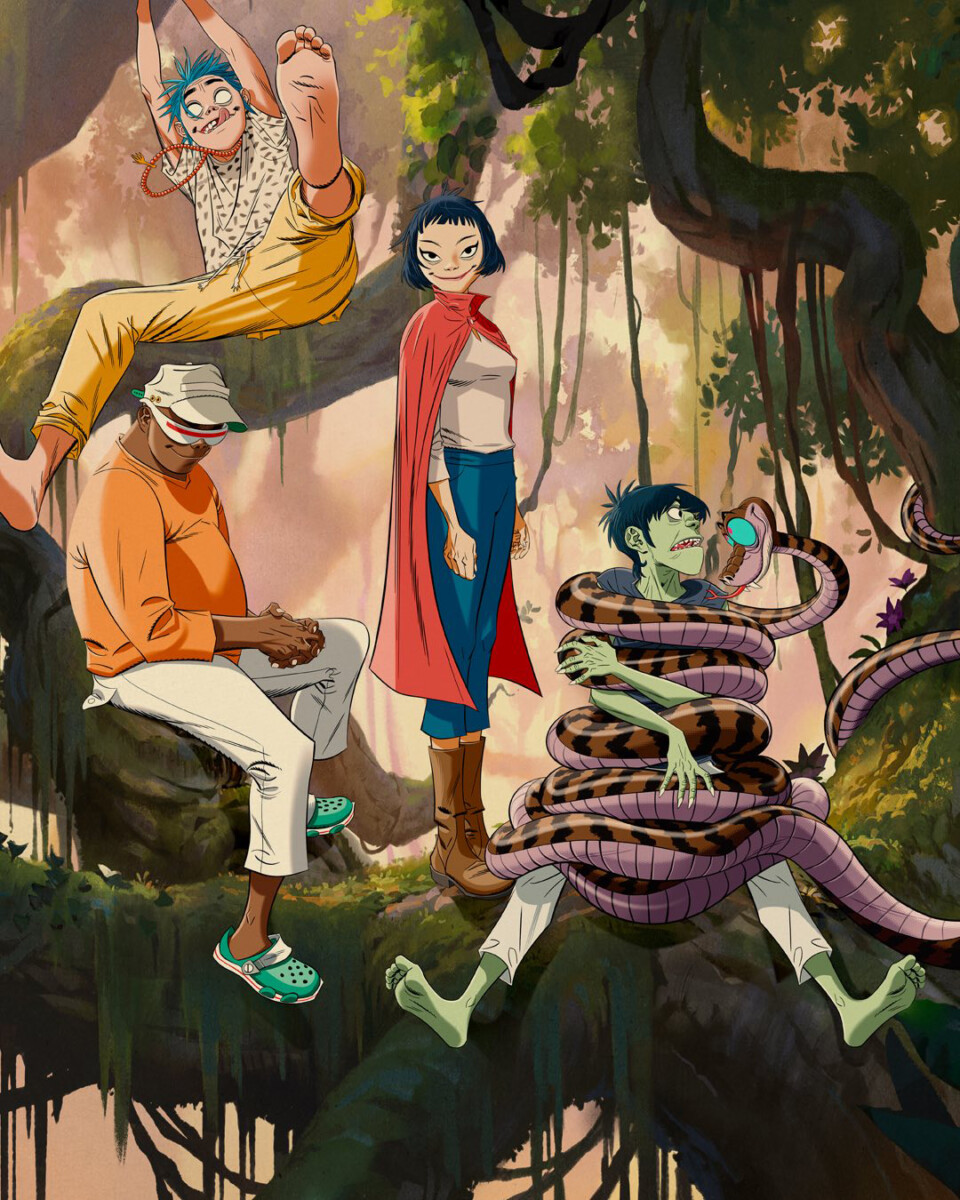
So what happened? If I hadn’t seen it pop up on a release calendar, I would have had absolutely no idea that Gorillaz were releasing their ninth album, The Mountain, this week. I can’t say I’ve heard a single tune from it, and from the record before, only really the title track ‘Cracker Island’ sticks in my mind and that’s really only through the collaboration with Thundercat. Back in 2022, I saw the band play All Points East, and it was good, but only that. Even back then, I remember thinking, ‘What went wrong?’
The answer comes down to the simplest fact: at that huge Victoria Park headline show, I barely even remember seeing the band members, as in, the band’s fictional lineup. Occasionally, they’d pop up on screen, but overwhelmingly, I remember seeing Damon Albarn pushing his way to the front of the stage, even during moments when he wasn’t performing, still needing to steal the limelight from the collaborators who made Gorillaz great.
I think the answer is that Gorillaz failed because of Albarn’s ego, meaning that the whole premise of starting a fictional and virtual band for the digital age collapses when the man behind it wants to be the star. It collapsed long ago when Albarn and Hewlett fell out. Talking to The Guardian in April 2017, the artists said, “Damon had half The Clash on stage, and Bobby Womack and Mos Def and De La Soul, and fucking Hypnotic Brass Ensemble and Bashy and everyone else. It was the greatest band ever,” praising the breadth of the music, but the issue, as he said, was, “The screen on stage behind them seemed to get smaller every day. I’d say, ‘Have we got a new screen?’ and the tour manager was like, ‘No, it’s the same screen’. Because it seemed to me like it was getting smaller.”
Pulling in different directions as Albarn was running away with musical ideas but forgetting the home base of the whole band, it prompted a hiatus after Plastic Beach, and if fans are honest, they never recovered. That was their last great record, but mostly, it felt like the last time the band had any sense of hype, or really any sense of relevance, despite the fact that in the age of AI, a human-made virtual band could be even more fascinating than people thought it would be back in the 2000s.
