


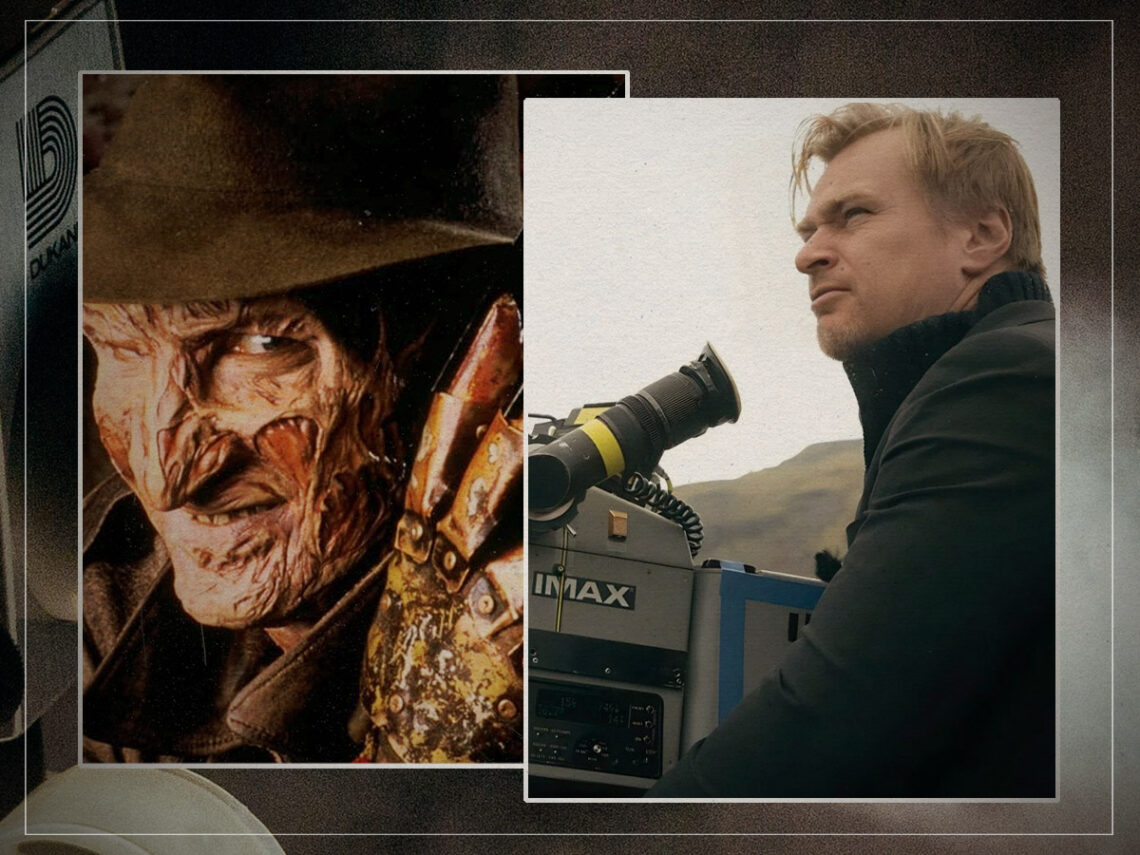
Freddy Krueger’s unsung influence on Christopher Nolan: “I found that pretty terrifying”

Horror is a genre that not many associate with Christopher Nolan, but that never stopped him from drawing inspiration from it.
In fact, you could even argue that there’s a brand of existential horror underlining some of Nolan’s biggest works, such as Interstellar which uses our philosophical insignificance within the context of the cosmos as a central narrative device. Or take Nolan’s debut feature Following, portraying the strange case of a man addicted to trailing people around until his own neuroses drag him into a situation that he can no longer navigate.
There’s also a sense of unintentional horror attached to some of his poorly designed projects like Tenet, where Nolan fans were deeply unsettled by the shoddy craftsmanship and were left wondering whether they would have to jump onto a different bandwagon and start calling someone else ‘The Messiah of Modern Cinema’. It didn’t take long for the “we’re so back, baby” memes to resurface when he hit it big again with Oppenheimer.
See, there’s layers to Nolan’s horror cinema, you just have to be patient and follow the trail, like he expected all of us to do in his 2010 movie Inception. Regarded by many of his fans as one of the pinnacles of his filmography, Nolan used the sci-fi/psychological concept of dream architecture to reimagine the modern heist film, resulting in an outpour of praises for the auteur who knew what it took to engage the “intellectuals” of the film community, if nothing else.
Interestingly, that central novelty that made Interstellar stand out as one of the most popular releases of the 21st century is something that Nolan partially borrowed from a Nightmare on Elm Street spin-off series: Freddy’s Nightmares. With the pilot directed by none other than Tobe Hooper, the Inception director was deeply influenced by the “dream-within-a-dream” gimmick that the show repeatedly used to reinforce the horror of Freddy Krueger.
In Tom Shone’s The Nolan Variations, he said: “There was a show they used to do called Freddy’s Nightmares, which was the Freddy Krueger spin-off, a TV version of the Nightmare on Elm Street films, and there were a lot of situations in that where you wake up from a dream into another dream, and then you wake up from that into another dream… I found that pretty terrifying.”
Of course, Nolan repurposed it into something completely different, but it’s wild to imagine how a lesser-known project like Freddy’s Nightmares contained the seeds for one of the biggest blockbusters of the century. It’s also not the only influence that shaped what Inception turned out to be, as Satoshi Kon’s Paprika contains a laughably long list of similarities with Nolan’s work, even though Kon is more interested in pushing the boundaries of animation to redefine the possibilities of the medium.
Those who stumbled across Paprika thanks to the comparisons to Inception at least have something that they can credit Nolan with: discovering a masterpiece. A few decades from now, it won’t be surprising to see Paprika being cited as one of the revolutionary works of the 21st century and Inception listed as a footnote.
