


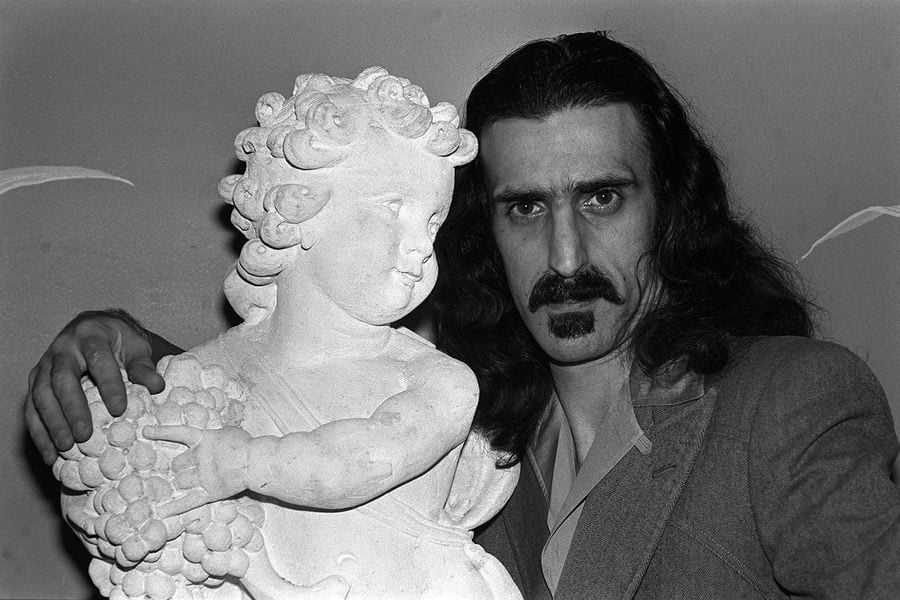
Six definitive songs: The ultimate beginner’s guide to Frank Zappa

In 1971 Frank Zappa was asked by journalist Howard Smith, what he made of audiences becoming increasingly political, Zappa replied in trademark fashion, “It’s superficial, it’s as superficial as their music consciousness. It’s just another aspect of being involved in the actions of their peer group.” When pressed for more details and whether he hadn’t noticed any changes coming from the political movements that began to entwine with his music he replied, “Sure, I’ve noticed a lot of changes, but I think they’re temporary changes. Any change for the good is always subject to cancellation, upon the arrival of the next fad.”
That dialogue, in a nutshell, encapsulates large swathes of what Zappa’s persona was all about. He never seemed to be in the music business, merely playing with its participants whilst masquerading as a rock star. He was shrewd, erudite and often inscrutably ironic. In that same interview where he dismisses political movements as a ‘fad’ he’s asked whether a woman could ever be part of his band, “I don’t think there’s a girl around,” he says, “that could fit in with what we do,” unbeknownst to the interviewer multi-instrumentalist Ruth Underwood was pretty much a fully-fledged member at that stage.
His music is equally inscrutable from a beginner’s perspective, but eventually, it proves terrifically rewarding, which sadly, as far as I’m concerned, amps up the pressure on this introductory piece. What’s worse is that his music is a sort of joyful avant-garde hot-mess that’s almost impossible to express in words.
The term genre-defying is perhaps overused, in part because some people get so pernickety about categorisation that avoiding it offers a safe way to navigate the genre-classified terrain, yet there’s scarcely any artists out there more befitting of the term than Zappa. His music prides itself on non-conformity as did his character; for instance, contrary to how he may look, he was actually an ardent anti-drug advocate. Similarly, his music, contrary to the instrumentation, has more in common with classical music than atypical rock and roll. He started off as a high-school drummer with his early influences being percussion-heavy modern-classical, before picking up the guitar and dipping into doo-wop.
The eclectic mix of influences, however, only tell half the story or as Zappa put it ‘exactly 50%’. After a brief time working in advertising Zappa understood that modern music was half about image and with that revelation the full artistic gestalt that became his act was formed.
Now that’s all quite a lot to take in and I fear we’re absolutely no closer to cornering down his enigmatic sound. Fortunately, with enough listens the music begins to speak for itself, below are simply the most welcoming places to start…
Frank Zappa’s six definitive songs:
Hungry Freaks, Daddy (1966)
Starting at the very beginning is not such a bad way to go. Unlike a lot of artists who start out weird before finding their feet, Zappa perhaps got more unconventional throughout his career. The opening track on the Zappa’s first record with his first band, Mothers of Invention, on their 1966 debut, Freak Out! already captures Zappa’s humour and revolutionary political paradigms.
‘Hungry Freaks, Daddy’ positions counterculture views over psychedelic guitar solos, R&B bass tracks and sound collages. If you manage to bend your ear towards the. Near-chanted lyrics you’ll hear a message that rebukes the ‘relentless consumer culture of America’. Perhaps the most unusual thing of all, and what hopefully makes this is decent starting block, is that this is all formatted in quite a conventional rock and roll way.
Peaches En Regalia (1969)
Although Zappa would continue to work intermittently throughout his career with his old Mothers of Invention bandmates the back end of the ’60s saw his go his own way. From Zappa’s 1969 record Hot Rats comes ‘Peaches En Regalia’ an instrumental roller-coaster through the stratosphere. It says a lot about Zappa’s work that one of his most accessible songs is an instrumental piece.
The track exists somewhere in the multicoloured splatter that would result when you chuck classical, jazz, rock & roll and Dr Suess in a blender. Once again though, it as a song that abides with Zappa’s paradoxical nature as somehow the kaleidoscopic mayhem is always perfectly structured and merely parading as being out of control. The rock influences were starting sway from prominence and varied grooves began to make an impact, Hot Rats, is one of his best as a result of this funky middle-ground.
Don’t Eat The Yellow Snow (1974)
In 1974 Frank Zappa released his most commercially successful album in the US – Apostrophe (‘) – in a decade where he was pretty much constantly making music. All the records he produced in the era are too wildly varied to concisely summarised but that’s part of the fun of being a fan, there’s so much variety all sharing a common madness.
On ‘Don’t Eat The Yellow Snow’ Zappa’s humour is expressed in full force once again. The song’s lyrics tell the zany story of an Eskimo and a fur trapper. The rhythms are audacious and the percussion, as always, is prolifically pronounced but it’s still somehow palatable enough for children to enjoy the juvenile wordplay on offer.
Bobby Brown Goes Down (1979)
Sheik Yerbouti was Zappa’s monumental 1979 double-album recorded at London’s Hammersmith Odeon and The Palladium in New York. The album provided the world with perhaps his biggest hits and easiest entry points. At this point, he was working under an independent label following various legal turmoils in a tumultuous decade and the big hit of the album served as the perfect middle finger.
‘Bobby Brown Goes Down’, is Zappa’s discerning take on societal conventions for decency within a pop song. His profane treatment of pop reaches new heights (or new lows). The track is absurd to a novel degree and yet somehow became his most successful commercial single.
Joe’s Garage (1979)
‘Joe’s Garage’ from 1979’s Joe’s Garage Act I exhibits Zappa’s disdain for the garage punk genre in all of its glory, but it proves far too humorous and light-hearted to ever come across as cynical. The protagonist of the piece is as much of a bonafide madman as his creator and it all makes for a truly chaotic story.
A bizarre narrative rolls around an R&B beat in a track that in some roundabout way slams corporate censorship with unabashed satirical and misanthropic stylings. Once again it is all very weird and wonderful, but the prominent groovy bass makes it not all that hard to digest.
Uncle Meat (1993)
During the ‘80s Zappa delved deeper into his eclectic influences and as a result, it all gets a little bit hard to tackle even for the most ardent fans of berserk beats and strange songs. However, in 1993, Zappa revisited some of his earlier rock classics on The Yellow Shark and produced a blistering reimagining of ‘Uncle Meat’, backed by his trusty band of stellar musicians the Modern Ensemble, it is a fairground fanfare of sound.
Tom Waits who toured with Zappa lent the effort a quote that could just about describe his entire career in the process: “The ensemble is awe-inspiring. It is a rich pageant of texture in colour. It’s the clarity of his perfect madness and mastery. Frank governs with Elmore James on his left and Stravinsky on his right. Frank reigns and rules with the strangest tools.”
Frank tragically passed away not long after this career-defining live album released, but his legacy remains as one of the most prolific wonderful weirdos in music.
