


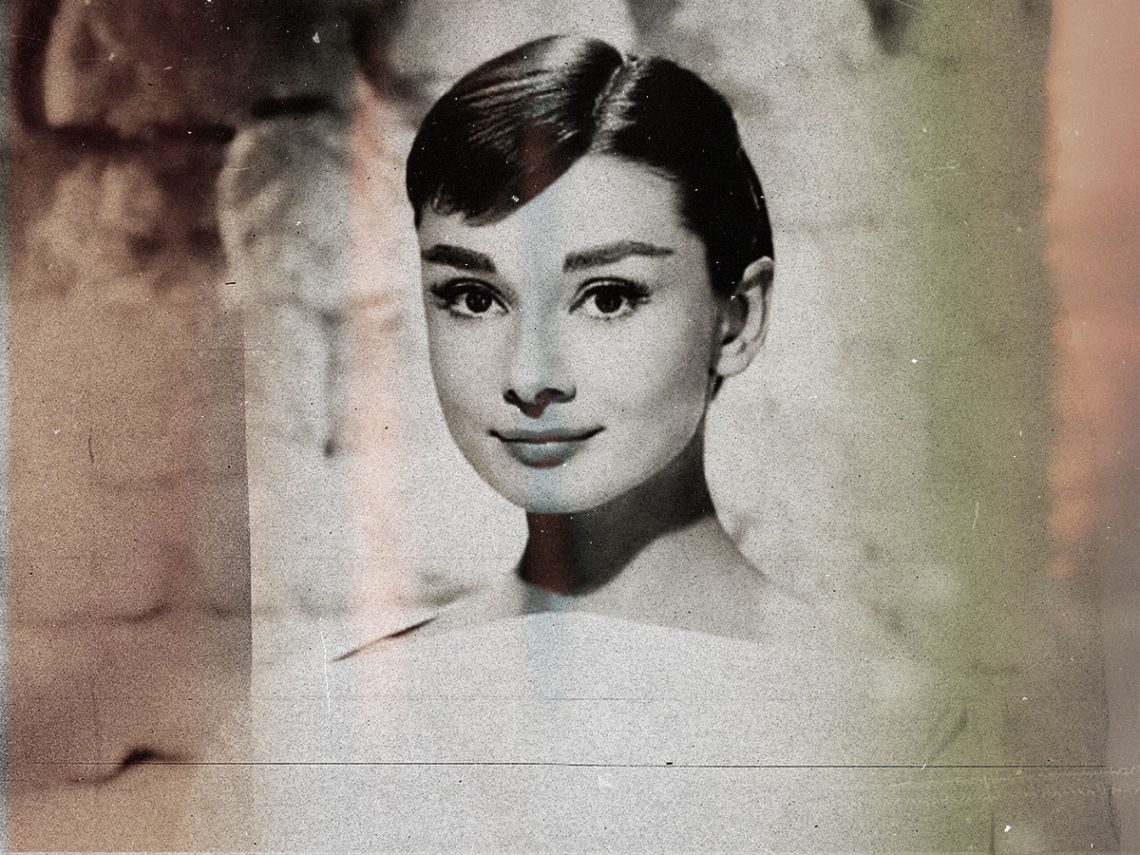
Another side of Audrey Hepburn: the forgotten history of a Hollywood icon

Hollywood did its utmost to portray Audrey Hepburn as a fragile damsel in constant need of protection. She was frequently cast opposite male actors twice her age. Take Fred Astaire in Funny Face, for example, who was 30 years her senior in 1957. Then there was her physique: in an age of curvaceous bombshells, she provided a stark contrast and was rumoured to suffer from anorexia. At just 48kg, she’d been the same weight since childhood, when she and her family had been forced to eat tulip bulbs to stave off starvation.
Hepburn’s life was far more complex than popular culture cares to acknowledge. Born in 1929 to Baroness Ella van Heemstra, a Dutch aristocrat, and Joseph Ruston, a British subject born in the municipality of Auschwitz in Bohemia, she was abandoned along with the rest of the family in 1935, when her father decided to move back to England. It was a huge blow, and even when Hepburn was sent to boarding school in Kent, her father visited just once. Audrey would later renew contact with her father in the 1960s, remaining emotionally detached though supporting him financially until the end of his life.
Ruston and Heemstra didn’t just flirt with Nazism, they were fervent sympathisers. Hepburn’s father was a close friend of English fascist Oswald Mosley, and Heemstra often wrote for the Blackshirt, a newspaper for British Fascists, in the 1930s. There’s less certainty around the claim that Heemstra shared a meal with Adolf Hitler, though she may well have met him. Hepburn’s son, Sean Hepburn Ferrer, has previously stated that Heemstra’s lunch with the Nazi leader was invented to sell Hollywood gossip books.
When the Nazi invasion of Europe began, Hepburn’s mother, believing that the Netherlands would remain neutral as it had during the First World War, moved her back to Arnhem. There she attended the Arnhem Conservatory, where she continued her ballet training. Despite possessing an unusually large pair of feet, she became the star pupil of tutor Winja Marova. Talent was no match for the Germans, however, who invaded the Netherlands in 1940. Her uncle, Otto van Limburg Stirum, was one of the many Dutchmen rounded up and executed for resistance activity. Hepburn’s half-brother Ian was later deported to a labour camp in Berlin.
Though she had little understanding of where they were being sent, Audrey witnessed countless Jewish men, women and children loaded into trains and taken to concentration camps, camps like the one in her father’s home village of Auschwitz. She would later recall meeting the gaze of a very small blonde boy in an ill-fitting overcoat being herded into one of the dark train compartments. The experience left a scar on Hepburn and her family, with her mother renouncing fascism to aid the resistance movement. Audrey may have lent a hand, too, with Ferrer claiming she carried messages hidden in her shoes.
Things grew much worse following the D-Day landings of 1944. The Germans had already demanded higher contributions of vital resources from occupied territories, leading to a decline in living standards. However, they soon lost control of the region and left the dutch to fend for themselves. The winter of 1944 was especially harsh, and Hepburn went for days without anything to eat. She would later recall making flour out of tulip bulbs to make bread. Of course, as an adult, she was noted for being able to eat anyone under the table.
In 1945, Hepburn fell gravely ill and was diagnosed with jaundice, anaemia, oedema, and a respiratory infection. In the October of that year, her mother recieved word from a former lover, a British officer who had spent the last couple of years in Colditz. On learning of Audrey’s condition, he sent thousands of cigarette cartons to Heemstra’s residence, which she then sold on the black market. The money was enough to buy the penicillin that saved Hepburn’s life.
Hepburn’s wartime experience may have been highly traumatic, but it also blessed her with the determination essential for a successful Hollywood career, not to mention the empathy to work for the UN practically full-time. The occupation crushed her dream of becoming a ballerina, but acting filled the gap: at the age of 22, she was spotted by the French author Collette. With her old-world beauty and steely resolve, Hepburn was the perfect fit for the lead role in Gigi, an adaptation of her novella. From that moment on, everything moved at double speed.
