


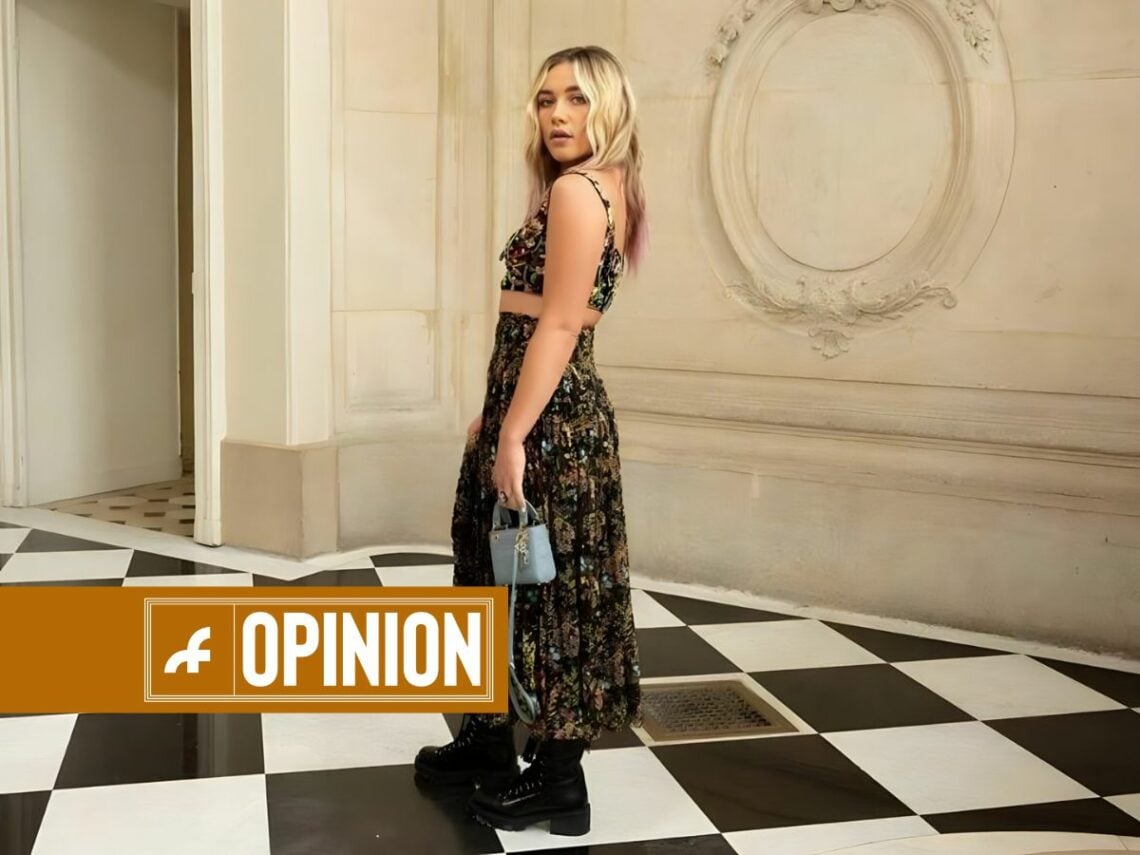
Florence Pugh body shaming speaks volumes about Hollywood’s never-ending misogyny

Surprise, surprise – social media proves to be a hotbed of questionable opinions, and certain fractions of this often toxic community refuse to change the record. Body-shaming actors isn’t a new phenomenon, particularly for Florence Pugh, who’s had to deal with it almost her entire career and twice publicly. The pressing question remains: when will we reach a point where enough is enough?
Pugh stars in Christopher Nolan’s latest blockbuster biopic Oppenheimer as Jean Tatlock, who has an affair with J. Robert Oppenheimer, played by Cillian Murphy. As always, Pugh’s performance is captivating, glamorous, and sophisticated, but of course, social media isn’t all that bothered about that. No, certain people remain more concerned with her appearance, namely her weight, and how unfitting this makes her for nudity in the film.
Unfortunately, this isn’t Pugh’s first foray into the hands of industry misogyny. Last year, she wore a beautiful Valentino dress to its couture show in Rome. The second that images surfaced of her gracefully sporting the piece, she faced a lot of backlash from red top news outlets about her appearance.
In response, the actor posted three pictures of herself wearing the dress on Instagram with a long caption addressing the comments. “What’s been interesting to watch and witness is just how easy it is for men to totally destroy a woman’s body, publicly, proudly, for everyone to see. You even do it with your job titles and work emails in your bio?”
Adding: “I wore that dress because I know. If being loudly abusive towards women publicly in 2022 is so easy for you, then the answer is that it is you who doesn’t know,” she concluded in her statement. “Grow up. Respect people. Respect bodies. Respect all women. Respect humans. Life will get a whole lot easier, I promise”. But it didn’t stop there.
In Oppenheimer, Pugh and Murphy perform a sex scene which includes a number of nude shots. Despite some backlash that doesn’t involve Pugh’s appearance, Murphy has defended its inclusion, deeming it “vital in this movie” and “one of the most crucial emotional parts of the film”. Alas, the chronically online couldn’t stay away from this one either, and commentators have since voiced their opinions about Pugh’s weight, saying that she has a “mid-body”, among other deeply offensive things.
Typically, that criticism fails to be directed toward Murphy. This film actually marks Pugh’s first venture into nude scenes, but not for the purpose of objectification. They exist to serve the wider plot and provide a glimpse into Tatlock’s complexities as someone who was romantically involved in Oppenheimer’s life. But still, these comments exist on the assumption that Pugh needs to look a certain way and appear desirable to perfect strangers.
Pugh has always talked candidly about her treatment in Hollywood, with higher-ups telling her that she needed to slim down and change her face to be successful in the industry. “[But] all the things that they were trying to change about me,” she said, “whether it was my weight, my look, the shape of my face, the shape of my eyebrows, that was so not what I wanted to do, or the industry I wanted to work in”.
With all of the discourse around misogyny, why are social media trolls, and Hollywood, still focused on appearances? Male actors rarely, if ever, get the same treatment. In fact, Murphy has been praised for his losing weight in Oppenheimer as a noble dedication to his craft; meanwhile, Pugh suffers at the hands of loud, obnoxious bigots. It’s a problem women face again and again, whereby their talents are overshadowed by conversations about beauty standards.
At the same time, if we’re going to talk about looks, Pugh does, in fact, align with today’s prevailing beauty standards, so why the obsession? The truth is, the “perfect body” worshipped by these trolls is an unattainable and unrealistic notion. Unfortunately, people seem to have forgotten the potential dangers of unrestricted freedom of speech on the internet, reigniting age-old discussions about its impact on impressionable young people who idolise public figures like Pugh. Engaging in body shaming directed at actors can leave a lasting impression on young users, leading them to question their own beauty and worth, as if their value is defined by such a thing.
Let’s look at what really matters: Pugh is an Oscar-nominated, supremely talented actor who has starred in the selection of the most significant films of the last few years, like Midsommar, Little Women, Don’t Worry, Darling, and Dune. Often, she dives into complex characters, delivering deeply nuanced and emotional performances in a largely effortless and natural way. She’s extremely versatile and has the ability to switch quickly between darker and lighter emotions within a scene, something that not all actors can accomplish. She also researches her roles at length and immerses herself in each experience, making sure that her performances do justice to the subject in which she is representing.
The film industry’s unrealistic expectations imposed on women persist as a relic of archaic beliefs, reducing them to mere objects of objectification. One would hope that by 2023, we would have transcended such antiquated notions, but sadly not. However, these circumstances do offer a revealing glimpse into people’s true character: in the end, if anyone takes issue with Pugh’s appearance, it reflects solely on their own biases and insecurities.
