


The secrets hidden in Fleetwood Mac’s ‘Rumours’ album artwork

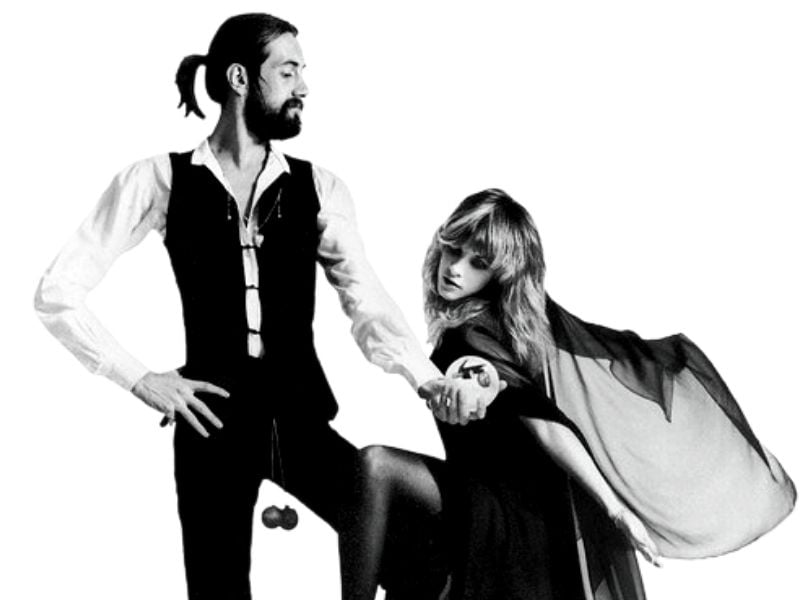
The mystic and the goon with his pendulous wooden bollocks are pop-riveted on the collective psyche of pop culture. The cover of Fleetwood Mac’s Rumours is an instantly recognisable piece of art which proves modern music’s ability to transcend society at large. Pass anyone from 14 to 84 a pencil and they’ll be able to have a go at etching it from memory. But amid the simplicity is a mysticism that holds secrets.
Why does Mick Fleetwood have a pair of groin baubles dangling down from his circus-like get-up? Why is Stevie Nicks clutching a glass orb and dressed like a witch? Why is there a tiny footstool? And why are the characters embraced in some sort of dance? Sure, these are all partly answered by the arty pointlessness of cover affectations (like the eternally unanswerable riddle of why Nick Drake inexplicably isn’t wearing his shoes on Bryter Layter but keeps them in shot).
But surely there is also some rationale? With that in mind, we’re delving into the symbolism hidden in Herb Worthington’s epic cover. So, let’s begin with the elephant in the room: Mick Fleetwood’s wooden testes. Does this rather comic touch downplay the grandeur of the piece, or does it have something important to say about the album therein?
Well, it does both and one informs the other. Rumours came at the precipice where the band were suddenly not sleeping with each other, but about the reignite this practice with different partners. Thus, testicles, in the traditional sense, really did have a big part to play in the album. That, in itself, is a comic disposition. Carnality was a key factor of the album, and it was creating a farce, hence depicting them as a joke amid the artistry is a visual punchline. And they’re front and centre rather than a wry aside, because, in essence, sex was central to the art.
These swinging nads also have a backstory. They were originally part of a chain toilet flush that Mick lifted from a pub and dangled them off his drumkit as a good luck charm. They stayed with the band through thick and thin thereafter, proving that the comedy also says that they’ve laughed through hard times in the past and get through things with a touch of charm.
The same can be said for Stevie Nicks’ witch-like attire. This outfit depicts Rhiannon, a character Nicks crafted as a sort of “celestial queen”. This mystic being is a goddess that represents the vitality and music. A sort of character who swoops along once in a while and revels in the freedom of rhythm. In this case, she represented how each of the members found themselves in a dark state of despair, but the music itself was a sense of transcendence.
So, what of the crystal ball she gazes at? Is it a prognostication of the relationship that the cover stars would enjoy further down the line? Well, seeing as though the orb also appears on their 1975 self-titled album and The Dance too, the murky image in the ball seems to foreshadow an uncertain future for the band but a future no less. The fact, it appears repeatedly, hints at a mystic continuation of Fleetwood Mac, and thank God for that I suppose.
This also explains the dance pose itself. The twists and turns of the album fit with a ferocious tango perfectly. Rumours, like tango, was the drama of troubled romance rendered in the tangible truth of art. And beyond that, there is also a touchstone to Pete Townshend’s proclamation: “Rock ‘n’ roll may not solve your problems, but it does let you dance all over them.”
As for the footstool, nobody knows! Worthington brought it along with him for the shoot, so unless he’d just picked it up along the way, he must’ve had some intent for it. Whether it was to give Nicks a leg-up in a literal sense is possible. Whether it said that Mick Fleetwood gave her a leg-up in the industry in a literal sense is also possible. Personally, neither of those sit quite right, but there are some mysteries – even in the most ubiquitous art – that are meant to endure.
