


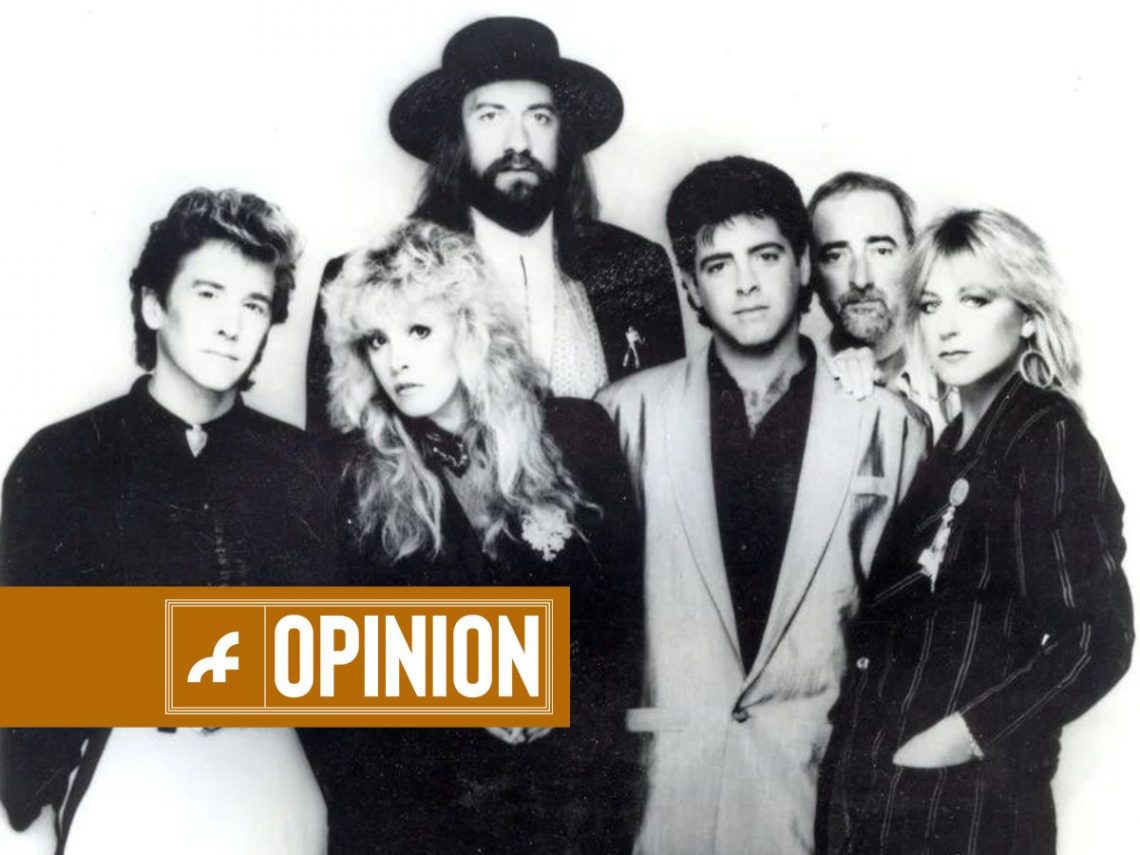
Hear Me Out: Fleetwood Mac album ‘Tusk’ was their greatest creation

Fleetwood Mac are a band with a history unlike any of their peers. Very few groups can claim to have had two such disparate incarnations that were quite so influential in their own right. Starting out as a heavily blues-orientated group underpinned by the guitar virtuosity of Peter Green, the late-1960s Fleetwood Mac was an entirely different beast to the one that would re-sketch the pop-music blueprint in the late ’70s.
In 1970, after three years of notable success with their LSD-induced blues incarnation, Green left the group to recuperate his mental health following dense touring commitments and a shed-load of illicit chemicals. With drummer Mick Fleetwood and bassist John McVie as the consistent hub of the band, they moved through a transitional period between 1970 and ’75, after which they were the proud hosts to the American power couple Stevie Nicks and Lindsey Buckingham.
The romantically entwined pair joined Fleetwood Mac on New Year’s Eve 1974, just in time to greet a new year of change. This rejig got underway in the form of the 1975 self-titled album, which brought Nicks’s lyrical talents to the global arena in the form of singles ‘Rhiannon’ and ‘Landslide’.
While Fleetwood Mac marked a shift in momentum for the group, the fiery, cocaine-fuelled exposé of 1977’s Rumours gave Fleetwood Mac their commercial peak, ten years and eleven albums into the band’s existence.
Rumours was also released ten years after The Beatles’ landmark Sgt. Pepper’s Lonely Hearts Club Band, an album with which I believe it has a lot in common. Sgt. Pepper trailblazed the fusion of avant-garde and pop, setting the controls for the heart of the sun and beckoning the prog-rock era. Ten years later, Rumours pioneered pop once again for a new generation. Needless to say, both albums sold handsomely.
The White Album (or The Beatles, as it is less commonly but correctly known), which brought a smorgasbord of creative dynamism to a two-LP epic, had fans divided upon its release in 1968. Some saw it as The Beatles’ masterwork, the main course to Abbey Road’s dessert, while others saw it as pretentious, indulgent and tedious. The argument I submit to you today is that Fleetwood Mac’s Tusk is, in many ways, akin to The White Album and deserves as much, if not more, respect than Rumours.
Tusk has, too, been described as indulgent (mainly on Buckingham’s part) and a little pretentious by some fans who were ostensibly expecting Rumours mark two. I agree with this sentiment in part but maintain that a little pretension never hurt a fly, and indulgence is key to artistic progression. Headstrong creative passion is, in its very nature, indulgent. Do you think The Beatles would have been quite so prolific had Paul McCartney sat in the back seat so as not to alienate his bandmates?
When listening to The White Album, I’m likely to skip a couple of tracks here and there to get to the sweet nectar of ‘While My Guitar Gently Weeps’ and ‘Happiness Is A Warm Gun’, but with Tusk I’m happy to enjoy the journey, as long as it might be. Often, double albums contain fat that should have been trimmed for B-side compilations, but Tusk came as a varied and finely-balanced listen.
With expectations riding high in 1978, Buckingham expressed his desire to depart from the pop-tendency of Fleetwood Mac and Rumours towards a more progressive and varied sound. His bandmates hesitantly agreed and let Buckingham take the reigns for much of the material. He would work on the new material alone at home before bringing ideas to the band at the studio.
Buckingham’s interest in the blossoming post-punk movement was a palpable influence on Tusk. After becoming fascinated with bands like Talking Heads, he was “desperate to make Mac relevant to a post-punk world.” Heavily picked and distorted guitar runs in numbers like ‘I Know I’m Not Wrong’ and ‘Not That Funny’ show this influence the most, but it’s prevalent throughout some of the album’s slower tracks too.
Elsewhere, Tusk offers balance in the form of Nicks’s plaintive balladry in ‘Storms’ and ‘Beautiful Child’, the tumbling tribal powerhouse that is ‘Tusk’ and the hippie hangover mystique of ‘Honey Hi’ – a likely unintentional nod to The White Album’s ‘Honey Pie’.
During a 2021 interview with Forbes, Buckingham reflected on his musical philosophy and explained why he wanted to avoid making Rumours 2 at all costs. Mentioning Tusk, Buckingham said: “The whole impulse was to make sure that you didn’t succumb to the external expectations that begin to sort of close in around you in terms of commerce from the label or in terms of just the set of preconceptions that people have about you that they want you to sort of formulise and stick to for the rest of your life, which is tantamount to painting yourself into a corner creatively.”
“And I was never one who wanted to do that,” Buckingham continued. “I always wanted to define myself as an artist in the long-term, as much as I was able to. And so those are choices you make, and there are outcomes you make.”
Expanding on the sentiment, Buckingham analogised his creative outlook to those of film directors. He addressed his less successful solo work at this point: “The solo endeavours I probably lose nine-tenths of the people that might gravitate to Fleetwood Mac, but it’s a difference between, ‘Do I want to be Steven Spielberg or Jim Jarmusch?’”
He then elaborated, saying that he would rather be like the lesser-known director Jarmusch because he focussed on the avant-garde and creative exploration rather than selling out with tedious “sequels”.
While Tusk didn’t sell as well as Rumours, it pushed more creative boundaries while retaining artistic integrity. The music is wholly enjoyable, and one can respect Buckingham’s boldness in expanding the horizon for Fleetwood Mac.
In a 2019 interview with The Independent, Mick Fleetwood described Tusk as his “personal favourite” and said: “Kudos to Lindsey … for us not doing a replica of Rumours.”
Hear the brilliant double album below.

Never Miss A Beat
The Far Out Beatles Newsletter
All the latest stories about The Beatles from the independent voice of culture.
Straight to your inbox.