


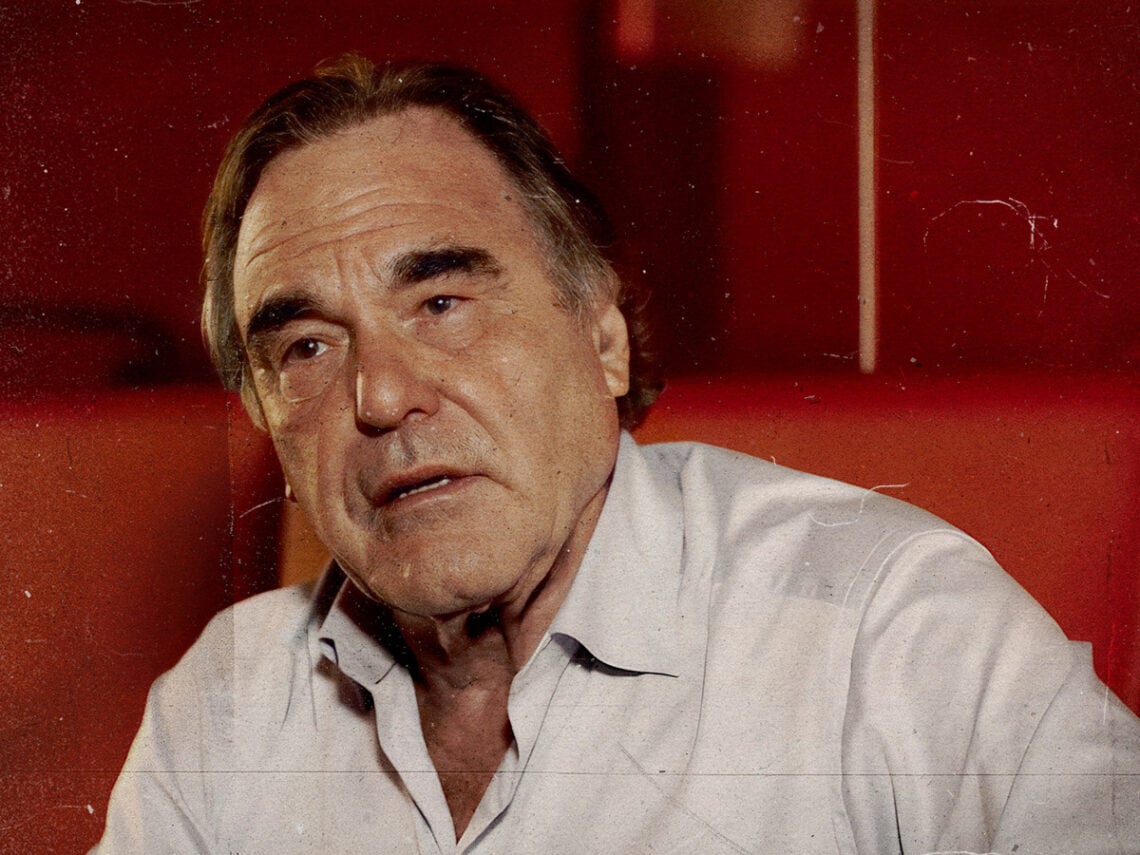
Five times Oliver Stone went too far

If you’re after a director with an incredible back catalogue who has also faced decades of stiff criticism for his professional and personal views, then look no further than Oliver Stone. The American filmmaker has led an extraordinary life. He served in the Vietnam War, earning multiple distinctions, including the Purple Heart. He began his Hollywood career as a scriptwriter, turning in the screenplay for Scarface, among other things, before finding his footing as a director with the likes of Platoon and Born on the Fourth of July.
Along with his old wartime stomping grounds, Stone is also famous for producing political movies that often contain ideas outside of the mainstream. He’s made a number of documentaries on subjects including nuclear power, John F Kennedy, and Hugo Chávez. He is outspoken, unflinching, and never too far away from controversy.
Stone never seems bothered by other people’s opinions of him. He does things his way, which can sometimes be great and other times an absolute catastrophe. This approach has earned him as many fans as it has detractors, but even his most ardent supporters would have trouble defending these incidents.
Whether through his work in fiction, non-fiction, or outside of film altogether, these five moments from across Stone’s extraordinary life and career reveal a depth of character like no other. Love or hate him, it is impossible not to have an opinion of him and a strong one.
Five times Oliver Stone went too far:
Promoting JFK conspiracy theories
Stone has directed several films about the lives of US presidents, but by far and away, the most well-known and impactful is JFK. Set in the aftermath of the assassination of John F Kennedy, the movie sees Kevin Costner’s character go down a rabbit hole of conspiracy, determined to prove that there is more to the crime than meets the eye. One on one hand, Stone should be applauded for pursuing his own version of events and asking questions about one of the most famous murders in history. On the other, given the state of modern American politics, he may have been the one to light the fuse.
JFK brought political conspiracy to the mainstream. Though it may not have been his intention, you can trace the influx of government suspicion in current politics back to Stone’s movie, as he was one of the first to legitimise claims that would have otherwise been dismissed as nonsense. Just look at Robert F Kennedy Jr, JFK’s nephew, who has long campaigned to release secret documents surrounding the case. There is even speculation that Donald Trump secured his support by promising to lift the lid on the remaining Kennedy files.
Savages’ fake scene
Let it never be said that Oliver Stone plays it safe when making his films. Platoon was heralded for its gruesomely accurate depictions of the Vietnam War, and he directed a fictionalised version of the September 11th attacks just five years after they happened. Sometimes, though, creativity can go too far and end up detracting from a movie instead of enhancing it. Just look at Savages, the 2012 cartel thriller starring Taylor Kitsch and Aaron Taylor-Johnson.
The film, which features two marijuana-growing pals trying to rescue their joint girlfriend (Blake Lively) from the clutches of a Mexican drug gang, runs quite smoothly until its third act. After a gunfight with the gangsters, the three lovers all inject themselves with a fatal overdose so they can die at the same time. A touching and poignant moment… until it’s revealed to a dream sequence a few moments later. Playing around with cinematic form is one, but getting your audience invested in three characters’ deaths and then pulling the ‘it’s just a prank, bro’ card is something else completely. The scene drew criticism from many sides and it left a black mark against an otherwise engrossing picture.
Inspiring real-life murders
This one isn’t strictly speaking Stone’s fault, but it still happened. One of the director’s most infamous works is 1994’s Natural Born Killers. Starring Woody Harrelson and Juliette Lewis as two psychopathic lovers, the film follows the pair as they commit a series of heinous murders. Stone’s mission statement with the film is to expose how the media glorify such acts of violence, as his main characters become celebrities off the back of their vicious killings. This is certainly a point worth exploring, but sadly, it became more pertinent than anyone could have ever expected.
In the wake of the film’s release, a number of real-life crimes were connected to it. A pair of 18-year-olds shot and killed a man two days after watching the movie and then shot another woman, who didn’t die but was rendered quadriplegic. The survivor, Patsy Byers, tried to sue the makers of Natural Born Killers, but the case was dismissed. The most notable incident inspired by the film was the Columbine school shootings of 1999. The perpetrators of the attack, which left 13 people dead, referred to their plans as “NBK” in their journals.
Defending Harvey Weinstein
You’d be hard-pressed to find anyone major in Hollywood who hadn’t worked with Harvey Weinstein prior to his sexual assault allegations. His and his brother’s company Miramax (and later The Weinstein Company) produced and distributed dozens of famous movies and TV shows. Stone was going to work with Weinstein on a TV series about Guantanamo Bay until the myriad of allegations surfaced against the producer. The director stepped away from the series, but not before sullying himself with a series of remarkably ill-judged comments.
“I’m a believer that you wait until this thing gets to trial,” Stone told The Hollywood Reporter in 2017. “I believe a man shouldn’t be condemned by a vigilante system. It’s not easy what he’s going through, either.” Knowing what we know now, that Weinstein was convicted of three counts of rape in California and two further felonies in New York (although those were later overturned), this remark is wildly inappropriate. Stone readdressed his words later that same day, saying he didn’t know the full extent of the accusations, but this just came across as pandering to the media in an attempt to save his own bacon.
Ukraine on Fire
Oliver Stone’s political views are a complete mystery. Everything about him, his movies, his attitudes towards government, and his comments to the press would suggest he is extremely left-wing. However, on more than one occasion, he has expressed an appreciation for Russian President Vladimir Putin. In 2017, he released The Putin Interviews, a series of hour-long conversations with the controversial politician. It was met with labels of bias that Stone was using his platform to promote a man with heinous ideals. It didn’t help that, just one year earlier, Stone had been involved in the highly contentious documentary Ukraine on Fire.
The film, which was directed by Igor Lopatonok, produces a Russia-friendly version of the 2014 Maidan Uprising when Ukrainian President Viktor Yanukovych was forcibly removed from office after refusing to sign a treaty with the European Union. Stone serves as the chief voice of the documentary, interviewing various pro-Russian figures and promoting their ideas that the Uprising was a US-backed coup. Russia had already annexed Crimea by this point, and considering what would happen between the two countries in later years, Ukraine on Fire comes across in extremely poor taste and in stark contrast to everything that Oliver Stone should stand for.
