


Five times Denzel Washington proved he was an improv genius

There are few actors working today who have the stature and respect of Denzel Washington. Throughout his nearly five decades on screen, he’s provided some truly iconic performances, from his turn as civil rights leader Malcolm X to his chilling role as LAPD detective Alonzo Harris in Antoine Fuqua’s Training Day.
Even as other veteran actors like Robert De Niro and Sean Penn devolve into lesser and lesser roles, Washington has maintained a formidable track record, turning out some of the best performances of his career in recent years. It’s no surprise that he’s been nominated for ten Oscars. His consistency sets him apart, and his number of nominations puts him on par with the likes of Al Pacino, Spencer Tracy, and Paul Newman.
Although Washington has shown his proficiency in interpreting the works of Shakespeare and other great playwrights of the ages, one of his strong suits as an actor is improvisation. This may come as a surprise to some film fans. Many of the actors who have a habit of ad-libbing have a reputation for being loose cannons on set, especially when everyone else is dutifully working off the script. Robin Williams, Jim Carrey, and Jack Nicholson are all known for riffing, which often leads to performances that overshadow everyone else’s.
Washington, in contrast, demonstrates how improvisation can be used to enhance a film without monopolising it, leaving his co-stars with material to work with instead of out-acting them into submission. There are countless examples of his use of the technique, but five stand out as some of his most memorable moments on screen. Not surprisingly, most of his collaborators admit that they were just as dumbstruck to see his skill unfold in real time as audiences are to see it unfold on screen.
Denzel Washington’s best improvisation moments:
When he outdid Malcolm X in Malcolm X
Whenever a biopic is made of a towering historical figure, finding an actor who can impart a similar sense of gravitas to the role can be tricky. Luckily for Spike Lee, Denzel Washington had gravitas to spare when he stepped into the shoes of the titular civil rights leader in 1992’s Malcolm X. Based on Malcolm’s posthumously published autobiography, there was plenty of carefully crafted prose to draw on for the script, as well as hours of documentary footage of his electrifying speeches. However, Washington found a way to enhance the primary sources even further, even if he hadn’t planned on it.
“All the speeches in the film were Malcolm’s actual speeches,” Lee explained on Black Media Minute. During one scene, he remembered watching Washington through the camera while keeping an eye on the text of the speech. When the star spoke the last line, Lee was about to call cut until he realised that the actor was still speaking. “He kept going for another five minutes,” Lee said, “Until finally, the film ran out of the magazine. And the stuff that he said was better than Malcolm’s words.”
Washington spent a whole year preparing for the role, putting the rest of his career on pause. By the time he was on set, he had the character so deeply ingrained that he was able to ad-lib as if he were Malcolm X himself. When Lee asked himwhere those extra five minutes came from, he simply said, “Spike, I don’t know.” Somehow, he lost the Oscar to Al Pacino that year.
When he refused to lose in He Got Game
One of Washington’s most memorable moments of improvisation may, ironically, have been more about personal competitiveness than acting inspiration. In Spike Lee’s 1998 drama, He Got Game, the actor plays an incarcerated man who is promised a reduced prison sentence if he can get his son Jesus, a star basketball player, to sign a contract with the governor’s alma mater. Long before Challengers turned the tennis court into a battleground of personal relationships, Lee turned a one-on-one game of pickup basketball into a wordless crucible for father and son.
Jesus was played by real-life NBA star Ray Allen, whose skills as a three-point shooter on the Milwaukee Bucks were already legendary just two years into his 18-season career. In the script, he was supposed to beat his dad 11 to zero, but Washington wasn’t about to lose that easily. In fact, he told Allen repeatedly in the lead-up to filming the scene that he wasn’t good with his left hand. On the contrary, he had been tirelessly practising with only his left hand so that when the time came to shoot the scene, he could catch his co-star off guard.
As Lee remembered it, Ray, a first-time actor, was stunned by the deviation from the script, calling for the director to impose a time-out. Meanwhile, his acting coach was standing on the sidelines, shouting at him to stay in character. Eventually, that take went into the movie, making the confrontation between father and son all the more tense.
When he cried a single tear in Glory
Washington won his first Oscar for his portrayal of a runaway enslaved man who joins the Union army in Edward Zwick’s 1989 Civil War drama. Private Silas Trip is world-weary beyond his years and mistrustful of those around him. Throughout the film, he remains hardened and stoic, except for one scene in which he betrays the smallest hint of vulnerability.
At one point, Trip leaves his regiment to look for shoes, only to be accused by his commanding officer, Captain Shaw (Matthew Broderick), of desertion. Shaw orders him to be flogged in front of the rest of the men. As the punishment begins, Trip is defiant, staring straight into Shaw’s eyes. When the camera zooms in, however, his chin trembles ever so slightly, and without breaking eye contact with Shaw or even blinking, he sheds a single, devastating tear. Washington has denied that the moment was intentional, insisting that the pain of the whip was to blame for his reaction.
Even if he was goaded into betraying emotion through some highly questionable tactics on the part of the director, the control he demonstrated in that moment – that barely perceptible tremble of the chin, that single tear delivered just as the camera reaches a close-up of his face – perfectly encapsulates his unparalleled skill as a performer. Even when he’s improvising, he is always controlled. Katharine Hepburn was legendary for her ability to cry a single tear on command, even doing it in take after take while filming Guess Who’s Coming to Dinner? But try finding another actor besides Washington who can do so without succumbing to the temptation to go just that little bit further. It’s the restraint that makes it so masterful.
During every scene in Gladiator II
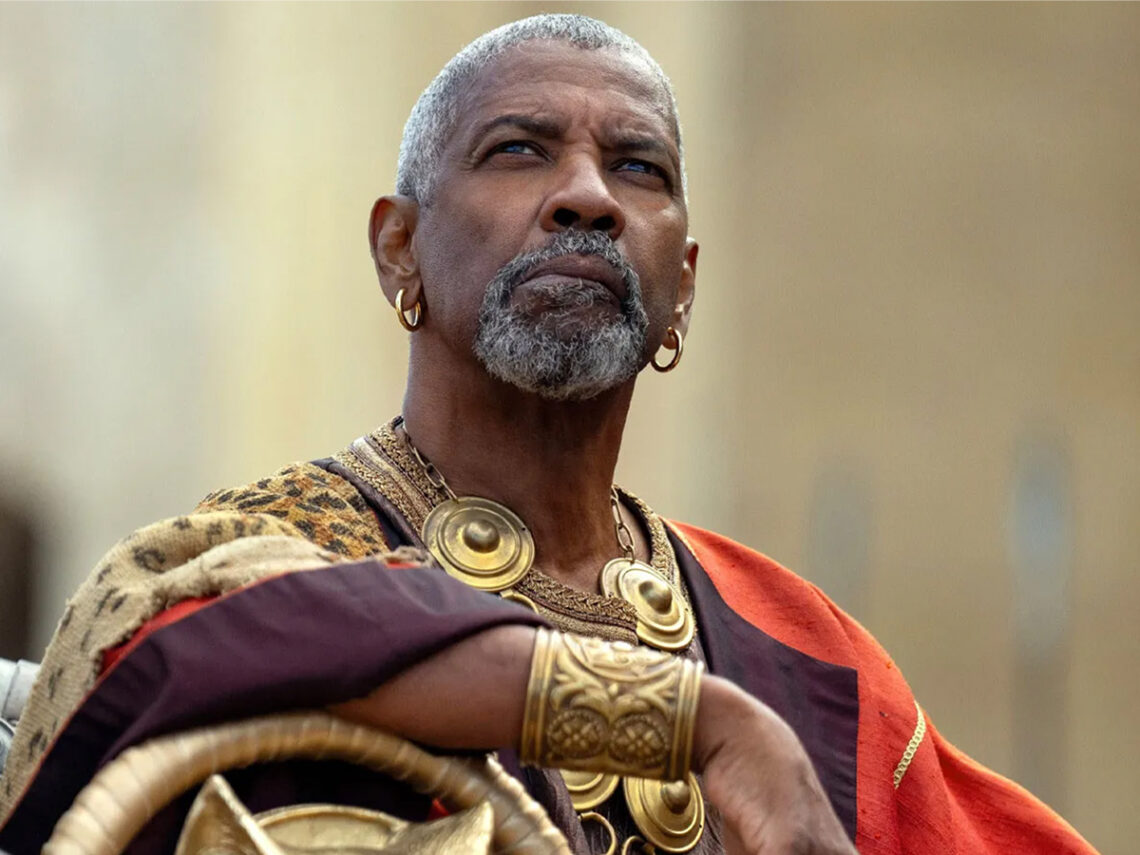
Much has been made of Washington’s performance in Ridley Scott’s 2024 sequel to his hit 2000 sword-and-sandals movie. There was controversy over his accent (he used his own), controversy over whether a same-sex kiss was cut from the film (Scott insists it was not), and questions about whether he was a bit too dramatic in his role as a Roman slave-turned-political powerbroker (no such thing). But all of this is beside the point. Washington is the backbone of this film, no matter how heroic and muscly Paul Mescal is. Whenever the Oscar winner is on screen, there is no room for anyone else.
It isn’t clear whether or how much improv Washington did in the movie, but it’s safe to say that his intonation and physicality were very much of his own creation. There is a scene in which he enunciates the word “politics” with so much devilish glee and so many syllables that it singlehandedly steals the picture. Then, there’s all the sleeve fondling, which is as suggestive and as strangely mesmerising as it sounds. It is quite possible that we will discover someday that Washington ad-libbed every line in the movie, but even if he did quote every word from the script verbatim, he demonstrated just how creative you can be in a role without changing a single letter.
When he made up the King Kong monologue in Training Day
Washington has held down some pretty iconic roles over the years, but it’s possible that his turn as corrupt LAPD detective Alonzo Harris will be the one he’s remembered for most. Directed by Washington’s frequent collaborator Antoine Fuqua, the film stars Ethan Hawke as Jake Hoyt, an eager young narcotics officer learning the ropes from the veteran detective. At first, Harris appears to be a by-the-book cop determined to rid the streets of crime, but Hoyt quickly discovers that he is as crooked as they come, using his power to brutalise the community and walk away a rich man.
What begins as a training day escalates into a life-and-death struggle between the two men. During the climax, Harris tries to use his influence one last time to get the neighbourhood to kill Jake. No one takes him up on the offer. Realising that he’s losing his grip on the community, he begins to rant, throwing out his usual threats of prison sentences that, for years, have gotten him the fear he desires. “Imma burn this motherfucker down,” He shouts. “King Kong ain’t got shit on me.”
It’s an iconic moment, a boiling point in which a bully isn’t brought low by someone who can match his brutality, but by indifference. The volatility that Washington brings to the character was mirrored in real life by his improvisation. “The King Kong moment came out of Denzel,” Fuqua told Vanity Fair. “I remember that moment because we were doing the scene, and he just started going off. I remember looking at the cameraman and saying, ‘I hope you got that, because I don’t think we’re going to get that again.’”
