


Five movies that eerily predicted the present

Most movies set in the future have pretty bleak expectations. They usually involve some form of dystopia, whether it’s a barren wasteland torn asunder by civil war or bloodlust in outer space. If a film looks like it’s set in utopia, fast-forward to the end. Things are guaranteed to get ugly.
Most movies about the future get things laughably wrong. 2001: A Space Odyssey imagined the cosmos as a heavily trafficked transit area in which spaceships flitted from planet to planet to take suited businessmen to board meetings. That might not exactly be the film’s premise, but it is the setting. Back to the Future II set expectations way too high when it predicted that in the year 2015, teens would be zipping around suburbia on hoverboards. They also imagined a world in which fax machines were conveniently affixed to mailboxes, so they weren’t thinking too far ahead on everything.
Some movies got some general things right about the future, but took such a big swing that specific inaccuracies overshadow those general accuracies. Ridley Scott’s Blade Runner predicted environmental destruction, overcrowding, and artificial intelligence, but the flying cars have yet to come to fruition.
The movies that got the future right were not dreaming up exciting new methods of transportation. They were predicting the breakdown of the media, police brutality caught on camera, reality TV, and an increasingly unimportant and imbecilic United States of America. All of them are almost certainly less entertaining to watch now than they would have been when they were released. Comedy turns to all-too-familiar tragedy, wild flights of imagination turn to grim docudrama. Still, we should give credit where credit is due.
Five movies that predicted the present:
‘Idiocracy’ (Mike Judge, 2006)

Stop me if you’ve heard this one before: America, gripped by anti-intellectualist fervour and zombified by consumerism, elects a former reality television star and certified numbskull as president, sees its collective intelligence plummet as the public discourse grows increasingly reactionary and polarised, and winds up barely verbal in a literal rubbish heap of a country. Perhaps that latter bit hasn’t happened yet, but otherwise, 2005’s Idiocracy was bang on the money. The catch is that it was set in the year 2505.
The story begins in 2005 when scientists recruit an army librarian (Luke Wilson) and a sex worker (Maya Rudolph) for a top-secret experiment in which they are put into hibernation for a year. When circumstances change, they are abandoned and left for 500 years until an avalanche of rubbish wakes them up. They awake to find that the intellectual elites of society have decided against having children due to climate change and the demands of their careers, which has led to a tipping of the scales toward anti-intellectualism, sensationalised media, and a massive food shortage (they’re feeding the crops electrolyte drink mix).
It might not get everything right, though. Its major flaw is that it attributes the decline in society to dysgenic rather than, say, the rise in social media and decline in the education system. However, it imagines a dystopian future that has some pretty eerie similarities to America’s war on science, the deterioration of the attention span, and the rise of government as entertainment.
‘Gattaca’ (Andrew Niccol, 1997)

Gattaca is a criminally overlooked science fiction film about self-determination over genetics, and it is the perfect antidote to the uncomfortable premise of Idiocracy. It is set in a future where eugenics has created a two-tiered society in which children who have been genetically engineered and selected (‘valids’) hold positions of power while children who were conceived naturally (‘in-valids’) are second-class citizens.
Ethan Hawke plays a cleaner in the latter category who dreams of going to space, even though only ‘valids’ are allowed to be astronauts. In order to make it through the genetic profiling at the space travel company he wants to work for, he enlists the help of Jude Law’s character, a ‘valid’ who is now confined to a wheelchair after an accident.
There is a growing pronatalist movement in the tech world right now that is ostensibly meant to help curb falling birth rates but is steeped in the sort of eugenics that Gattaca depicts. Self-described ‘techno-puritans’ are advocating for IVF in order to screen embryos for physical illnesses, mental health issues, and even intelligence. While all of this is still on the fringes of society, it has some pretty prominent supporters, most notably Elon Musk, who believe it is the way of the future.
‘Strange Days’ (Kathryn Bigelow, 1995)

Kathryn Bigelow has never pulled her punches. Her movies tend to be graphically violent and bitterly realistic, so it’s no wonder 1995’s dystopian thriller Strange Days bombed at the box office. Set only a few years in the future, it depicts a version of Los Angeles in which riots are a constant state of life, and the police have instated martial law.
It follows a former LAPD officer, played by Ralph Fiennes, who sells bootlegged recordings of memories. Through a new type of technology, both visual and physical sensations can be recorded directly from the cerebral cortex onto a disc so that others can experience it as if it were firsthand. Not surprisingly, those recordings involve sex, violence, and crimes that the perpetrators never meant for anyone to see.
The movie was a direct reaction to current events, most notably the brutal police beating of Rodney King. In a post-George Floyd world, when police killings are broadcast over the news on bodycam footage, Strange Days doesn’t look like it’s set in the future at all, and only those minidiscs betray that it was made in the ‘90s and not the present day. As virtual reality becomes more and more sophisticated, the idea of first-person experiences – even ones as grotesque as those – becomes a black market commodity, seems like more of a ‘when’ and not an ‘if.’
‘Network’ (Sidney Lumet, 1976)

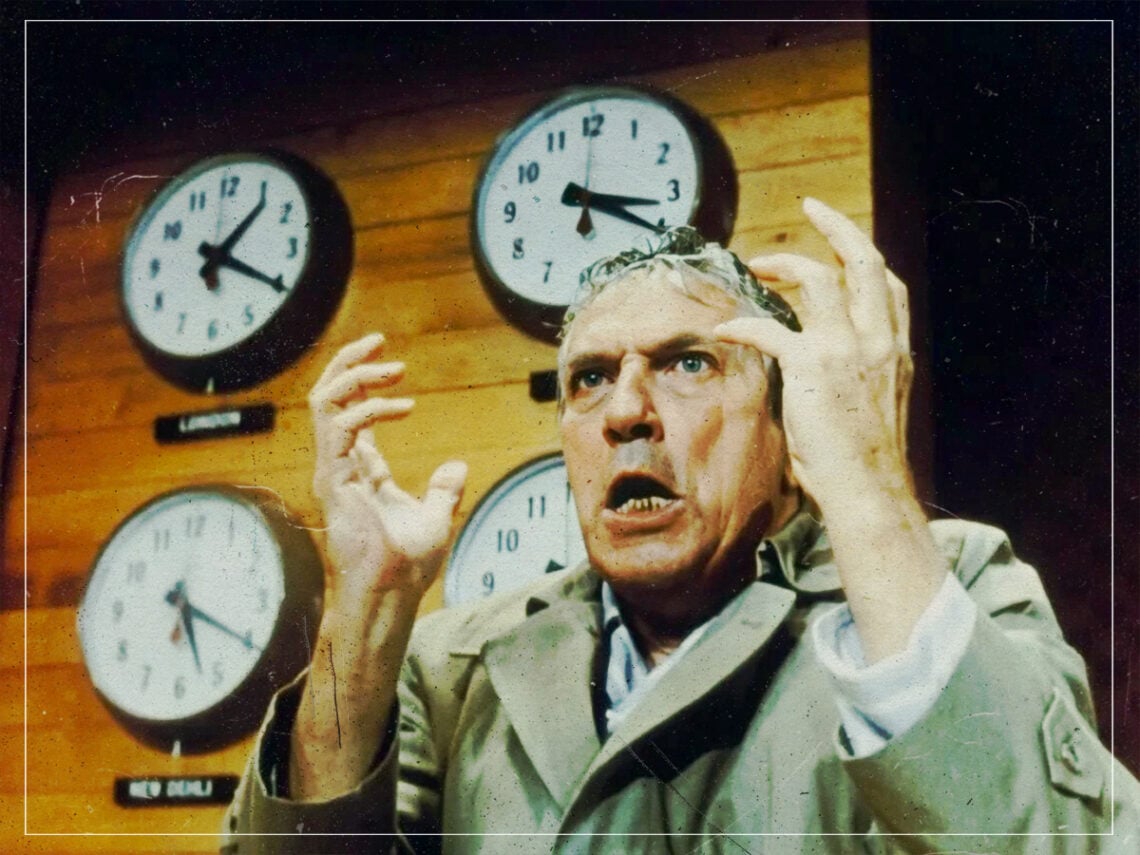
Chances are, you’ve heard the phrase, “I’m mad as hell, and I’m not going to take this anymore.” You have Sidney Lumet’s Network to thank for that. Although it wasn’t set in the future, it perfectly encapsulated the trajectory of TV news shows and became more relevant with every passing year.
It stars Peter Finch as Howard Beale, an anchorman on the fictional UBS Evening News who becomes so jaded and despairing about the dark, chaotic state of the world and his boss’s intention to fire him over declining ratings that he stops reporting the news and starts ranting on-air. When this sends viewership numbers through the roof, the network decides to keep him in his job. Soon, he has his own self-titled show and is hailed as “the mad prophet of the airwaves”.
His catchphrase, repeated by viewers all over the country, is “I’m mad as hell, and I’m not going to take this anymore.”
The parallels to Fox News and other similar networks are blindingly obvious. Audiences flock to hear one disgruntled white man scream about society, while his overlords try to coerce him into peppering some of their business interests into his act as well. If Network had included collusion with politicians, it would have been spot on.
‘The Year of the Sex Olympics’ (Michael Elliott, 1968)

Reality TV wasn’t really a thing back in the 1960s, which makes it all the more impressive that writer Nigel Kneale predicted dating and survival shows. The Year of the Sex Olympics was a BBC television play directed by Michael Elliott that was heavily influenced by George Orwell’s 1984. Set sometime in the future, it imagines a society in which a small elite controls politics and media and the rest of the world are second-class labourers.
To keep the population distracted and compliant, the elites (known as the ‘high-drives’) concoct an array of mindless and exploitative television programmes, including one in which care home residents throw food at each other, another in which sex becomes a competition, and a final one in which a family is left stranded on an island and filmed 24/7 for the world to see.
In the five decades since the play aired, Kneale has been proven chillingly prescient. Big Brother, named after Orwell, may as well have been modelled after the reality show in The Year of the Sex Olympics. However, there is a case to be made that all reality shows are some variation on the shows that the high drives use to pacify the masses. A sobering thought.
