


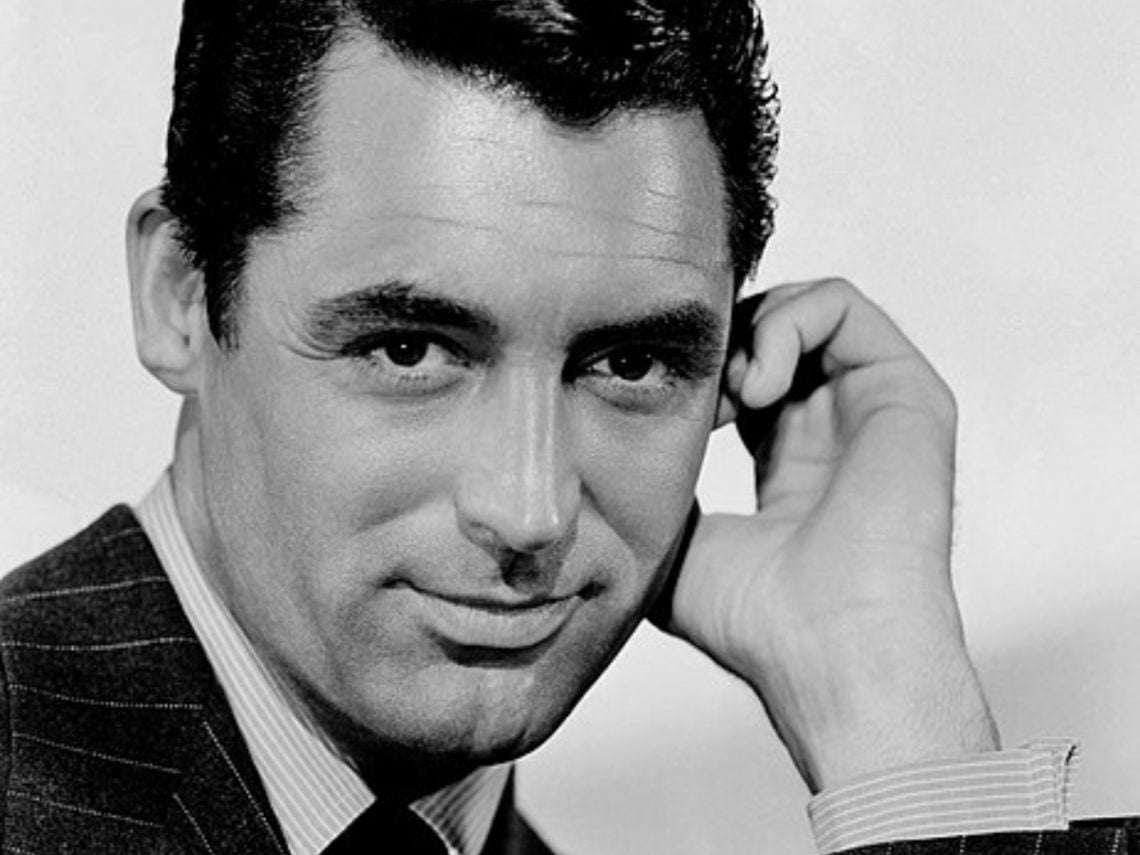
The five most overlooked Cary Grant performances

Born Archie Leach in Bristol in 1904, Cary Grant’s upbringing was a far cry from the glamorous life of a Hollywood star. He grew up in poverty with a father who suffered from alcoholism and a mother who was institutionalised for mental illness. When Grant was 14, he left school and joined a circus troupe, and when they travelled to America to perform, he stayed.
When Grant began acting in movies, his matinee idol looks, comic timing, and easy charm made him the consummate star of Hollywood’s Golden Age. For three decades, between the mid-1930s and the mid-1960s, he was the poster child of cinematic glamour. He was a favourite of Alfred Hitchcock and Howard Hawks and bantered with some of the starriest leading ladies of the era, including Katharine Hepburn, Grace Kelly, and Audrey Hepburn.
Grant is such an icon of Old Hollywood that it might seem unlikely that he’d have any movies that have fallen under the radar, but while The Philadelphia Story, North By Northwest, and His Girl Friday remain some of the greatest films of all time, there are plenty of others that deserve to be mentioned in the same breath.
The films on this list feature some of Grant’s best performances. He was almost always cast in barbed comedies opposite lightning-fast leading ladies, but seeing his range in these movies reminds us that he could do much more.
Cary Grant’s five most underrated performances:
Suspicion (Alfred Hitchcock, 1941)

Before Alfred Hitchcock found his stride in Hollywood with 1946’s Notorious, he made a film about a sheltered young woman from a wealthy family who falls in love with a dangerously charming man, only to discover that he is penniless, jobless, and addicted to gambling. Joan Fontaine plays the shy heiress in a similar performance to the one she gave in Hitchcock’s 1940 film Rebecca. As she begins to understand the extent of her husband’s deceit, she starts to suspect that he may be trying to murder her as well.
Grant is perfectly cast as the husband. He was still on the ascent as a movie star, and had yet to be irrevocably pigeonholed as a suave, witty protagonist. In Suspicion, his first of four pairings with Hitchcock, he uses his megawatt charisma as a sinister mask concealing a much darker truth. Crucially, Hitchcock leaves the audience guessing. Is the character a conniving killer, or is he just a hapless ne’er do well trying to turn himself around?
This was the last time Grant would play such a sinister and unlikeable character, which is a shame, because he pulls it off with chilling ease. The character is petulant, entitled, and manipulative, the perfect encapsulation of toxic masculinity eight decades before it became a 21st century buzz word.
The Bishop’s Wife (Henry Koster, 1947)

A year after Frank Capra introduced the movie-going public to a Christmas-saving angel in It’s a Wonderful Life, director Henry Koster helmed a film in which the exact same thing occurs. The only difference is that, in The Bishop’s Wife, Cary Grant plays the angel.
In this version of the story, David Niven is the man who needs celestial intervention. He’s a bishop in a small town who has become so obsessed with funding the construction of a new cathedral that he’s forgotten why he wants it in the first place. The project has also made him neglect his wife, played by Loretta Young. The angel answers his prayers for help, but instead of instructing him on how to raise money for his project, he helps him recognise what really matters in his life. In the process, however, the angel finds himself falling in love with the bishop’s wife.
Grant’s performance in this film is more earnest than in any of his other films. As much as he excelled at speedy banter, that arch humour can start to feel deflective. In The Bishop’s Wife, we see genuine warmth and tenderness, which is moving in a way that few of the actor’s other performances managed to be.
The Awful Truth (Leo McCarey, 1937)

It will always be a mystery as to why Grant’s pairings with Irene Dunne are no longer as well known as his pairings with Katharine Hepburn. Though The Awful Truth doesn’t get the 10/10 rating that Bringing Up Baby or The Philadelphia Story does, it deserves a solid nine, and the chemistry between the actors is just as spiky. It also happens to be one of Peter Bogdanovich’s favourite films. Grant and Dunne play soon-to-be divorced spouses who find themselves sparring more than ever over the minutiae of their breakup. Even as she moves on to another man, the sparks between them are so fiery that it’s a wonder the film made it past the Hayes Code.
Grant is in tip-top form as a seemingly nonchalant almost-bachelor who manages to trade withering insults with his almost-ex-wife without ever sounding like a jerk. His charisma is absurd in this movie, and Dunne was the perfect partner. Not only does she exude a similar level of glamour, but she is equally cutting, and it soon becomes clear that those vicious takedowns are tantamount to sweet nothings.
Charade (Stanley Donen, 1963)

To those who say that Charade is far from underrated, I can only respond that everything is relative, and relative to the perfection of this movie, its profile is, indeed, far too low. Grant was nearing 60 when he starred opposite the 34-year-old Audrey Hepburn, but their chemistry is so bubbly that it hardly registers. She plays Regina Lampert, a woman who discovers without much feeling that her husband has died under mysterious circumstances. When she returns to their home in Paris after a skiing vacation, she is stalked by a group of strange men who seem to have been connected to her late spouse.
Grant plays an easy-going American who appears seemingly at random as these mysterious events unfold. Even though his identity changes with nearly every encounter, Regina falls madly in love with him. Donen took a much wittier, lighter take on the murderous caper than Hitchcock and triumphed. Though Grant and Hepburn were stars of Old Hollywood and Donen had directed some of the era’s most enduring classics, Charade is much fresher and more modern. Sexy, violent, and twisty, the film works on every level and features one of Grant’s most relaxed performances.
Holiday (George Cukor, 1938)

Aside from the ending of 2001: A Space Odyssey, there is no cinematic mystery quite as confounding as the complete omission of George Cukor’s Holiday from the romantic comedy canon. Perhaps Grant and Katharine Hepburn simply had too many perfect pairings for all of them to make the cut, but no matter how flawless Bringing Up Baby and The Philadelphia Story are, I dare you to watch this movie and find it lacking by comparison.
Grant stars as Johnny, a free-spirited self-starter who enters into a whirlwind engagement with a woman he meets on holiday. Soon, he realises that she is the daughter of a millionaire and becomes increasingly uncomfortable with her family’s expectations for the marriage. His only consolation is his fiancee’s sister, Linda (Hepburn), who is the self-described black sheep of the family.
Unlike many romantic comedies from the 1930s all the way to the present, Holiday doesn’t condescend to its female protagonist. Linda is happily independent, and even when she finds herself falling in love with her sister’s fiancé, she doesn’t become defined by longing. Both Linda and Johnny are remarkably progressive characters, even by today’s standards, and the alchemy of Grant and Hepburn is unparalleled. Without unnecessary plot contrivances, their relationship is refreshingly grown up, allowing the actors to provide their most naturalistic performances.
