


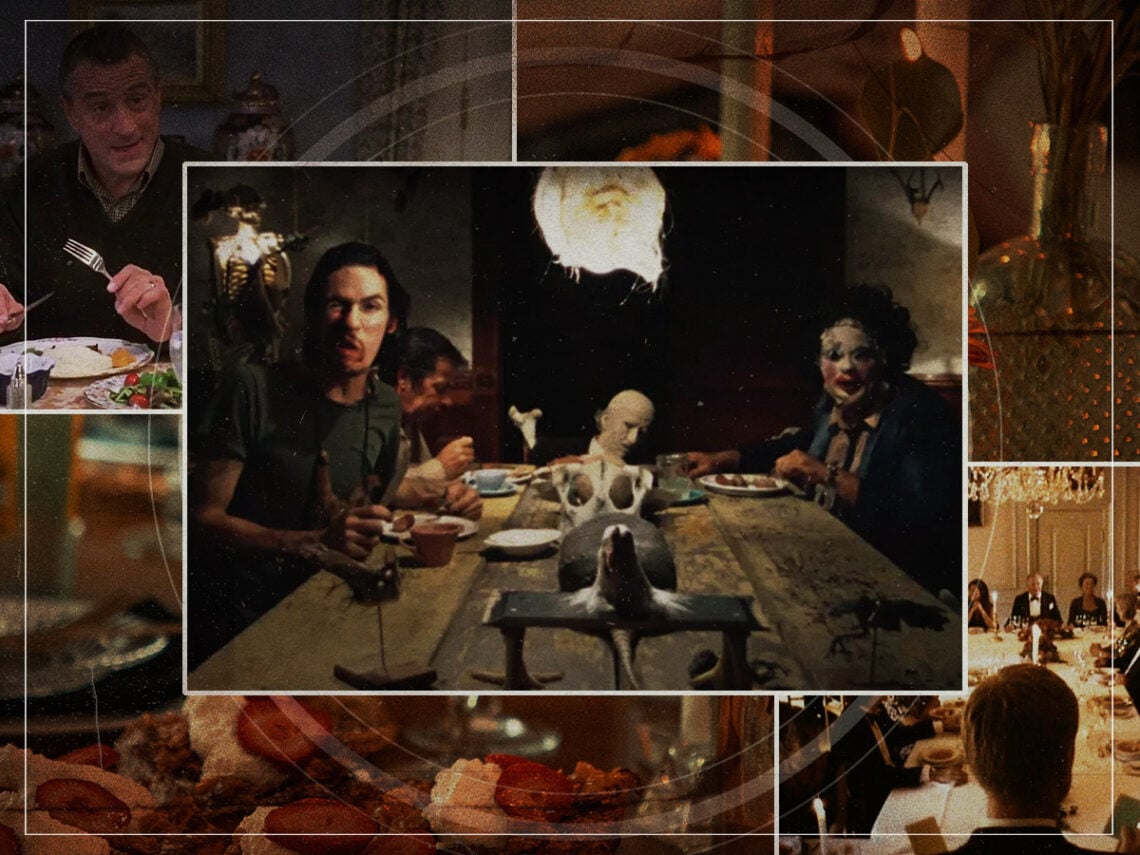
The five most heinous family dinners in cinema history

Family dinners are full of symbolism. They signify wholesomeness, domesticity, and the strength of the family bond and are, therefore, ripe for cinematic deconstruction and subversion. They are also an easy plot device for getting lots of characters in the same room. If the story calls for a big fight between a parent and a child, an awkward interaction with in-laws, or a moment of tension between spouses, the dinner table is the perfect place to do it.
It’s no wonder filmmakers have found so much opportunity for tension in them. Whether it’s a world-stopping revelation or the slow deterioration of a seemingly happy family, the dinner table has been the centre of many a cinematic meltdown for both comedic and tragic purposes.
We’ve all probably had our own uncomfortable experiences at a family dinner. There are the endless wedding toasts, the cyclical political arguments, and the one parent who won’t let their kids leave the table until every speck of food is gone. All of these scenarios have played out on screen, but filmmakers have a knack for taking a kernel of a universal experience and spinning it off into a whole new direction, so you’re never really safe when a group of characters sits around a table for a meal.
We’re counting down some of the most painful dinner scenes in cinema, running the gamut from comedy to horror to Dogma 95. Make sure you have an empty stomach. They’ll make you downright queasy.
The five most heinous movie dinners:
5. The Birdcage (Mike Nichols, 1996)
As the saying goes, when you marry someone, you are marrying the whole family. Nowhere is this truism more agonisingly portrayed than in the 1996 Mike Nichols comedy The Birdcage, in which Robin Williams and Nathan Lane play a gay couple who have to put on the performance of their lives to fool their son’s future in-laws into believing that they are the definition of conservative heterosexual domesticity. While Armand (Williams) owns a drag club and Albert (Lane) is his star performer, their son’s soon-to-be parents-in-law are conservative senator Kevin Keeley (Gene Hackman) and his demure wife Louise (Diane Wiest). The families arrange a dinner party at Armand’s home, and Albert puts his theatrical skills to work by masquerading as Armand’s wife in order to avoid scandalising the Keeleys and jeopardising their son’s marriage. What follows is an excruciatingly painful dinner scene in which everything unravels.
At first, things seem to be going to plan. Armand is charming Louise at the piano while Albert and Kevin dance. Once they’ve gathered at the dinner table, however, the evening starts to deteriorate. Louise notices that the dishes appear to depict “young men playing leapfrog,” and Albert becomes increasingly bold with his performance. The Birdcage is a comedy through-and-through, but this scene is a nail-biter.
4. American Beauty (Sam Mendes, 1999)
Pretty much all of American Beauty is uncomfortable to watch. Sam Mendes’ take-down of suburban America is just as cutting today as it was when it was released, and it’s a moment centred around that most clichéd symbol of domestic wellbeing, the family dinner table, where all hell breaks loose. Kevin Spacey plays Lester Burnham, an office drone in the advertising sector who hates just about everything in his life, including his wife, real estate agent Carolyn (Annette Bening). The contempt is mutual. Things come to a head over dinner when Lester asks her to pass the asparagus.
Sitting across the table from each other, complete with candles and Laurence Welk crooning in the background, the couple is in the middle of an argument about how Lester just quit his job and blackmailed his boss when they are interrupted by their daughter, Jane. While Carolyn berates him, Lester intersperses his own insults with the request that someone pass him the plate of asparagus. He eventually picks up the platter himself, hurls it against the wall, and whispers, “Don’t interrupt me, honey”, before sitting back down to enjoy his meal. Not only is it a chilling depiction of a marriage breaking down, but it’s a turning point in the film. From then on, any feeble attempt at normalcy is literally off the table.
3. Meet the Parents (Jay Roach, 2000)
Meeting your partner’s parents is the necessary evil of any serious relationship. It is always awkward and almost always excruciating, so it’s no wonder there’s a whole movie about it. Jay Roach found even more fodder for anxiety in Meet the Parents by casting Robert De Niro as the titular parent who Ben Stiller’s character, Greg, must meet. As if that wasn’t terrifying enough, De Niro is playing a retired member of the CIA who isn’t afraid to use some tricks of the trade to intimidate his future son-in-law. The lie detector test scene is uncomfortable, but it pales in comparison to the dinner scene, a moment so excruciating that you might end up trying to somehow cover your eyes and ears at the same time.
It starts off when De Niro’s character, Jack, asks Greg to say grace despite knowing that he is Jewish and therefore unaccustomed to the Christian tradition. Greg decides to go for quantity over quality, offering a stream of vaguely related religious words that morph into a way too-long series of rhymes. He then pokes fun at a vase on the mantelpiece, which turns out to hold the ashes of Jack’s mother, and then attempts to save face by – what else? – recounting in vivid detail the time he milked a cat.
2. The Texas Chainsaw Massacre (Tobe Hooper, 1974)
A family of cannibals is the last group of people you’d want to have a meal with, so it’s no wonder The Texas Chainsaw Massacre produced one of the most horrific family dinner scenes of all time. Following a group of teens stranded on the wrong stretch of road, it is a seminal low-budget horror flick that still induces nightmares and inspires filmmakers. Within all the grisly dismemberment and jump-scares, one scene stands apart as stomach-churningly terrifying. After her compatriots have been murdered in various ways by Leatherface and his family, Sally Hardesty (Marilyn Burns) is brought, bound and gagged, to the dinner table.
Sitting in a chair made of human remains and surrounded by rotting corpses, she has nowhere to escape. On a plate in front of her is meat, its origin unknown, though it’s fair to assume that some of it might come from her friends. As she struggles and screams and sobs for release, the family mocks her, and the camera zooms dizzily in on her eyes, open wide in terror. The extreme, juddering close-up, combined with the cacophony of a soundtrack, is a masterclass in cinematic claustrophobia and one of the most unpleasant viewing experiences the genre has to offer.
1. The Celebration (Thomas Vinterberg, 1997)
The most effective moments of extreme discomfort in movies often arrive when you least expect it, and boy did Danish director Thomas Vinterberg know that when he deployed his feature debut, The Celebration, in 1999. Following a family reunion to celebrate the 60th birthday of its beloved patriarch, it seems to be a slow-paced and documentary-like depiction of complicated yet familiar family dynamics right up until the most harrowing family dinner scene in cinematic history.
When the party gathers around the dinner table for the celebratory meal, the eldest son, Christian (Ulrich Thomsen ), is set to give a speech. Tapping his champagne glass and standing up, he begins to reminisce, in clichéd speech-giving fashion, about his childhood, much to the enjoyment of the guests. Then, his story begins to develop into something else. In the same tone of voice, he reveals in detail how his father sexually abused him and his siblings for years. There are a few uncomfortable titters in the audience, but the table is otherwise silent. As the speech wears on, the most chilling part is not the revelation but the way the guests seem so determined to pretend it didn’t happen.
