


From Phoebe Bridgers to Pete Townshend: The five most famous destroyed guitars in history

Music and destruction come hand in hand. For decades, musicians have been at the forefront of innovation, annihilating outdated mores and establishing new ones. Largely, this trend has been maintained in the modern era, with classical composers such as Franz Liszt and a plethora of popular musicians, including Keith Richards and G.G. Allin, willing to destroy everything in their path, both literally and figuratively. Admittedly though, things appear to have died down in more contemporary times. Whether this is a definitive sea change or merely a tea break remains to be seen.
The current state of play might be to do with the fact that over the past 80 years, music, and particularly rock ‘n’ roll, left a trail of smouldering destruction in its wake. Whether it be physical, environmental or, most commonly, personal, music took destruction to its limits in the 20th century.
Instead of being purely musicians, rockstars were almost god-like figures who acted with impunity. Given the unchecked backing of a major label, hedonism-fuelled carnage became ubiquitous. Scenes such as The Who’s drummer Keith Moon driving a Lincoln Continental into a swimming pool and Ozzy Osbourne biting the head of a live bat emerged from this era. In more recent times, notable hellraisers were London rockers The Libertines and shock-metallers Slipknot. With that said, it must be noted that rock ‘n’ roll devastation isn’t always fuelled by hedonism. It comes naturally.
Whilst destruction at the hands of musicians can manifest in many forms, one consistent target has been the guitar. From the days of classic rock to now, the list of six and four-strings feeling the wrath of their owner is extensive. From Jimi Hendrix setting his Stratocaster on fire to Phoebe Bridgers sending her Danelectro to the grave on live TV, there have been many instances of the guitar really feeling the pain.
The most famous destroyed guitars in history:
5. Phoebe Bridgers – Danelectro Dano ’56 baritone (2021)
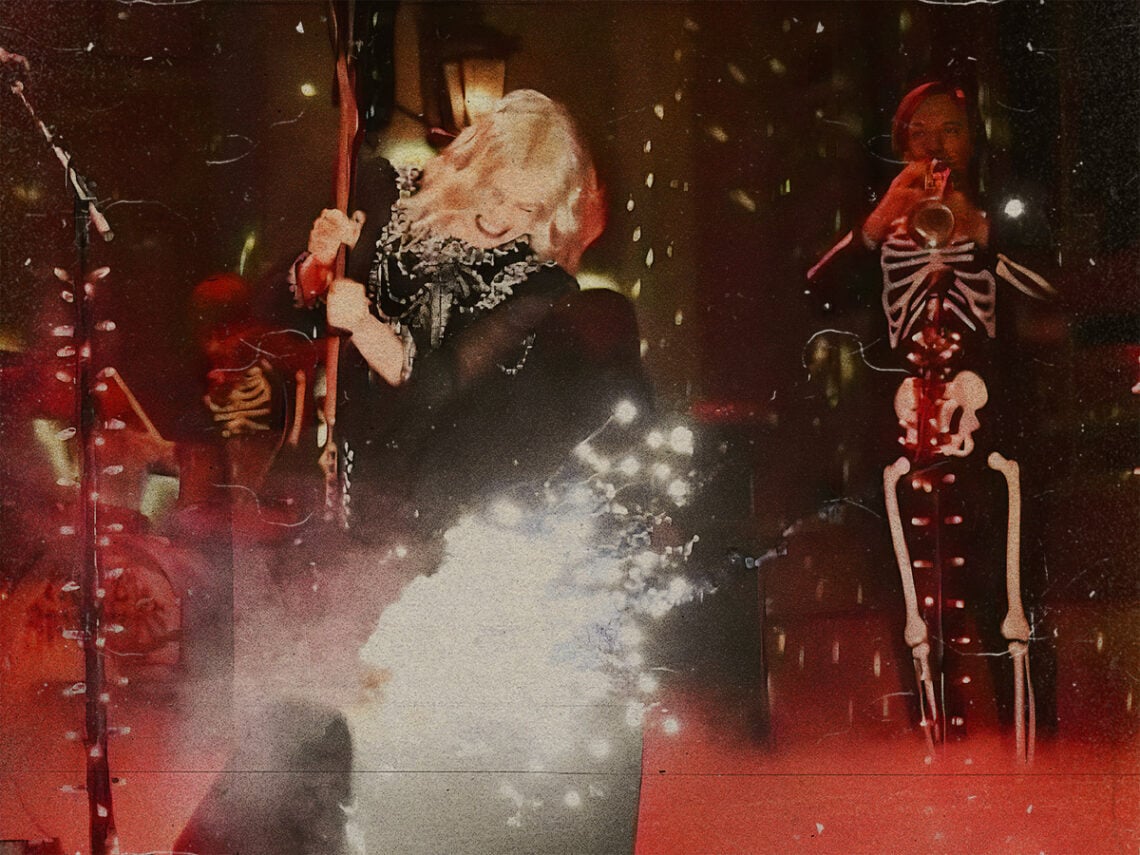
There was no better place to start than the most famous contemporary moment of a guitar meeting its maker. As Phoebe Bridgers enjoyed a highly successful 2021, thanks to releasing Punisher the previous June, it was only fitting that she and her band take to NBC’s Saturday Night Live to regale fans with cuts from the album.
Towards the end of the mammoth track, ‘I Know The End’, the ante was upped, and things got truly heavy, with the bassist strumming meaty power chords as a breakdown ensues. Following this rhythm change, Bridgers let out an unhinged scream. As the music swirled around her and the separate components of the song fell away, Bridgers started smacking her Danelectro Dano ’56 baritone guitar against the defenceless monitor, which even started to spark. Almost snapping the body in half, the stunt caused a stir, with Bridgers even facing criticism from David Crosby, who she would comically go on to label a “little bitch”.
The instrument was eventually sold for $101,500 at the 2021 GLAAD Media Awards, with the funds going towards helping the organisation’s work for LGBTQ acceptance.
4. Ritchie Blackmore – 1970 Fender Stratocaster (1977)
Deep Purple’s Ritchie Blackmore isn’t necessarily known as a destroyer of guitars, although he has done it at points over the years. Luckily for him, his innate appetite for destruction has largely been trumped by his many achievements on the six-string, which include the timeless cuts ‘Smoke on the Water’ and ‘Black Knight’.
However, there is one moment he can’t get away from. During a 1977 show in Munich with his other group, Rainbow, Blackmore destroyed his axe in a way that has gone down in history as totally wild. Here, he started the scene by pummelling his Fender Stratocaster head-first into the stage floor as if trying to drive the sword into the stone. After the neck finally gave way, he repeatedly slammed the body into the floor with fury.
Not finished there, Blackmore began whipping it around on its lead like a flail before finally chucking it into the audience, who were lapping the scene up. Adding to the carnage was that the PA was on for the entirety. The feedback and clangorous bangs imbued a different dimension into the sight of the possessed guitarist.
3. Paul Simonon – Fender Precision Bass (1979)
This entry is the only bass casualty on the list. The unfortunate instrument is one of the most iconic in music, thanks to the prominence of its owner and the fact that it features on the cover of one of the greatest albums of all time. The musician in question is bassist Paul Simonon of The Clash, and the album is their masterpiece, 1979’s London Calling. Famously, the album cover features a photo of the split-legged Simonon in the middle of smashing his Fender Precision Bass into the stage floor.
Now on permanent display at the Museum of London, the guitar can be seen there in all its smashed-up glory, with its body split, neck bust, and the original spirit of punk conveyed by the skull and crossbones and ‘pressure’ stickers. It endured the historic thrashing when The Clash played at The Palladium in New York City on September 20th, 1979, during their ‘Take the 5th’ tour of North America.
At the end of the set, Simonon smashed the bass into the floor in anger, frustrated that the bouncers wouldn’t let the audience get out of their seats to dance. The moment was captured by Pennie Smith and became a symbol of rebellion through music. After the set, Simonon kept the pieces and claims that he even stopped frontman Joe Strummer from robbing off with one. Unsurprisingly, that was the last time the bass was played on stage.
2. Pete Townshend – 1964 Rickenbacker Rose Morris 1998 (1964)
The Who’s Pete Townshend was the original guitar destroyer in music history, with him breaking 35 guitars in 1967 alone. However, his most iconic example of this trend came in 1964. This was also its first recorded and public instance, occurring at The Railway Tavern in Harrow, London.
The guitar was a 1964 Rickenbacker Rose Morris 1998, a model which helped to define The Who’s early sound and reportedly featured on ‘I Can’t Explain’ and ‘Anyway, Anyhow, Anywhere’. For his first public execution of a guitar, Townshend cracked the headstock on a low ceiling, and after realising what had occurred, he smashed the rest of the instrument in a frenzy. As if nothing had happened, the guitarist then picked up his Rickenbacker 12 and continued with the set.
Recalling the event, Townshend later said: “(After cracking the headstock) I was expecting everybody to go, “Wow, he’s broken his guitar, he’s broken his guitar,” but nobody did anything, which made me kind of angry in a way. And determined to get this precious event noticed by the audience. I proceeded to make a big thing of breaking the guitar. I bounced all over the stage with it, and I threw the bits on the stage, and I picked up my spare guitar and carried on as though I really had meant to do it.”
1. Jimi Hendrix – 1965 Fender Stratocaster (1967)
In 1967, Hendrix started his penchant for setting guitars on fire. The first moment came at London’s Astoria Theatre, a stunt suggested by the rock journalist Keith Altham. Although this original action helped to create the notoriety that would see fans flock to his shows, after the performance had concluded, the American guitarist checked into hospital afterwards with minor burns. However, across the rest of the tour, he would perfect the act, burning more guitars to cinders with the assistance of lighter fluid.
However, Hendrix’s love for fire would reach its pinnacle later that year at the Monterey Pop Festival. As he and his band, The Jimi Hendrix Experience, smashed through a cover of The Troggs’ ‘Wild Thing’, and drummer Mitch Mitchell brought it to its climax, Hendrix promptly dropped to his knees whilst somersaulting with the painted guitar.
As the finale ensued, Hendrix gave the guitar a final kiss before dousing it in lighter fluid and setting it on fire with a match. After, the flaming guitar was smashed apart with ease before Hendrix tossed the scorched remains into the crowd, walking off stage as an icon. Thanks to this performance and many others – in tandem with his various musical feats – it was in 1967 that the legend of Jimi Hendrix really began.
