


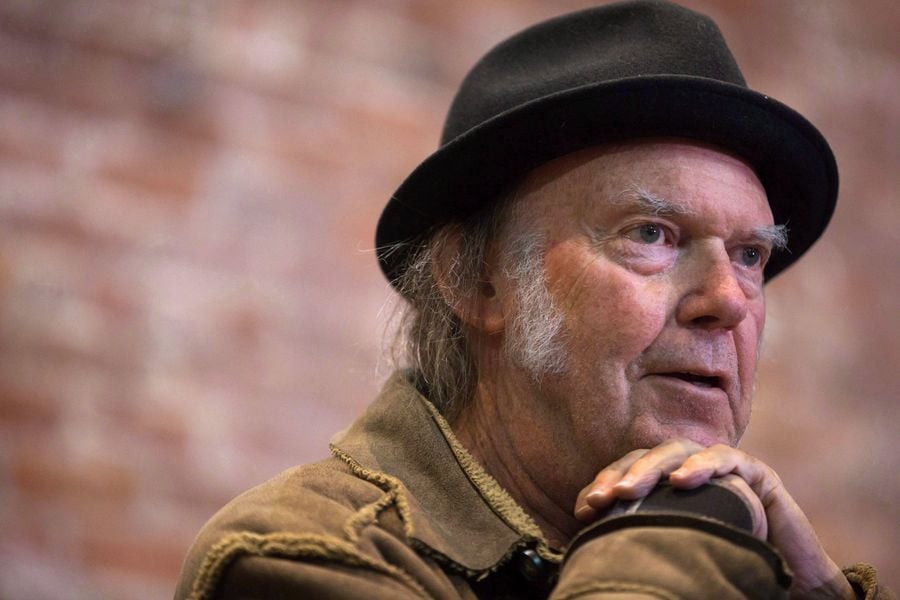
Five more times Neil Young stood up for what is right

Neil Young has long been hailed as one of the finest songwriters of his generation, and when you take a quick glance at his discography, it becomes clear why. Whether it be Buffalo Springfield, Déjà Vu, or After the Gold Rush, Young has his name on a myriad of classics that clearly outline his status.
After starting his career in his native Canada, Young first found real success as a countercultural hero in the Californian outfit Buffalo Springfield. The band, which also featured Stephen Stills, was a short-lived one, and after they called it a day after two years in 1968, he then embarked on the first chapter of his solo career. It was a short one, though, with it put on hold by him linking up with the supergroup Crosby, Stills and Nash.
After the quartet imploded due to the friction caused by their respective characters, Young returned to his solo career, where he would make his real mark. He seamlessly picked up from where he left off, heading into the promise of the future and maintaining an artistic quality that not many of his generation can claim.
Running concurrently with Young’s artistic endeavours have been his efforts to improve the world. Since he first broke through, he’s attempted to use his status for good, throwing his name behind various causes, from the political to the environmental. These actions have compounded the spirit of his songs, imbuing them with an authenticity rare for such a famous artist.
As we’ve already listed five of the most prominent examples of Young standing up for what is right, today we’re listing five more, as figures such as the ‘Ohio’ songwriter are gold dust. It’s certain that without him, some of the people who need their voices heard the most would still be in the dark, shouting into the void.
Five more times Neil Young stood up for what is right:
The timeless power of ‘Rockin’ in the Free World’
The story of 1989’s ‘Rockin’ in the Free World’ is famous. It was written on tour with The Restless in February of that year. After Young was told that a planned tour of the Soviet Union would not happen, guitarist Frank Sampedro commented, “we’ll have to keep on rockin’ in the free world”, which gave Young the idea for one of his most profound political anthems.
He mentally logged the phrase, thinking it could be a hook used in a song about the “stuff going on with the Ayatollah and all this turmoil in the world.” Quickly thereafter, the track came together.
Elsewhere, the lyrics criticise the administration of George H.W. Bush and quote the President’s “thousand points of light” remark from his 1989 inaugural address, and the promise from his 1988 campaign that America would become a “kinder, gentler nation”.
Although the song is very much written about the state of the world at the end of The Cold War, it has become a broader political symbol for left-leaning causes in the years following its release. Unsurprisingly, it came to the fore again in 2015 when Donald Trump used the track to announce his presidential run without Young’s consent.
The musician released a lengthy statement decrying Trump and the political state of the US, which concluded: “I do not trust self-serving misinformation coming from corporations and their media trolls. I do not trust politicians who are taking millions from those corporations either. I trust people. So I make my music for people not for candidates.”
Afterwards, no one, regardless of their beliefs, was in doubt. ‘Rockin’ in the Free World’ is a song to unite the people, and not to be used for hollow political or economic gain.
Slamming the malign influence of social media
Neil Young has always been a champion of empathy. After Trump supporters stormed the US Capitol on January 6th, 2021, he called for us to be balanced in how we viewed them, going on to outline the malign influence social media has on culture. He argued that when wielded by the powerful, it divides us and turns us “against one another”.
In a message on his website, Young wrote: “I feel empathy for the people who have been so manipulated and had their beliefs used as political weapons. I may be among them. I wish internet news was two-sided. Both sides are represented in the same programs. Social media, at the hands of powerful people – influencers, amplifying lies and untruths, is crippling our belief system, turning us against one another. We are not enemies. We must find a way home.”
Again, he turned his attention to Donal Trump, and slammed the outgoing President, maintaining that he had “betrayed the people, exaggerated and amplified the truth to foment hatred”. However, he expressed that at that point, his feelings were now “beyond” Trump.
He continued: “Resentment of the Democratic party among the insurrectionists at the Capitol was rampant. We don’t need this hate,” he wrote. “We need discussion and solutions. Respect for one another’s beliefs. Not hatred … With social media, issues are turned to psychological weapons and used to gather hatred in support of one side or the other. This is what Donald J Trump has as his legacy.”
Warning us of environmental collapse years before the COP summits
Neil Young has form for writing about what he cares about, and back in 1970, he configured the title track of After the Gold Rush about the most critical topic of our time: the environment. Although other prominent countercultural heroes spoke out against the destruction of the environment, such as Joni Mitchell with ‘Big Yellow Taxi’, there is none more emotive than ‘After the Gold Rush’.
In his 2012 biography, Young explained that the inspiration for the track came from a screenplay of the same name that was never produced. It told the story of California’s last days amid a catastrophic flood, with the title referring to the civilised iteration of the state’s origins in the Gold Rush.
Young concluded: “‘After the Gold Rush’ is an environmental song… I recognise in it now this thread that goes through a lotta my songs that’s this time-travel thing… When I look out the window, the first thing that comes to my mind is the way this place looked a hundred years ago.”
The line “look at Mother Nature on the run in the 1970s”, is arguably one of Young’s most profound, with Mother Nature no longer on the run 52 years later. She’s cornered.
Attacking Monsanto
Back in 2015, Young released Seeding Fear, a ten-minute short film that bolstered his campaign to highlight the alleged wrongdoings of agrochemical giant Monsanto. It tells the story of farmer Michael White, who fought against the company in court after they accused him of using their copyrighted genetically modified soya beans. Interestingly, White was just one of many small-scale farmers sued by Monsanto for what they claimed was copyright infringement.
“The film I would like you to see tells the story of a farming family in America, but the same thing is happening around the world,” Young explained on Facebook. “It is a story that takes 10 minutes of your time to see. It is a simple human one, telling the heartbreaking story of one man who fought the corporate behemoth Monsanto.”
He continued: “Monsanto is a corporation with great wealth, now controlling over 90% of soybean and corn growth in America. Family farms have been replaced by giant agri corp farms across this great vast country we call home. Farm aid and other organisations have been fighting the losing battle against this for 30 years now.”
Notably, the film followed his album The Monsanto Years, which addressed many of the issues outlined in the short.
Opposing the Iraq War
The counterculture was all about peace and love; two things Neil Young has never taken for granted. Therefore, when the younger George Bush decided to invade Iraq in 2003 as a part of his controversial “War on Terror”, the Canadian musician had much to say about it. In 2006, this came to a head when he released Living With War, a politically-charged record that was damning of the Bush administration and the invasion of Iraq.
It is one of his most abrasive albums to date, with visceral music matched by hard-hitting lyrics. The track ‘Let’s Impeach the President’ kicks off with the line, “Let’s impeach the President for lyin'”, “and misleading our country into war / Abusing all the power that we gave him / And shipping all our money out the door.”
