


Five films that capture the beauty of Rajasthan, India

Few places are more opulent or as well-fortified as Rajasthan, India. The former seat of the Maharajas, this northern province is a kaleidoscopic swirl of sepia-toned fortresses, painted villages, deserts and lakes.
As India’s largest state, Rajasthan is home to all manner of landscapes and terrains, boasting sections of the Thar Desert, the tiger-stalked hills of Sawaimdhopur and the lake palaces of Udaipur. It is, of course, also home to some of the most serene historical cities and religious sites in all of India.
Truly a region like no other, Rajasthan’s complex beauty has been attracting filmmakers from all over the world for generations. Even the great Bengali director Satyajit Ray could not resist the sunburnt charm of Jaisalmer Fort.
In this list, we’ll be looking at five films that not only capture Rajasthan’s rare beauty but celebrate it. Join us as we take a trip to some of the state’s most astonishing cities, soaking up everything they have to offer.
Five films that capture the beauty of Rajasthan:
Junun (Paul Thomas Anderson, 2015)
In 2015, Paul Thomas Anderson accompanied Jonny Greenwood and Israeli poet, composer and musician Shye Ben Tzur on a trip to Jodhpur, Rajasthan, where they were hosted by the Maharaja. For the next few weeks, Anderson documented Greenwood and Tzur’s collaboration with the musicians of the Rajasthan Express as they worked towards completing the Junun album.
Feeling “wary of how so-called ‘word music’ is recorded and treated,” Greenwood joined some of India’s top musicians to help craft some truly incredible music. Focused on the group’s rehearsals and recording sessions, Anderson’s documentary celebrates the energy and nuance of North Indian music while capturing the beauty of Jodhpur, with its looming 15th-century fortress and Shivanian blue old town.
The Darjeeling Limited (Wes Anderson, 2007)
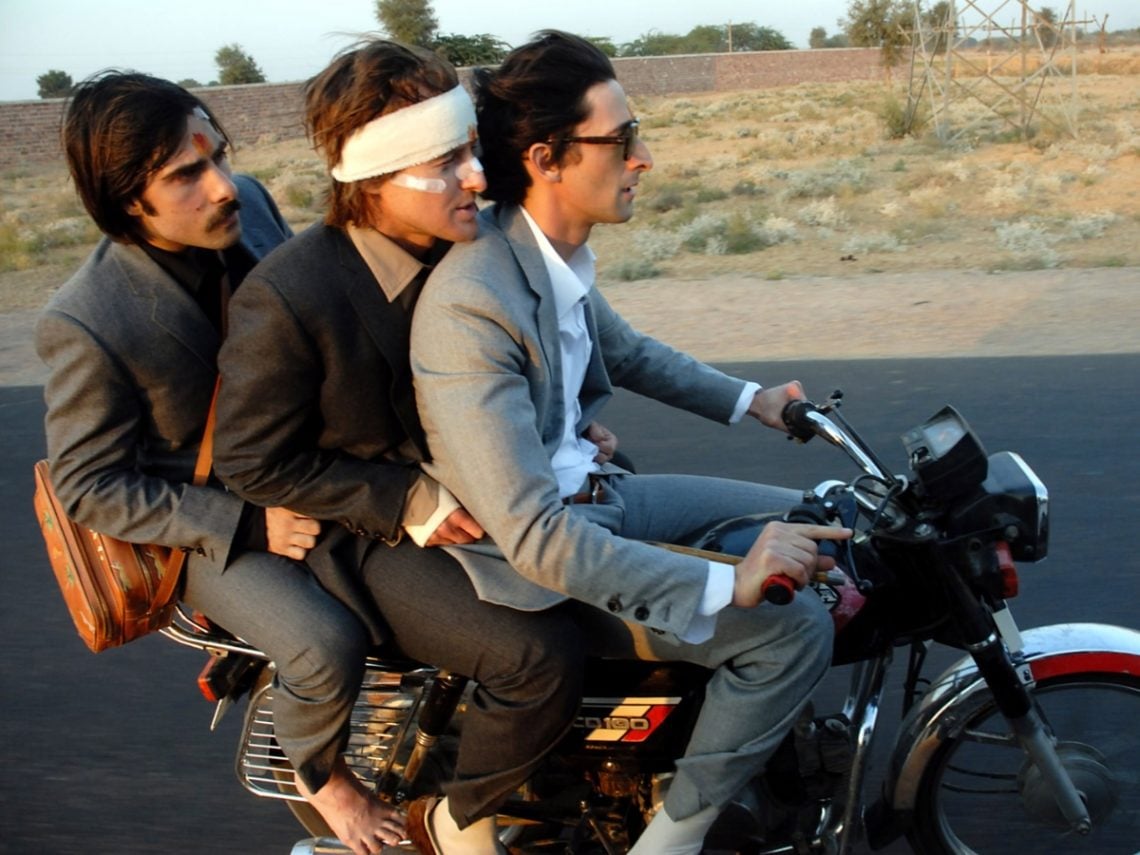
Seeking to shoot his next film as “organically” as possible, Wes Anderson journeyed to Rajasthan in 2007 to film The Darjeeling Limited, his movie about three estranged brothers who decide to take a train trip through north India in an attempt to heal their fractured relationship.
The scenes set in India were all shot in Rajasthan, with the jade-green Darjeeling Limited beginning its journey in the city of Jodhpur. From there, the brothers slide towards Jaisalmer or ‘The Golden City’. Once home to a tribe of warrior traders called the Rajputs, this honey-coloured city is home to a 12th-century fortress mentioned in the foundational Indian epic poem, The Mahabharata. Anderson also travelled to the city of Udaipur to film the scenes set in Patricia’s Convent. “The location needed to feel both remote and dramatic,” designer Friedberg said of the hunting lodge used to film these scenes, which once belonged to the Maharana of Mewar.
Duvidha (Mani Kaul, 1973)
Boasting the kind of cinematography that would make Wes Anderson weep with envy, Duvidha is a blisteringly beautiful supernatural romance by revered Hindi director Mani Kaul, who was born in Jodhpur in 1944.
Based on the novel bu Vijayadan Detha, the film tells the story of a newly-married couple living in the windswept hinterlands of Rajasthan. When the husband, a merchant’s son continually thwarted by his work, is sent away on business, a ghost falls in love with his wife and adopts his form to be closer to the object of his affection. Filmed on a shoestring budget with limited access to equipment, it is as much an exploration of female sexual freedom as it is a love letter to Borunda village in Tehsil Bilara, Vijayadan Detha’s birthplace.
The Best Exotic Marigold Hotel (John Madden, 2012)
Following a group of British retirees immersing themselves in (and occasionally retreating from) Indian culture for the first time, The Best Exotic Marigold Hotel captures the vibrancy of Rajasthan through the eyes of individuals who have spent their entire lives in drizzly old England.
Principal photography took place in the cities of Udaipur and Jaipur, the latter of which is home to the labyrinthine Tripolia Bazar. Ravla Khempur, meanwhile, formerly the palace of a tribal chieftain from Khempur, was used as the site of the hotel. Located some 50 miles from the hustle and bustle of Udaipur, this 17th-century rural hotel was once the haveli of Khemraj Dadhivadia, who was gifted the land after killing two assassins hired to dispatch Jagat Singh II, the Rana of Udaipur and builder of the Taj Lake Palace, which stands in the centre of Lake Pichola.
Cobra Gypsies (Raphaël Treza, 2015)
In 2015, French filmmaker Raphaël Treza spent three months in the Rajasthan desert on the border of Pakistan filming the Kalbelyia, the “most emblematic tribe of the Rajasthan gipsies”. During his travels, he managed to earn the trust of the snake-charming tribe and wound up immortalising one of the most fascinating nomadic groups in the world.
For his basecamp in the jaw-dropping city of Pushkar, Treza was able to travel Rajasthan with a young Kalbelyia called Biram, who became the director’s translator, guide and fixer during his travels. Travelling by motorbike, Treza captures a frequently overlooked aspect of northern India’s rich and complex heritage without prejudice. You can watch the full film below.
