


Five essential mockumentaries to see before you die

In 1938, Orson Welles, then an acclaimed 23-year-old magician and theatre director, narrated a radio adaptation of HG Wells’s novel The War of the Worlds as if it were live news coverage. In doing so, he convinced a sizeable proportion of listeners that the planet had been invaded by Martians and the end was nigh. The hoax is one of the earliest known examples of a mockumentary, and it might have been the genre’s greatest moment.
When it comes to cinema, many people think of Rob Reiner’s 1984 music comedy This Is Spinal Tap as the beginning, but avant-garde filmmakers like Luis Buñuel and Federico Fellini had already messed around with the idea decades before. Monty Python proved particularly adept at blending comedy with a fake documentary style throughout Monty Python’s Flying Circus. In 1978, Eric Idle pioneered the form to an even greater degree with the TV movie All You Need is Cash, a precursor to Spinal Tap that followed a fictionalised band called The Rutles – ‘the Prefab Four’ – ‘whose legacy will last a lunchtime.’
In recent years, the mockumentary genre has exploded, particularly on television. The Office, Arrested Development, and Documentary Now! have all offered their takes on the category. Meanwhile, movies like Borat and Brüno have pushed the boundaries further by blurring the line between fiction disguised as reality and reality turned into fiction.
It is, quite frankly, a bit agonising to distil this genre into just five movies. This list is strictly limited to comedy (District 9 is shot in documentary style but doesn’t quite fit the ‘mock’ part of ‘mockumentary’), and it only features films that use a talking-head style of documentary (A Hard Day’s Night doesn’t qualify). It also excludes made-for-TV movies like All You Need is Cash and Peter Jackson’s Forgotten Silver.
Films like Popstar: Never Stop Never Stopping, A Mighty Wind, and Man Bites Dog deserve to be on the list, but sadly, they do not fit. Maths is a bitch.
‘Real Life’ – Albert Brooks (1979)

Five years before Rob Reiner made This Is Spinal Tap, Albert Brooks made a film that foreshadowed the current state of reality TV. Real Life follows a documentary filmmaker, played by and named Albert Brooks, who sets out to film an ‘average’ American family for a year. The filmmaker plans to win an Oscar and a Nobel for his project and quickly starts engineering scenes to gain the outcome he’s hoping for. It was a direct spoof of a 12-part television series that aired in 1973, but it has only become more relevant.
Critics were divided on the film. Roger Ebert gave it one star and scolded Brooks for being unable to sustain the central idea beyond the first ten minutes, but other critics praised it for its biting takedown of preening, self-important documentary filmmakers. It isn’t a perfect film, and there have been many better mockumentaries in the years since, but it is a seminal piece of work that still hits home.
‘Best in Show’ – Christopher Guest (2000)

The best mockumentaries are the ones that zero in on the most obscure niches in society, and it doesn’t get much more niche than dog shows. Those who are part of this world know that it is insular, competitive, and full of the type of characters that belong in Hollywood. The fact that Christopher Guest was the filmmaker to train his satirical eye on this particular microcosm is hardly surprising, but it still feels like a stroke of immense good fortune from the audience.
Gathering his usual ensemble of improv royalty, Guest follows five contestants as they prepare for and travel to a renowned dog show. There is the folksy Florida couple played by Eugene Levy and Catherine O’Hara, the neurotic Chicago couple played by Parker Posey and Michael Hitchcock, and the gay hairdressers played by Michael McKean and John Michael Higgins. Jennifer Coolidge plays the trophy wife of a nonverbal octogenarian who falls for her dog’s ultra-competitive trainer, played by Jane Lynch, and Guest himself plays a ventriloquist from the South.
One of the smartest and most accurate elements of the movie is that all the dogs are mirrors of their owners, whether it’s the Chicago couple’s highly strung Weimaraner or Guest’s bloodhound. It’s just one of the ways that the director proves, yet again, to have razor-sharp powers of observation that somehow manage to surprise you while also ringing exquisitely true.
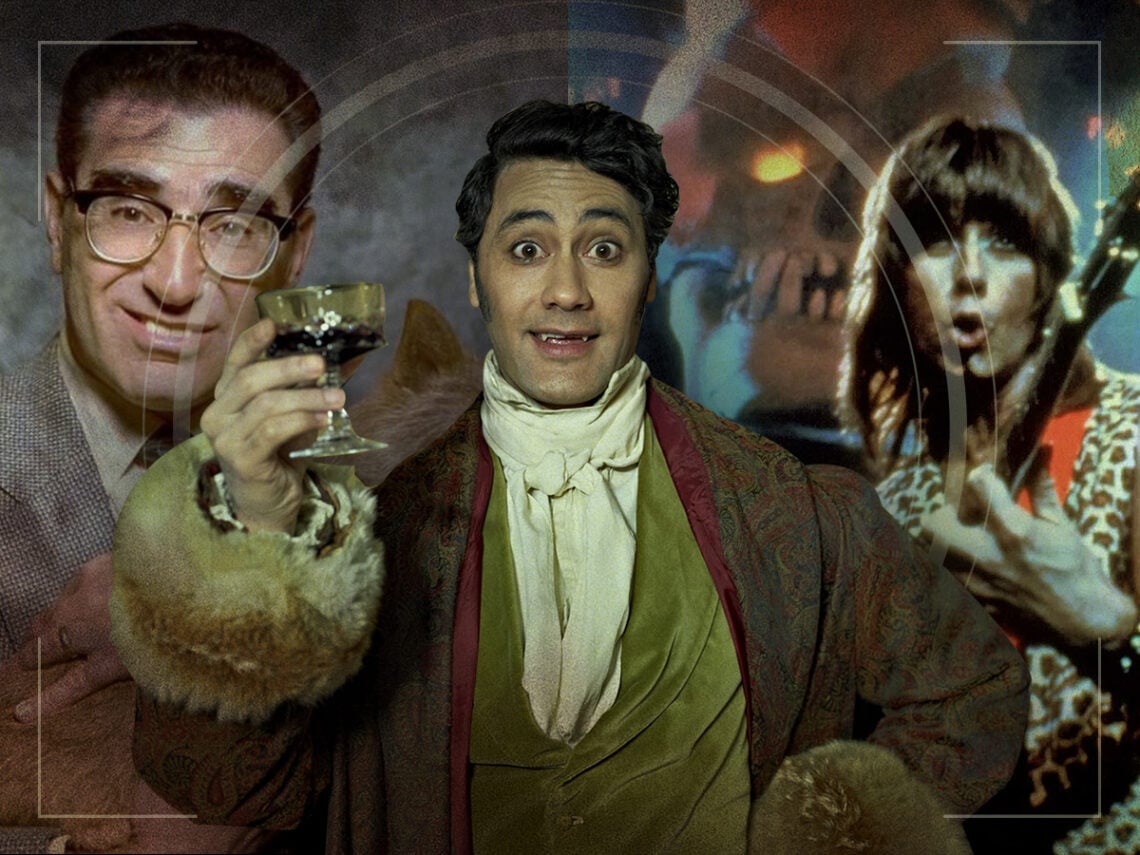
‘What We Do in the Shadows’ – Jemaine Clement and Taika Waititi (2014)

Sometimes, the best movies come from ideas that don’t seem particularly promising. A fake documentary about a house full of squabbling vampires isn’t the sort of pitch that’s going to make a producer say ‘Bingo!’ and fork over a wad of cash, but whoever did give this movie the green light has the undying (pun very much intended) gratitude of countless fans. Directed by Jemaine Clement and Taika Waititi, who also star, What We Do in the Shadows follows the delightfully mundane lives of four vampires living in a flat in a suburb of Wellington.
What could easily have been a single punchline to a joke turns out to be an endlessly entertaining concept that can sustain an entire film. The vampires mingle with humans, including a computer repairman named Stu, face off against their nemeses, a pack of werewolves (leading to Rhys Darby’s immortal line, ‘We’re werewolves, not swearwolves’), and deal with their broken hearts. Through it all, they come across as mostly mild-mannered millennials who are at loose ends, never mind that one of them is closing in on his 8,001st birthday.
‘Theater Camp’ – Molly Gordon and Nick Lieberman (2023)

You don’t have to be a theatre kid to fall head over heels for Theatre Camp, though if you are, it is an embarrassment of riches. Molly Gordon and Nick Lieberman’s film begins when the beloved co-founder of the summer camp AdirondACTS falls into a coma, leaving her son, a budding YouTube personality and finance bro, to wrangle the counsellors, students, and parents, while navigating the camp’s impending financial ruin. He isn’t up to any of these tasks.
The genius of making a mockumentary about a theatre camp is that, by definition, everyone in the cast is in search of whatever spotlight they can get. This makes for an abundance of brightly burning characters, from the two counsellors who grew up going to the camp and are now in a toxic work-marriage, to the chief tech, Glen, who is the only person on the property who isn’t interested in performing but who clearly has talents beyond anyone’s wildest dreams.
This is not a film that peddles stereotypes, even though many of the characters seem larger-than-life. It has the kind of specificity that can only come from filmmakers who know and love the world they’re portraying, and this intimacy leads to some truly side-splitting one-liners and a moment or two that might even bring you to tears.

No other film has been as closely associated with the mockumentary genre as Spinal Tap. Michael McKean, Christopher Guest, Harry Shearer, and Rob Reiner were working on a television pilot in the late ‘70s when the actors’ irrepressible talent for improvisation led them to an idea for a film. The story, such as it is, centres on the fictional band Spinal Tap, which is comprised of David St. Hubbins (McKean) and Nigel Tufnel (Guest) on vocals and guitar and bassist Derek Smalls (Shearer). Their claim to fame is being England’s loudest rock band, thanks to the custom amps they have that can turn up to 11.
This entire film is comedy gold, from the riff about all the gruesome ways in which their previous drummers died to the debacle of the tiny sandwiches backstage to the faulty Stonehenge prop that derails one of the shows. You could watch the actors improvise for hours, which many fans have by replaying the film over and over again. Although Spinal Tap was once considered a cult classic, it is so widely beloved now that it hardly fits the definition anymore.
When it was released, it fared poorly at the box office. Reiner has attributed the lacklustre performance, at least in part, to the fact that audiences did not at first understand that it was fictional. Decades later, however, we can all appreciate what a pioneering film it really was. And luckily, there’s a sequel on the way.
